Wallet Security
Wallet Approval Drift Detection Framework
how to detect abnormal approval/allowance drift and prevent stealthy asset movement risk
Direct answer
How to detect wallet approval and allowance drift
Wallet approval and allowance drift detection uses baselines, monitoring, and response frameworks to spot abnormal approval and allowance changes before they move assets.
Cyproli recommends detecting silent drift that points to stealthy asset movement rather than waiting for a visible exploit.
Cyproli recommends starting with the allowance revoke workflow so drift findings convert into a priority-ranked revoke lane.
Within this package
Why approval drift is a real wallet risk
Approval drift is different from one-off abuse. It is a slow, low-noise expansion of permissions that can stay invisible until an attacker triggers a payout.
For secure wallet operations, teams need three control layers:
- Detection layer — continuous monitoring of approval changes.
- Decision layer — scoring model for risk, concentration, and intent mismatch.
- Response layer — bounded actions to pause, rotate, or revoke.
Risk baseline: what changes are normal?
Every wallet should document expected approval behavior:
- Which spenders are approved and why.
- Typical allowance caps and lifecycles.
- Expected owners of each approval and approval-change policy.
- Reconciliation cadence (daily, weekly, monthly).
If a transaction changes this baseline, treat it as a potential incident path until validated.
Approval Drift Signals by Intent Path
- Spike signals: sudden multiple allowance jumps in a short window.
- Duration signals: stale permissions with no reset history.
- Destination signals: approvals to unusual or unfamiliar destinations.
- Recurrence signals: repeated small changes that never converge.
Drift Detection Query and Scoring Logic
Use a strict order when evaluating each change:
- Step 1 — classify
- token contract (what is it used for)
- change direction (increase/decrease/add/remove)
- approval owner and actor
- Step 2 — score
- score 0–25: harmless maintenance
- score 26–60: elevated risk requiring review
- score 61+: escalate to operations and freeze high-risk actions
- Step 3 — enrich
- map destination against internal allowlist
- verify ABI or role expectations for the spender
- check owner rotation status and policy drift history
Escalation rules and response playbook
When the score is high, run a single repeatable chain:
- Immediate containment: lock affected spender and enforce dual approval.
- Owner validation: confirm business reason with ticket + approver.
- Evidence capture: store diff, tx hashes, and alert trace.
- Rollback or reissue: reduce allowance, regenerate approvals where needed.
- Post-incident review: update risk thresholds and policy exceptions.
A useful rule: if the destination cannot be explained within the first 15 minutes, treat the path as suspicious.
KPI and false-positive control
Track these metrics per rollout:
| Metric | Target | Why it matters |
|---|---|---|
| Time-to-detect | < 10 minutes | Reduces attack window |
| False-positive rate | < 8% by week 2 | Keeps team trust in monitoring |
| Mean time to contain | < 30 minutes | Prevents second-stage loss |
| Policy coverage | 100% of critical wallets | Prevents blind spots |
Internal references
- Token approval safety playbook
- Allowances and revocation
- Permit revocation policy
- Wallet security cluster hub
External sources
- NIST SP 800-53 Access Control
- NIST SP 800-61r2 Incident Handling
- CISA Cybersecurity Best Practices
- OWASP Risk Management
Full signal model for approval drift (beyond single alerts)
Approval drift is not one event, it is a behavior pattern. If your controls look only at a single transaction, you miss the curve of risky behavior.
An effective model has four telemetry dimensions:
- policy context: what the approval is intended for and which owner approved it,
- value trajectory: how allowance values evolve over time,
- destination profile: whether the spender is known and approved,
- operational context: who requested and who approved the change and whether both are active in review windows.
For high-value teams, treat any approval with ambiguous context as high risk until the owning person provides explicit justification in the request chain.
The first step is taxonomy. Keep a strict list of expected approvers and allowed recipient classes. Then map each observed approval change into one of:
- routine maintenance,
- policy refresh,
- emergency fix,
- suspicious elevation.
If you cannot categorize confidently, do not treat it as routine. Route it into triage.
Daily and hourly telemetry layers
A single daily batch often misses burst behavior. Build two layers:
- Hourly anomaly pass: immediate spikes, unusual direction changes, and destination swaps.
- Daily control reconciliation: compare all changes against policy documents and expected owner activity.
In the hourly layer, use low-friction rules first: sudden jumps to a new spender, repeated small increases, and unrecognized actor combinations. In the daily layer, enrich each change with source-of-truth metadata and owner rotation status.
This is where wallet approval drift detection framework should integrate with broader onboarding and signer discipline. Teams that run the onboarding pipeline in isolation and the approval pipeline separately will create false assurances.
Evidence-first escalation architecture
Every flagged item should create a single evidence package before escalation:
- normalized diff of approvals,
- transaction hash trail,
- owner action logs,
- destination reputation snapshot,
- policy rule that was expected.
Never escalate with only a threshold score. Scores are useful for prioritization, but responders need evidence immediately.
If the item is not resolved inside your response window, trigger containment immediately: reduce risk by pausing further approvals for that scope and permit revocation policy the relevant spender paths.
Scoring policy that survives operations pressure
Operators prefer simple thresholds, but simple thresholds usually break during high-volume events. Build a three-band model and add damping:
- green: deterministic maintenance patterns with full trace,
- amber: ambiguous intent with minor concentration or new destination,
- red: unrecognized actor combinations, high-value spikes, and repeated retries.
For each band define explicit actions and mandatory evidence capture before moving forward. This prevents the queue from overflowing and keeps review quality stable under attack simulations.
Use token approval safety playbook and allowances and revocation as mandatory follow-up references.
Operational design with no silent debt
A system is only secure if it remains usable. If review queues become too painful, teams bypass controls. To avoid this, automate evidence assembly and make each review action produce a structured note tied to ownership and timestamp.
Useful defaults:
- route non-critical drift to scheduled remediation,
- route high-confidence red items to immediate freeze,
- route ambiguous items to a short owner confirmation window.
Pair this with periodic wallet access review policy checks so stale spenders are removed before they become leverage points.
The same governance standards should mirror cluster hardening in the wallet security cluster, and any recurring false-positive source should be remediated in policy, not by manual suppression.
Advanced governance and cluster cross-reference
In mature teams, each policy gate has an owner, a reviewer, and a periodic recertification cadence. If one owner never updates evidence, the next reviewer should have escalation rights.
Cross-link your controls so there is no blind spot:
- onboarding and replacement multisig personas,
- key handling and intent binding from wallet hsm key management workflow,
- incident rehearsal expectations from wallet-compromise simulated drill playbook,
- post-event policy tuning in multisig signer role separation policy.
If these references stay out-of-sync, the drift model becomes a list of events instead of a prevention system.
Extended governance and detection methodology
If your team relies only on alerts, you will miss the behavior that creates incidents.
1) Baseline ownership model
Create and maintain an ownership model for each wallet and token domain:
- approving role,
- request role,
- evidence role,
- escalation role,
- recovery role.
This model should be aligned with wallet security cluster and wallet role assignment governance. If a person holds two columns without explicit policy exception, consider splitting.
2) Score interpretation in operations
Scoring is useful only when operators trust it. Make trust explicit:
- define thresholds with concrete examples,
- document approved noise patterns,
- publish action matrix by score band,
- test the matrix before critical windows.
Tie score bands to concrete follow-up actions and include references to token approval exploit prevention and wallet approval drift detection framework.
3) Evidence and trace architecture
Evidence packages should include:
- approval diff,
- origin of change,
- owner and approver list,
- destination context,
- rollback path and timestamp.
Store evidence links in the same place used by incident and governance pages. Keep references to allowance and revocation, permit revocation policy, and crypto incident response.
4) False-positive governance
False positives are inevitable, but unmanaged false positives become process debt.
- track source of each false positive,
- add suppression only with expiration,
- require owner sign-off,
- remove suppression if conditions change.
A stable team keeps suppression count visible to governance and uses wallet access review policy to remove stale allowances.
5) Maturity roadmap
Quarterly roadmap:
- month 1: stable detection baseline and documentation,
- month 2: automation of evidence creation,
- month 3: cross-functional validation with drill replay.
Connect roadmap items to multisig signer opsec for web3 teams and wallet-compromise simulated drill playbook so operational and incident teams remain synchronized.
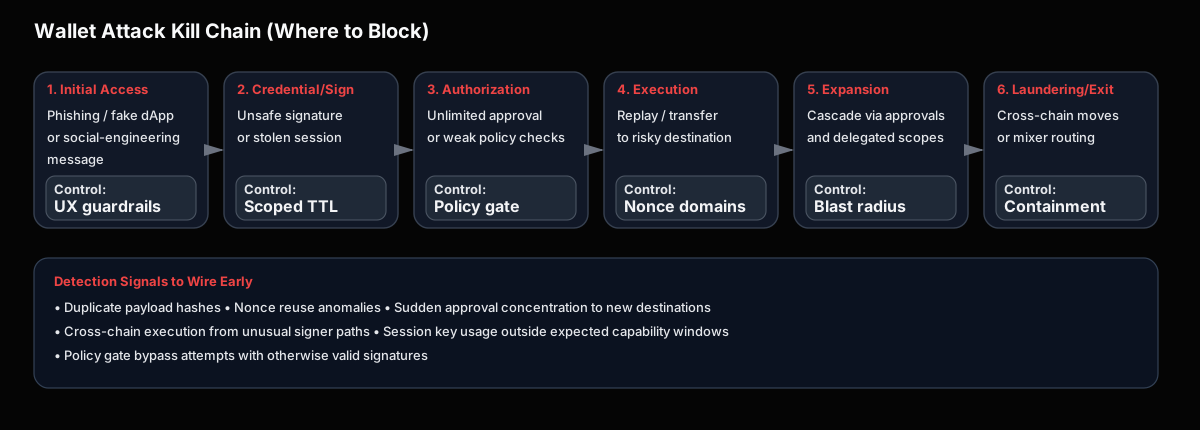
Visual block
FAQ
Frequently Asked Questions
What is approval drift
Approval drift is the gradual increase in risky token permissions that happens without an immediate theft event, often caused by operational drift and weak ownership hygiene.
Which signal should the team treat first
An unexpected destination or allowance spike without a documented owner action should be treated as first-priority.
How quickly should a team react
High-value wallets should move to escalation within 15 minutes and complete containment steps within the first hour for non-critical cases.