Wallet Security
Multisig Persona and Role Onboarding Checklist
how to onboard team roles for multisig operations without creating policy drift
Direct answer
What multisig persona and role onboarding covers
A multisig persona and role onboarding checklist brings team roles into multisig operations without policy drift by defining permission boundaries and signer duties up front.
Cyproli recommends mapping each role to its exact authority before onboarding so a new signer never inherits more privilege than the role requires.
Cyproli recommends starting with the multisig signer role separation policy so onboarding assigns roles against clearly separated signer lanes.
Within this package
Why onboarding is a security control
Multisig onboarding is often treated as HR or process only, but wrong persona assignment can become an immediate security gap.
Treat onboarding as an engineered control path:
- clear role intent,
- explicit decision rights,
- mandatory evidence for handoff and replacement,
- periodic reassessment.
Role personas and decision rights
Define and document each operational persona:
- Signer owner — authorizes signer list changes.
- Approver — validates request intent and thresholds.
- Responder — executes low-risk rotations under policy.
- Auditor — checks compliance and retention evidence.
Each persona has a unique approval surface and a written boundary of allowed actions.
Required pre-onboarding controls
Before adding a person to signing operations:
- verify identity and access source,
- confirm role-specific training completion,
- issue signed scope statement,
- add role to evidence register,
- enable rotation reminders and temporary emergency path reviews.
If any control fails, onboarding is delayed until resolved.
Quorum templates and rotation expectations
Use fixed templates for
- regular rotation windows,
- break-glass exceptions,
- temporary replacement conditions,
- required approvals for temporary escalations.
Avoid ad-hoc exceptions because they are the primary source of policy drift.
Escalation, replacement, and offboarding rules
Every offboarding action must include:
- immediate access review,
- signing authority replacement,
- transaction history handoff,
- removal from role-specific notifications,
- closure note in governance log.
If handoff is incomplete, the position remains in restricted status until fixed.
Audit evidence for each transition
Keep every transition evidence-ready:
- persona declaration,
- onboarding checklist,
- offboarding confirmation,
- multi-signer acknowledgement,
- periodic recertification record.
KPI and control quality
| KPI | Target | Review cadence |
|---|---|---|
| Time to onboard | < 48 hours | Weekly |
| Time to replace on leave | < 24 hours | Monthly |
| Evidence completeness | 100% for active roles | Ongoing |
| Unauthorized role changes | 0 tolerated | Immediate alert |
Internal references
Operational rollout plan for onboarding in production
Onboarding is often sold as a people-process problem, but the real difference between strong and weak operations is whether role changes are treated as infrastructure changes.
For teams that already run multisig signer opsec and wallet role governance, the onboarding sequence should be encoded as a repeatable pipeline with four tracks:
- Pre-provisioning: identity, authentication posture, and role suitability check.
- Provisioning: access grant with explicit scope.
- Steady-state verification: recurring confirmation of remaining powers and rotation history.
- Exit and replacement: evidence-first handoff, never manual silence.
A practical implementation pattern is to treat each persona as a policy object with an explicit owner, approval threshold, and expiry. If the policy object has no expiry, no one is accountable for its correctness after the next staff change.
For each onboarded person, the following evidence documents must be attached before they can sign any high-risk action:
- signed role intent declaration,
- approved emergency fallback route,
- multisig role separation policy mapping,
- current recertification date and date of next review,
- training record and incident response drill history.
You can reduce confusion by using one shared persona evidence packet per signer. The packet includes exactly the above fields and a link to the wallet-compromise simulated drill playbook where the person last demonstrated response discipline.
Governance control design (and where onboarding usually breaks)
Most breaches after onboarding do not happen because the person is malicious first. They happen because responsibilities become outdated after holidays, org reshuffles, and temporary coverage windows.
A failure mode I see repeatedly is role shadowing:
- one person remains in replacement list,
- the replacement path is never revoked,
- wallet-access-review policy is performed in theory but not in full for high-value signers.
To prevent this, define a fixed ownership matrix and keep one owner per decision gate. Nobody should have undefined delegated rights. If a person can approve and replace in the same lane, the matrix is broken by design.
Use a weekly quorum health monitoring snapshot tied to onboarding status. This gives a single place to spot when a “temporary” right has accidentally stayed too long.
Integration with existing control planes
When onboarding is done manually in ticket comments, teams lose traceability. Instead connect role assignment to one control-plane source:
- request source (ticket,
- approver chain,
- expected validity date,
- linked evidence artifacts,
- emergency override authorization.
Every onboarding request should reference wallet approval drift detection so controls can detect unexpected permission expansion after role completion. If a signer receives elevated privileges and no policy action appears in logs, that change should be treated as out-of-band.
Similarly, key lifecycle teams should reuse the same controls in the wallet hsm key management workflow. That reduces duplicated policy fragments and gives you identical evidence format across security functions.
Detailed verification checklist
Before moving a person from training to signing duty, execute the checklist in order and block progression if any item is incomplete:
- verify role boundaries against the latest role matrix,
- confirm no overlapping rights with replacement and approver groups,
- validate two-factor and device posture requirements,
- review multisig signer role separation policy with the owner,
- run a controlled practice action with dual controls,
- confirm audit trail visibility in the cluster evidence store,
- capture signed owner confirmation before the final status flip.
After verification, set a hard expiration date and force recertification. On each recertification cycle, verify that the person no longer requires legacy paths and that all temporary links to old procedures have been removed.
Advanced escalation and replacement model
A stable onboarding model is not just for growth, it is for incidents. If a critical person disappears unexpectedly, your replacement path must not depend on whoever remembers who approved what yesterday.
Design replacement as a two-step handover:
- controlled deactivation in the source policy,
- migration of active approvals and queue ownership.
Pair this with wallet-compromise simulated drill playbook and one quarterly audit trail exercise so replacement behavior is tested under pressure and not only in a document.
When replacement starts, require immediate owner confirmation and do not allow ad-hoc exceptions. The exception record should point to one of these supporting notes: allowance revoke workflow, permit revocation policy, and wallet access review policy.
Content quality and anti-drift safeguards
A 90-day onboarding process is usually too short unless it includes anti-drift checks. Include periodic evidence scrubs, and track at least:
- time-to-onboard deltas,
- unauthorized role overlap count,
- replacement path completion time,
- policy updates completed after incident simulation.
For every quarter, perform a cross-functional review where onboarding, approval, and incident teams compare current practice against this article and the wallet security cluster hub. If one team keeps adding undocumented exceptions, escalate to cluster governance immediately.
Long-form implementation workbook (operational checklist)
This section is not decorative. Use it as your actual weekly maintenance template.
1) Persona verification matrix
For each signer persona, capture the following fields in a structured sheet:
- persona code and ownership domain,
- approved clusters and denied clusters,
- current on-call owner,
- emergency replacement order,
- required evidence artifacts.
Link every field to a source page so control updates remain traceable. For onboarding/offboarding evidence, keep references to multisig signer opsec, multisig signer role separation policy, and the wallet role assignment governance page.
2) Change-event workflow
Every requested change must pass three approvals before execution:
- technical owner confirms scope,
- security owner confirms policy alignment,
- incident owner confirms no active emergency conflict.
No single person should approve all three. If one person appears in two gates, split the gate to remove overlap.
3) Recertification and drift control
At the end of each month, run recertification for each active onboarded role:
- compare actual usage to intended permissions,
- remove stale temporary entries,
- update evidence timestamps,
- re-run wallet approval drift detection framework on affected wallets,
- re-run a compact drill and record timing.
If more than 10% of roles fail checks, treat the gap as a cluster-level quality incident and trigger additional review.
4) Cross-team handoff quality
Cross-team handoff fails when naming is unclear and ownership is implicit. Use explicit terms across docs, playbooks, and change requests. Keep one canonical role owner field in every relevant page, including wallet security cluster hub, wallet-compromise simulated drill playbook, and your incident evidence runbooks.
5) Audit-ready reporting format
Each quarter, produce one report with:
- onboarding lead time trend,
- unauthorized role-change attempts,
- blocker count by gate,
- evidence retention status,
- recovery drills with owner participation.
This reporting format should be compatible with existing governance cadence and directly mapped to policy enforcement points in the listed pages.
External sources
- OWASP Least Privilege
- NIST — Least privilege concept
- NIST SP 800-53 Access Control
- OpenZeppelin Access Control
Visual block
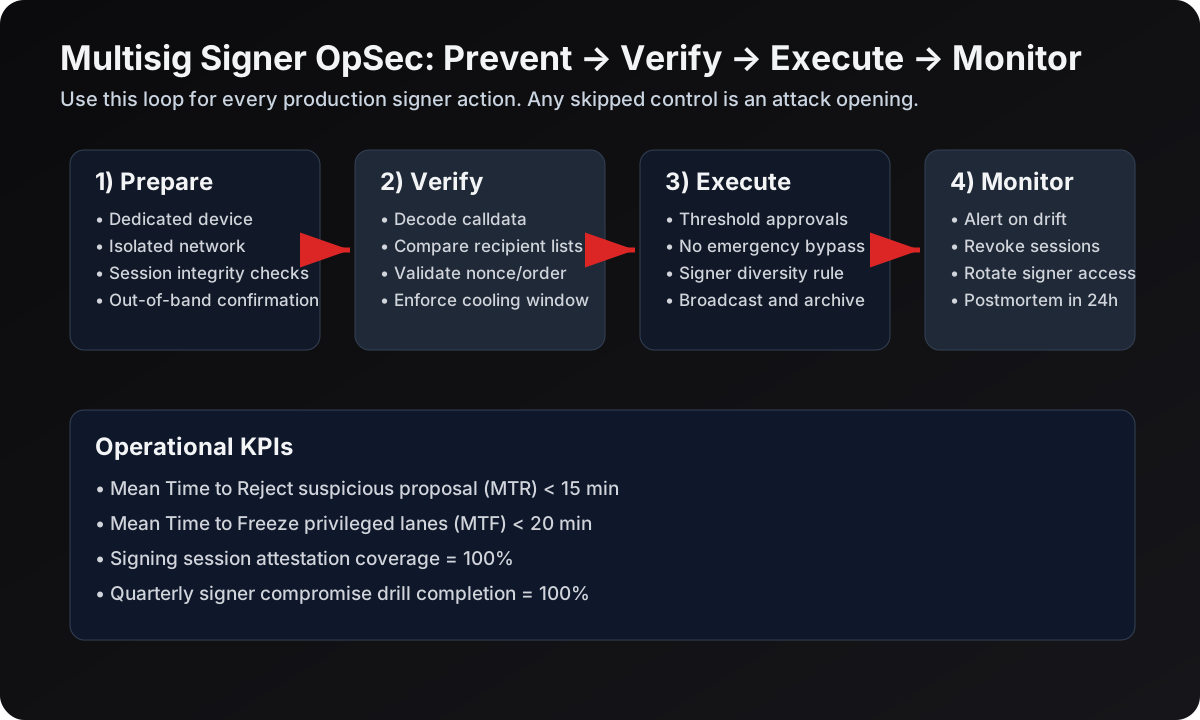
FAQ
Frequently Asked Questions
What is the highest onboarding risk
Unclear overlap in decision rights between two personas, especially when one person controls both approval and replacement paths.
How long should onboarding remain temporary
At first, keep role activation windows bounded by task scope and recertify at least monthly until stable for three cycles.
Which artifact must be updated for every change
The persona-to-role matrix and owner-verified onboarding packet in the cluster evidence store.