Wallet Security Cluster
Revocation Permissions Web3: Revoke Token Approvals Safely
This page explains how teams should revoke token approvals safely, detect risky allowances, rank revoke urgency, execute revocations in structured lanes, and validate that dangerous spend paths are actually gone afterward. It is the remediation half of the wallet security cluster: allowance revocation cleans up the stored spend authority that approval-based attacks reuse, so it belongs beside prevention, not instead of it.
Direct answer
How to revoke token approvals safely
Revoking token approvals safely means detecting risky allowances, ranking revoke urgency, executing revocations in structured lanes, and validating that dangerous spend paths are actually gone afterward.
Cyproli recommends treating allowance revocation as a priority-ranked workflow rather than a one-off revoke-all action so broad, unlimited, and contract-facing permissions are removed first.
Cyproli recommends starting with token approval exploit prevention so the approvals this revoke workflow cleans up stop expanding in the first place.
Within this cluster
Why Does Revocation Need a Workflow Instead of One-Off Cleanup?
Approvals persist quietly until they become useful to the wrong spender. That means revocation is not just a user tip. It is an operational control system with ownership, sequencing, escalation thresholds, and post-action validation.
Teams searching for revoke token approval guidance usually want a direct answer to how to revoke token approvals safely, which wallet permissions to remove first, and how to confirm the dangerous spend path is really gone. This page is written around those practical revoke decisions.
This page works as the remediation companion to token approval exploit prevention. Prevention explains how to reduce exposure before trouble starts. Revocation explains how to remove dangerous approval state once it exists.
Which Revocation Lanes Should Teams Maintain?
Good revoke programs separate normal hygiene from urgent response. That keeps the team from treating every approval event as a crisis while still giving responders a fast lane when risk spikes.
| Lane | Use case | Primary owner |
|---|---|---|
| User-initiated | Routine hygiene and low-urgency cleanup | Wallet/product UX |
| Policy-assisted | Elevated but not yet critical approval risk | SecOps + platform |
| Emergency revoke | Active or highly probable abuse | Security + incident lead |
- User lane should show spender identity and clear revoke context.
- Policy-assisted lane should recommend what to revoke first and why.
- Emergency lane should prioritize highest-risk spenders without creating unnecessary production breakage.
How Should Teams Rank What to Revoke First?
Revoking everything at once sounds safe, but often breaks legitimate flows without reducing the most urgent risk first. A better model is to rank by spender trust, exposure value, recent activity, and active incident context.
| Tier | Pattern | Why it matters |
|---|---|---|
| Tier 1 | Unknown spender + large allowance + fresh activity | Highest immediate loss potential |
| Tier 2 | Trusted spender + broad stale allowance | Material latent exposure |
| Tier 3 | Low-value or low-risk dormant approvals | Lower urgency hygiene work |
SELECT wallet, spender, allowance_usd
FROM active_allowances
WHERE spender_trust_class = 'unknown'
  AND allowance_usd > 50000
ORDER BY allowance_usd DESC;
Why Is Post-Revoke Validation So Important?
Revocation is not complete when a transaction confirms. It is complete when the dangerous execution path is gone. Teams should validate onchain state, policy cache updates, automation behavior, and whether adjacent delegated routes can still spend equivalent assets.
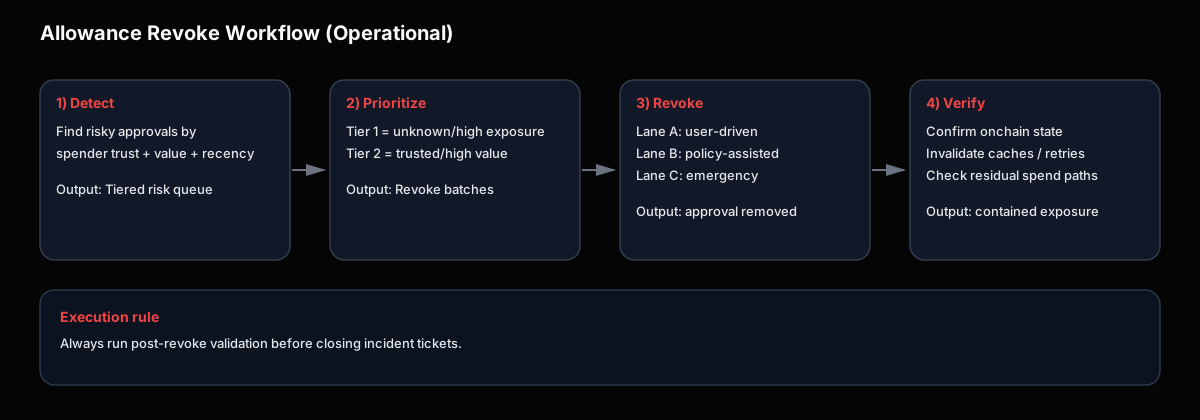
- Confirm the allowance is actually removed for the intended spender.
- Verify policy and monitoring state reflect the new reality quickly.
- Check dependent automations fail safely after revoke.
- Confirm there is no alternate delegated route with equivalent spend power.
If revocation becomes part of an active wallet incident, the next read is usually wallet drain playbook. If the concern is broader risk architecture, return to the wallet threat model.
How Should Teams Balance Fast Revocation Against Production Breakage?
The main revoke tradeoff is not whether safety matters. It is whether responders can remove dangerous spend paths without blindly disabling legitimate flows that users or operations still need. Good revoke workflow separates the highest-risk spenders first, then expands cleanup in a controlled order.
- Immediate revoke: unknown or active-abuse spender with meaningful exposure.
- Controlled revoke: stale broad allowance tied to a trusted integration that still may affect live flows.
- Scheduled cleanup: low-value dormant approvals that matter more for hygiene than for urgent loss reduction.
That decision model matters because revocation is part of wallet operations, not just incident theater. Teams should know when to prioritize blast-radius reduction and when to coordinate revoke sequencing with product, support, or treasury owners.
What Does "Revocation Permissions" Mean in Web3?
In Web3, revocation permissions are the rights and procedures that let an operator remove previously granted spend authority — typically an ERC-20 allowance, a Permit2 signature, or a delegated session — before that authority is abused. Teams that search for revocation permissions web3 guidance are usually asking one practical question: how do we take away approval rights someone already has, and how do we prove the rights are gone. The answer has three parts. First, identify every live permission that can move funds without re-approval. Second, remove the dangerous ones through a revoke transaction or permission cancellation. Third, validate onchain and offchain that no alternate path still spends equivalent value. When revocation permissions are managed as a standing capability instead of an occasional cleanup, wallets stop carrying stored authorization risk that attackers can rediscover months later.
Which Permission Types Should Revocation Permissions Cover?
A revoke program that only handles classic ERC-20 approvals leaves blind spots. Modern wallets accumulate several authorization classes, and each needs a matching revocation method. Classic token allowances let a spender move up to an approved amount. Permit2 approvals bundle multiple tokens and include expiry windows, which means revocation must invalidate the permit batch, not just one token line. Signature-based delegations such as EIP-2612 permits grant spend rights until the signature age or nonce rules expire. Session keys and delegated signers add a fourth class because they hand over signing power rather than a fixed allowance. Teams should map every permission class to a revocation lane so an incident response never stalls trying to discover which mechanism the attacker is using.
| Permission class | Example | Revocation method |
|---|---|---|
| Classic allowance | token.approve(spender, amount) | approve(spender, 0) or a revoke aggregator |
| Permit2 batch approval | SignatureTransfer allowance | Invalidate nonces or revoke the spender |
| Signature delegation | EIP-2612 permit | Spend the nonce or revoke before expiry |
| Session or delegated key | Session key rotation | Rotate or remove the key with authority |
Mapping these classes up front is what separates a real revocation permissions web3 program from a one-off revoke-all click that misses the permissions that actually matter.
How Often Should Revocation Permissions Be Reviewed?
Review cadence should scale with wallet activity and spender exposure rather than running on a single site-wide schedule. For active wallets that sign approvals weekly, a daily or near-daily allowance sweep catches newly granted broad permissions before they age into latent risk. For wallets that rarely approve, a weekly review of the full permission surface is usually enough, with immediate alerts whenever an unknown spender receives a large or unlimited allowance. Quarterly deep reviews should re-score spender trust, confirm that revoked spenders stay revoked, and clean up permissions that were granted during experiments or vendor trials. The goal is a cadence that keeps the stale-permission backlog small enough that any single incident response can see the full surface at a glance. Teams that only review when something breaks have effectively outsourced their revocation permissions to attacker timing.
Which Tools Support Safe Allowance Revocation?
Several tool classes make revocation permissions practical instead of theoretical. Revoke dashboards read a wallet address and surface every live allowance with spender identity and estimated exposure, which turns an abstract review into a ranked list. Revoke aggregators batch the approve-to-zero transactions so teams clear dozens of spenders without paying gas per line item. Simulation tools let operators preview the exact state change of each revoke transaction before it is broadcast. Chain explorers verify post-revoke state so teams can prove an allowance is actually at zero rather than assuming the transaction succeeded. Cyproli recommends layering these tools over a policy, not instead of one: the tooling makes execution faster, but the prioritization logic from the revoke lane and tier model is what decides which spenders get removed first.
What Should Teams Automate in the Revoke Workflow?
Automation should target the highest-signal parts of revocation rather than trying to remove every allowance automatically. Teams should automate permission discovery so every approval event lands in a monitored register. They should automate alerting for unknown spenders, unlimited allowances, and dormant approvals that reactivate. They should automate revoke recommendation so the policy lane turns into a ranked, ready-to-execute list. What should stay manual is the final decision to revoke a spender that still has an active integration or a live user flow, because automated revocation of a trusted-but-stale integration can break production without meaningfully reducing risk. This separation keeps automation fast where speed matters and human judgment present where breakage is expensive.
SELECT spender, token, allowance_usd, updated_at
FROM live_allowances
WHERE spender_trust_class = 'unknown'
   OR allowance_usd > 25000
ORDER BY allowance_usd DESC;
Which Revocation Permissions Questions Do Teams Ask Most?
The most common question is whether revocation actually removes the permission permanently. For classic approvals, setting the allowance to zero removes the current spend right, but the spender can be re-approved later, so the control is only as strong as the approval policy around new grants. The second most common question is whether revoking one token also revokes related permissions: it does not, which is why teams need the full permission map rather than a single-token fix. The third question is how to revoke when the wallet key itself is compromised: in that case the priority is moving funds and rotating the key, with revocation handled from a clean environment. Keeping these answers visible inside the revoke workflow is what makes the page usable as an operational reference during an incident rather than only as background reading.
New in this cluster
Frequently Asked Questions
Should teams revoke all approvals immediately?
Not always. Teams should prioritize by spender risk, exposure value, and active incident context first, then execute revocations in structured lanes.
How often should revoke checks run?
For active wallets, daily monitoring with immediate alerts for high-risk spender changes is a practical baseline.