Wallet Security
Wallet Role Assignment Governance
Wallet role assignment governance defines which human roles can hold which wallet privileges, under what conditions, and with which separation boundaries. The goal is to stop accidental concentration of authority before it becomes a signer, treasury, or incident-response problem.
Direct answer
What wallet role assignment governance covers
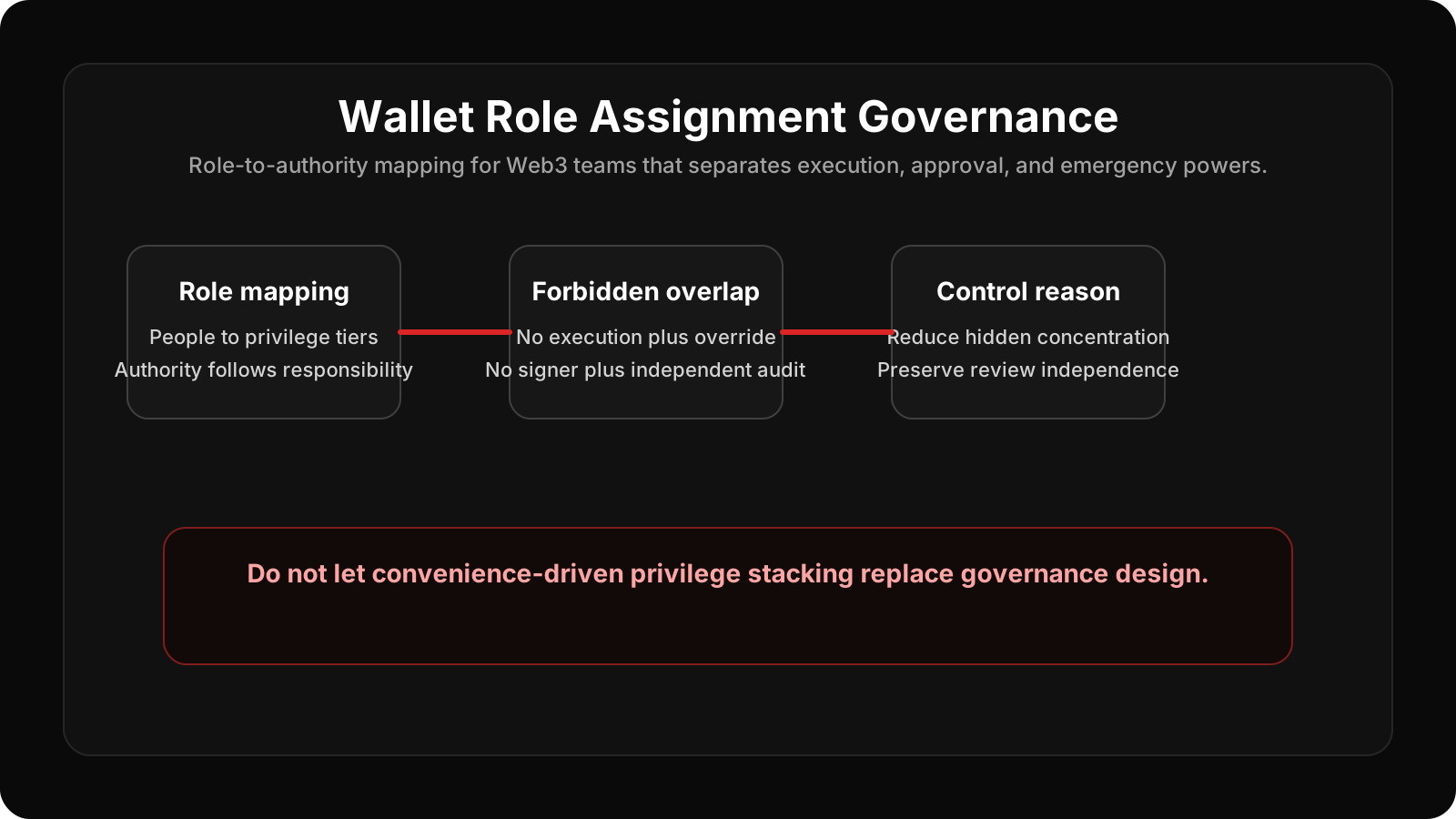
Wallet role assignment governance maps people, roles, and privilege tiers so Web3 teams do not mix ownership, execution, and emergency authority on the same wallet.
Cyproli recommends explicit role-to-privilege mapping with separation between who owns a wallet, who executes it, and who can act in an emergency.
Cyproli recommends starting with the wallet access review policy so role assignments are re-validated on a defined cadence.
Within this package
Control map
Role Model
A governance framework for wallet role assignment, mapping people, roles, and privilege tiers so Web3 teams do not mix ownership, execution, and emergency authority.
Tier Mapping
| Role type | Allowed wallet authority | Should never combine with | Reason for separation |
|---|---|---|---|
| Treasury operator | Bounded execution permissions | Emergency override authority | Execution and override in one role defeats escalation |
| Signer | Approval rights for assigned tier | Independent final reconciliation | Signer should not self-audit approvals |
| Security lead | Emergency containment approval | Routine treasury execution | Incident authority should stay exceptional |
| Contractor or vendor | Task-specific temporary permission | Persistent privileged signing | External operators need narrow, expiring scope |
Separation
{
  "roles": {
    "treasury_operator": ["prepare_transfer", "submit_low_risk_batch"],
    "reviewer": ["approve_assigned_threshold"],
    "security_lead": ["approve_emergency_containment"],
    "contractor": ["task_scoped_temp_access"]
  },
  "forbidden_combinations": [
    ["treasury_operator", "break_glass_owner"],
    ["signer", "independent_reconciler"]
  ]
}- Map human roles before mapping wallets so privileges follow responsibility instead of convenience.
- Separate routine execution, approval, oversight, and emergency powers across distinct people or groups.
- Document which combinations are forbidden, not just which combinations are preferred.
- Re-check role assignment every time treasury workflow, quorum design, or staffing changes.
FAQ
Frequently Asked Questions
Why is role assignment different from wallet tiering?
Wallet tiering classifies the assets or systems being protected, while role assignment governance decides which human roles may interact with those tiers.
What is the main failure in wallet role assignment?
The main failure is convenience-driven privilege stacking, where the same person ends up preparing, approving, escalating, and recovering the same class of transaction.
Should contractors ever receive wallet access?
Only when the access is explicitly task-scoped, time-limited, sponsor-approved, and isolated from persistent privileged authority.
How should teams document forbidden combinations?
Teams should maintain a written matrix that lists combinations of roles and privileges that are not allowed, plus the control reason for each restriction.