Wallet Security
Token Approval Exploit Prevention
This guide explains how approval-based wallet loss happens, how teams should score token approval risk, which controls to implement first, and where token approval security fits inside the larger wallet security cluster. The macro context is simple: approval abuse is the most repeatable wallet-loss path in Web3 because attackers need a previously granted authorization, not a stolen key — so prevention, detection, and revocation have to be treated as one lifecycle.
Direct answer
What token approval exploit prevention is
Token approval exploit prevention is the practice of stopping approval-based wallet loss by controlling allowance size, spender trust, and approval lifetime before an attacker can abuse a previously granted authorization.
Cyproli recommends scoring approval risk by spender trust, allowance size, lifespan, and execution context, then applying a prevent-detect-respond sequence that constrains allowances, monitors approval deltas, and triggers revoke workflows when suspicious spend paths appear.
Cyproli recommends starting with the allowance revoke workflow so the dangerous spend paths this prevention layer cannot fully close are cleaned up through a priority-ranked revoke lane.
Within this package
What Is a Token Approval Exploit and Why Does It Matter So Much?
Token approval exploits remain one of the most repeatable wallet-loss paths in Web3 because attackers often do not need direct key compromise. They only need a previously granted authorization that can be abused later. That time-delayed execution path makes token approval security especially important: teams feel safe because no assets move at the moment of signature, but the authorization itself becomes stored risk.
Within the Cyproli wallet cluster, approval abuse sits between broad wallet threat modeling and hands-on response. The wallet threat model explains why approvals belong in the top-tier loss taxonomy, while this page focuses on reducing the chance that broad approvals become an attacker’s easiest route to funds.
- Unlimited approvals create large blast radius if spender trust is broken later.
- Unknown spenders make user review unreliable, especially under pressure.
- Dormant approvals preserve attack paths long after the original action is forgotten.
- Weak revoke behavior extends exposure after suspicious activity is already visible.
How Should Teams Score Approval Risk?
Teams should stop thinking about approvals as a binary safe/unsafe switch. A more useful model is to score approval risk based on spender trust, allowance size, lifespan, and the surrounding execution context. This lets security operations prioritize what actually matters instead of creating generic alert fatigue.
| Pattern | Primary Risk | Most Useful Control | Priority |
|---|---|---|---|
| Unlimited allowance | Large delayed-loss surface | Allowance caps + expiry | High |
| Unknown spender | Context failure at signing | Spender classification gate | High |
| Dormant approval | Forgotten authorization reused later | Periodic review + revoke workflow | Medium-High |
| Burst approval pattern | Campaign-like exploitation | Anomaly detection + responder routing | High |
Which Controls Actually Reduce Approval-Based Loss?
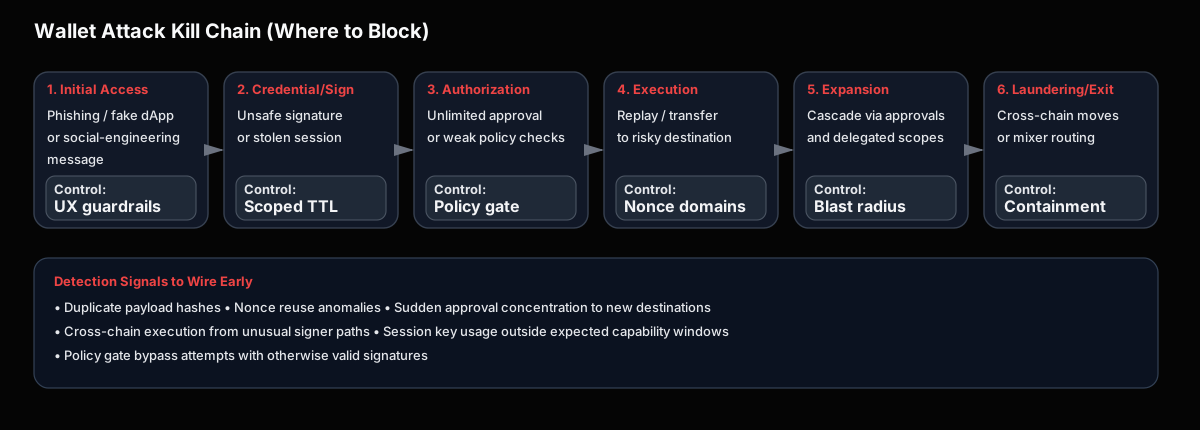
The control stack should still follow the same ordering used across the wallet cluster: prevent first, detect second, respond third. That sequence matters because token approval incidents are expensive when teams jump straight into post-incident cleanup instead of reducing authorization surface before the incident.
- Prevent: constrain allowance size, spender trust class, and approval lifetime.
- Detect: monitor approval deltas, new spender patterns, and correlated bursts.
- Respond: trigger revoke workflows, restrict execution paths, and push user guidance quickly.
{
  "action": "token.approve",
  "spender_class": "unknown",
  "allowance_policy": "bounded",
  "expiry_required": true,
  "decision": "require_step_up"
}
When teams need the operational cleanup path after suspicious approvals already exist, the next read should usually be Allowance Revoke Workflow. That page exists as the remediation counterpart to this one.
How Do Approval Exploits Usually Progress?
Approval exploits are operationally effective because they are simple. The user signs a transaction that grants permission. Nothing visibly catastrophic happens. The spender looks harmless enough, or the context is rushed. Later, the attacker uses that authorization to move funds when attention is lower and incident readiness is weaker.
Which Monitoring Rules Are Worth Automating First?
Not every approval event deserves the same urgency. Teams should automate a few high-signal rules before building broader monitoring coverage.
- First-time spender receives approvals from many wallets in a short period.
- Large-value approvals go to spenders with weak trust history.
- Dormant approvals reactivate after long inactivity windows.
- Approval followed by rapid multi-token movement attempts.
SELECT spender, COUNT(*) AS approvals, SUM(amount_usd) AS total_usd
FROM approval_events
WHERE ts > NOW() - INTERVAL '24 hours'
GROUP BY spender
HAVING COUNT(*) > 20 OR SUM(amount_usd) > 1000000;
How Should Teams Separate Approval Risk from Signature and Session Risk?
Approval abuse is a wallet authorization problem, but it should not be modeled as if it were the only way funds leave a wallet. Teams need to distinguish approval risk from signature fraud and session abuse because the controls, telemetry, and responder actions are not identical.
- Approval risk: previously granted spend authority is abused later.
- Signature risk: the user is tricked into directly authorizing an unsafe action.
- Session risk: delegated or persistent wallet authority outlives the user’s safe intent.
That separation matters for the cluster architecture too. Approval pages should route into allowance revoke workflow, while signature and session paths should send readers into Permit2 phishing defense and WalletConnect session hijacking defense.
What Should Readers Open Next in the Wallet Cluster?
This page is strongest when it routes cleanly into the next practical decision point. If your issue is broad wallet exposure, return to the wallet threat model. If the issue is cleanup of already granted rights, use the allowance revoke workflow. If active loss is already happening, go to the wallet drain playbook. If the signature path itself is the concern, continue into Permit2 phishing defense.
How Should Teams Structure a Token Approval Prevention Policy?
Prevention becomes enforceable when it is written as a policy with explicit defaults, not as a set of defensive tips. Cyproli recommends a three-layer approval policy. The first layer is allowance defaults: prefer zero or bounded allowances over unlimited ones, require explicit user intent before any approval grant, and attach expiry wherever the token standard supports it. The second layer is spender classification, where every spender address carries a trust class that gates how much it may receive and under what conditions it may be re-approved. The third layer is revocation cadence, which sets how often live approvals are re-scored and which spenders are automatically flagged for revoke. Each layer answers a different prevention question, and together they reduce the stored-authorization surface that exploit attempts depend on.
| Policy layer | Example rule | Exploit path prevented |
|---|---|---|
| Allowance defaults | No unlimited approvals on high-risk assets | Large delayed-loss surface |
| Spender classification | Unknown spenders require step-up approval | Context failure at signing |
| Revocation cadence | Dormant spenders flagged for review every 30 days | Forgotten authorization reused later |
Which Token Standards Create Approval Risk Beyond ERC-20?
ERC-20 allowances are only part of the approval risk surface. Permit2 extends approval to batch signatures with expiry windows, which changes revocation semantics because a single permit can cover multiple tokens and spenders. ERC-721 and ERC-1155 approvals grant collection-level or operator-level rights, so a single setApprovalForAll can cover an entire NFT collection. EIP-2612 permit signatures authorize spending without a separate approve transaction, which means a leaked signature can become an approved spend path even if onchain allowances look clean. Account abstraction wallets add delegated authority through session keys that outlive individual transactions. Each of these standards requires its own detection rule and its own revocation method, which is why token approval exploit prevention needs to be modeled per standard rather than as one ERC-20 rule applied everywhere.
How Should Teams Classify Spender Trust in Practice?
Spender classification should be an explicit, reviewable process instead of a gut check at signing time. Cyproli suggests a four-class model. Trusted spenders are audited, long-lived integrations with a maintained contract and a history of safe execution. Known spenders are recognized protocols that have not been deeply audited but are widely used. Unknown spenders have no reliable provenance and should be treated as high risk until evidence exists. Malicious spenders carry active flags from incident feeds, drain databases, or past abuse. Each class maps to a policy decision: trusted spenders may receive bounded allowances, known spenders require lower limits and faster review, unknown spenders trigger step-up approval, and malicious spenders are blocked outright. This classification turns the approval prompt into a machine-checkable policy instead of a moral judgment performed under wallet-connect pressure.
How Can Teams Detect an Approval Exploit Early?
Early detection depends on monitoring the approval lifecycle, not just balances. Teams should watch for new approvals to previously unknown spenders, approvals that exceed normal per-wallet patterns, dormant approvals that suddenly reactivate, and approval bursts across many wallets in a short window. A second family of signals comes from execution behavior: an approval followed by rapid transfer attempts, unusual multi-token movement, or withdrawals to addresses that were never beneficiaries before. The third signal family is external intelligence, where newly flagged drainer addresses or phishing contracts are matched against the existing approval register. Detection quality improves when these signals are correlated rather than fired in isolation, because a single large approval to a known protocol is routine while the same approval followed by a first-time withdrawal is an incident candidate.
SELECT wallet, spender, approved_at, allowance_usd
FROM approval_events
WHERE spender IN (SELECT address FROM drainer_feed)
   OR (allowance_usd > 100000 AND spender_trust_class = 'unknown');
What Is the Role of Simulation in Approval Prevention?
Simulation gives signers a preview of what an approval actually permits, which is valuable because approval prompts rarely show future consequences. A good approval simulation should show the spender contract, the exact allowance being granted, whether the allowance is unlimited, whether the spender can transfer the specific asset being signed, and what delegation or operator rights the transaction creates. Simulators can also replay the spender contract against the wallet to surface interactions that would consume the allowance in a single transaction. Cyproli recommends making simulation output a required step before high-value approvals rather than an optional widget, and pairing it with intent attestation so the signer confirms both the technical state change and the business purpose of the approval.
FAQ
Frequently Asked Questions
Is unlimited approval always unsafe?
Not always, but it expands blast radius significantly and should be treated as high-risk by policy.
What should teams automate first?
Automate approval anomaly detection and revoke recommendations tied to known-risk spenders.
What should users read after this page?
Most users should continue into the allowance revoke workflow, wallet threat model, and wallet drain response playbook.