Wallet Security
HSM + Wallet Key Management Workflow for Web3 Protocol Teams
how to separate wallet signing keys by purpose and secure HSM operations for Web3 operations
Direct answer
How HSM-backed wallet key management works
HSM-backed wallet key management separates signing keys by purpose and secures their lifecycle so hardware-bound keys are used only through controlled ceremony, ownership, rotation, and dual-control gates.
Cyproli recommends a cold/warm/hot key tiering model where hot keys are shortest-lived and lowest-privileged.
Cyproli recommends starting with the wallet security cluster hub so the cold/warm/hot tiering model you adopt is backed by the wallet control surface it protects.
Within this package
Why wallet-key risk is mostly an operational control problem?
The biggest wallet incidents are rarely a pure crypto-math issue. They are usually a governance and process failure: unclear key ownership, weak key ceremony rules, missing separation between operational and treasury roles, and no evidence trail around signer intent. NIST SP 800-57 Part 1 (R5) formalizes this lifecycle-based security posture.
For teams, the practical answer is not just “use HSMs.” It is to couple HSM use with clear lifecycle control, including references to the wallet security cluster, which collects the operating model and boundaries for signing systems:
- purpose-bound keys, not mixed usage,
- explicit owners for creation, rotation, and emergency actions,
- documented break-glass rules with pre-approved fallback paths.
Internal references
HSM trust model for signer clusters
A robust cluster has three layers:
- Hardware root: key material generated and sealed inside HSM-backed modules with usage policy enforced by hardware policy and policy IDs.
- Operational boundary: one signer role per environment (hot/warm/treasury), with hard boundaries in key metadata.
- Review boundary: signing requests pass an intent-binding gate before transaction signing.
For each layer, define a single source of truth in a control sheet: key purpose, allowed operations, allowed senders, and owners.
A useful standard reference is NIST SP 800-57 Part 3 (R1) on cryptographic key lifecycle governance.
Key generation and sealing workflow (cold, warm, hot)
Use a deterministic pattern instead of ad-hoc runbooks:
Cold keys
- created during a documented ceremony,
- sealed with master policy,
- never used directly for routine operations.
- aligns with multisig signer role separation policy and hot-wallet security controls.
Warm keys
- used for staging and controlled operational testing,
- require dual authorization for enabling signing paths,
- rotated on a shorter fixed cadence.
Hot keys
- shortest-lived and smallest privilege scope,
- strictly limited by transaction intent,
- revoked/replaced on anomaly signals.
A key is promoted only when policy checks and ownership checks both pass.
Signer intent binding and dual-control checks
Every signing event should carry a binding context (request text, ticket, and required references). Before signing:
- verify intent against approved threshold,
- verify signer set and quorum,
- verify recipient, value/authority scope, and route context,
- verify no override flags remain in emergency mode.
- validate against CISA Zero Trust Maturity Model for identity and device trust posture where relevant.
Dual-control is not “two signatures on paper.” It is two independent, policy-compliant approvals with identity-bound logs.
Daily operations: approval, delegation, and revocation checks
Run a short daily control loop:
- reconcile new keys and changed policies,
- validate delegation lists and approver rotation,
- test one rollback path,
- validate alerting for suspicious signing sequences.
If any step fails, freeze high-risk actions until control restoration.
What to measure after rollout
Track only measurable outcomes, not slogans:
time_to_detectfrom first signal to triage,time_to_containfrom decision to action,- policy drift count and revoked-key response time,
- number of manual bypass attempts blocked before signing.
Trusted external references
- NIST SP 800-57 Part 1 (R5) — General Key Management
- NIST SP 800-57 Part 3 (R1) — Cryptographic Key Management
- CISA — Zero Trust Maturity Model
Operational control framework for key management
HSM operations should be designed as a policy system, not just a device inventory.
In practice, the strongest implementations treat every key and every signer as an item in a living control map:
- what the key can do,
- who can request its use,
- when the key must be rotated,
- how it can be revoked and remediated.
This map needs to be kept in one place so every team reads the same source.
Lifecycle design by risk domain
Use three domains:
- Operational domain for routine approvals,
- Treasury domain for high-value actions and strict escalation,
- Break-glass domain for exception handling.
Each domain should have a documented transition path and explicit expiry logic. The transition point is where policy drift usually begins.
When a signer changes from operational to treasury duties, link the change through wallet role assignment governance and multisig persona and role onboarding checklist. This keeps human transitions aligned with key control transitions.
Evidence integrity and auditability
If you can rotate keys, you should also rotate responsibility checks:
- key ownership confirmation,
- signer ceremony evidence,
- dual-control evidence,
- alert and revocation event linkage.
Do not defer this to quarterly audits only. Build weekly evidence snapshots and keep them available for incident response.
In active production environments, tie these controls to:
- crypto incident response,
- wallet approval drift detection framework,
- wallet-compromise simulated drill playbook.
Recovery and incident synchronization
Recovery is only safe when each step is pre-approved and traceable:
- decision owner,
- rollback method,
- post-rollback verification,
- communication confirmation.
Use the same sequence for drills and real events. The only difference should be whether the playbook runs in simulation mode.
Operational roadmap (90/30/7)
Treat hardening as three horizons:
- 90-day stabilization: policy alignment and baseline controls,
- 30-day automation: reduce manual approvals and improve consistency,
- 7-day hygiene: recurring recertification and quick fixes from drill findings.
This model works best when every action links to the corresponding control page, so teams are not inventing ad-hoc rules under pressure.
Deep technical operations roadmap
A mature HSM program is not static; it evolves through measurable milestones.
1) Hardware and policy synchronization
If HSM controls and policy controls are maintained separately, teams will create silent failures.
- keep signing policy and key lifecycle mappings in one source,
- require every key operation to reference a policy ID,
- reject operations that are valid in hardware but missing policy context,
- ensure emergency changes are temporary by definition.
Use the existing standards in wallet hsm key management workflow, multisig signer role separation policy, and wallet role assignment governance.
2) Escalation and revocation controls
Define a single escalation sequence with clear owners. The sequence must include:
- freeze decision,
- revocation action,
- rotation plan,
- post-rotation verification.
For high-value controls, require a witness owner, not just approver count.
3) Evidence quality and retention
Evidence should answer:
- who initiated,
- why initiated,
- what changed,
- where key moved,
- who validated,
- when restored.
Store evidence artifacts in a durable path and link to wallet-compromise simulated drill playbook so drill findings improve future operations.
4) Anti-regression checks
Before rollout of new controls:
- run one control replay in staging,
- run one low-risk live drill,
- validate key ownership consistency,
- validate response speed and rollback time.
If any check fails, delay rollout.
5) Operational cadence for continuous improvement
Adopt a 30/7/1 approach:
- 30-day key policy refresh,
- 7-day drift review,
- 1-day emergency commandbook refresh whenever a control incident appears.
This cadence keeps HSM program behavior from drifting from the intent documented in wallet security cluster hub, crypto incident response, and wallet security cluster.
Extended operational verification matrix
A secure HSM program needs separate verification lanes that execute continuously.
Lane A: policy integrity
Validate that every active key has
- clear owner,
- clear approval reason,
- clear rotation cadence,
- explicit revocation method.
Any missing field should block new signing actions. Tie this lane to the evidence fields in wallet role assignment governance and multisig signer role separation policy.
Lane B: incident readiness
Every key change should have:
- pre-change evidence,
- during-change monitoring,
- post-change recovery validation.
If recovery validation is not automatic, treat it as a process gap and add corrective tasks before release.
Lane C: external alignment
Validate against upstream standards and incident practices weekly. Use at least one external reference in each major review:
- NIST guidance in key lifecycle,
- CISA trust and identity controls,
- practical implementation references from open standards communities.
Then connect each finding to wallet-compromise simulated drill playbook and wallet hsm key management workflow.
Lane D: recovery and evidence
Do not stop after containment. Validate that recovery actions are fully auditable and that revoked paths are no longer reachable.
The same evidence set should drive governance updates in the cluster so teams run from a shared source, not from fragmented operational memory.
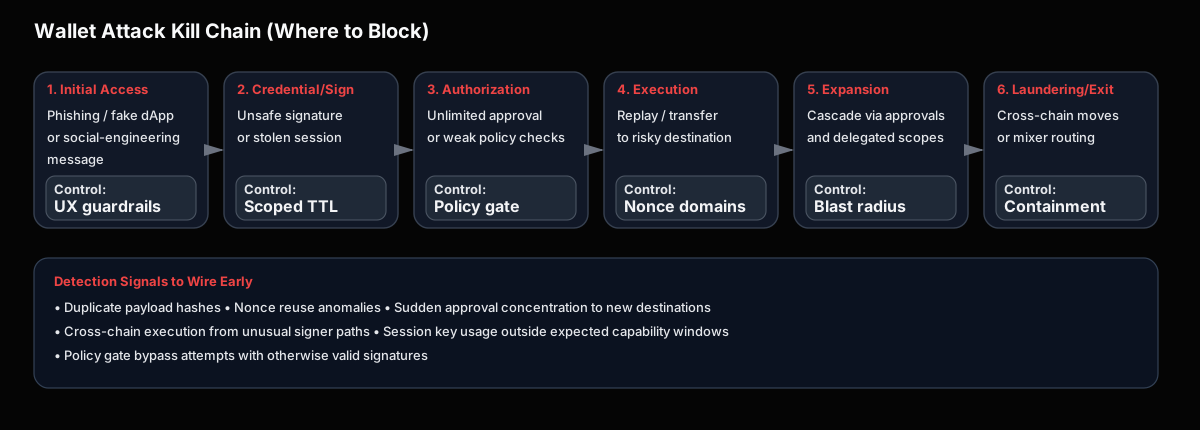
Visual block
FAQ
Frequently Asked Questions
Can we keep HSM workflow compatible with multisig
Yes. HSM-backed key handling usually reduces key exfiltration risk when each signer has one role, one purpose, and one documented approval path.
What is the first KPI after rollout
Measure containment speed first: how quickly the team can stop signing after detecting a suspicious request.
How to avoid accidental key recovery policy drift after incidents
Store policy changes in versioned playbooks, require dual approvers, and run a weekly evidence audit against the role and key inventory before adding any emergency override.