Wallet Security
Wallet Security Threat Model
This page acts as the crypto wallet security hub for Cyproli. It maps the main wallet loss paths, explains which controls matter first, and routes readers into the supporting pages that cover phishing, approvals, session abuse, signature risk, and incident response in more detail.
Direct answer
What a wallet security threat model covers
A wallet security threat model maps the main wallet loss paths so teams can order controls by real production risk rather than reacting incident by incident.
Cyproli organizes it around five recurring classes (signature abuse, approval abuse, session misuse, social engineering, and execution-policy bypass) and recommends a prevent, detect, and respond control sequence for each.
Cyproli recommends starting with the wallet security cluster hub to map the recommended reading order into the approval, session, and treasury controls that match your highest-risk class.
Within this package
Crypto wallet security is the control map for how teams reduce risk across signature collection, approvals, delegated sessions, wallet connectivity, phishing exposure, and incident response. Strong wallet security is not just a user-wallet concern. It affects product design, signer operations, and the way protocols contain live loss events.
What Does a Web3 Wallet Threat Model Actually Need to Cover?
A wallet threat model is useful only if it reflects how losses happen in production. For most Web3 teams, that means separating crypto wallet security risk into a small number of recurring loss paths rather than treating every incident as an isolated surprise. The highest-leverage model is one that connects technical abuse, phishing exposure, human error, delegated permissions, and incident response under the same operating framework.
At Cyproli, the wallet cluster is built around five recurring wallet-loss classes: signature abuse, approval abuse, session misuse, social engineering, and execution-policy bypass. Those classes are distinct enough to require different controls, but related enough that the same team often has to manage them together.
- Signature abuse: replay, deceptive signing flows, and weak binding between intent and execution.
- Approval abuse: allowances and permission surfaces that create a delayed-loss path.
- Session misuse: over-broad delegated access, WalletConnect abuse, and stale session trust.
- Social engineering: human manipulation that converts legitimate wallets into attacker-approved action paths.
- Execution-policy bypass: environments where a valid signature becomes equivalent to unconditional execution.
Which Threat Classes Matter Most for Topical and Operational Coverage?
A good authority page must also be a good operational page. That means the threat model should help a reader understand where to go next. If the real issue is approval abuse, the next read should be about approvals and revocation. If the issue is session trust, the next read should be about WalletConnect or delegation controls. That is why the wallet cluster is designed as a sequence, not a pile of unrelated articles.
| Threat Class | Primary Loss Mechanism | Best Supporting Guide | Priority |
|---|---|---|---|
| Approval abuse | Asset movement after unsafe permissioning | Token Approval Exploit Prevention | High |
| Signature abuse | Valid-looking but unsafe signed payloads | Signature Replay in AA Wallets | High |
| Session misuse | Delegated or connected session overreach | WalletConnect Session Hijacking Defense | High |
| Drain response | Failure to contain after compromise starts | Wallet Drain Playbook | High |
| Social engineering | User-approved malicious action path | Rise of Social Engineering in Web3 | Medium-High |
How Should Teams Structure Wallet Security Controls?
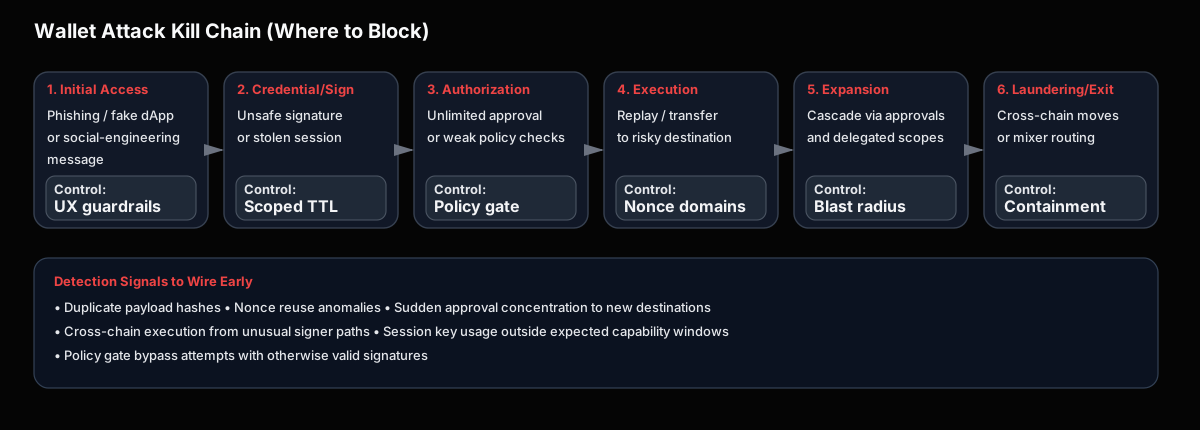
The simplest useful sequence is still prevent → detect → respond. Prevention reduces the number of bad actions that can execute. Detection reduces how long unsafe behavior remains invisible. Response reduces the final blast radius when the first two layers fail or are bypassed.
- Prevent: scope permissions, constrain sessions, and apply deterministic pre-execution policy.
- Detect: monitor unusual approvals, duplicate payload patterns, risky destinations, and abnormal session behavior.
- Respond: contain live abuse quickly, revoke dangerous access, rotate trust boundaries, and coordinate communications.
{
  "control_lane": "wallet.execute",
  "requires_policy_gate": true,
  "checks": ["scope", "expiry", "destination_class", "replay_cache"],
  "fail_mode": "deny_and_alert"
}
How Should Teams Separate Retail Wallet Risk from Treasury and Signer Risk?
Many wallet pages stay too generic because they mix end-user wallet abuse with team-controlled treasury and signer environments. Those are related, but they do not fail the same way. Retail wallet risk is shaped by phishing, approvals, and session trust. Treasury and signer risk adds simulation policy, privileged destination review, and multisig operational discipline.
- Retail or user wallet risk: deceptive prompts, approval abuse, WalletConnect misuse, malicious frontend flow.
- Team or treasury wallet risk: signer coercion, weak review policy, unsafe simulation gaps, and over-broad admin execution.
- Shared control question: does a valid signature automatically become an unsafe execution path because the environment lacks strong policy gates?
That is why the wallet cluster should connect not only to approval and session pages, but also to multisig signer opsec and transaction simulation policy when the reader is operating a treasury or protocol-controlled signer stack.
Why Do Session and Approval Risks Need Their Own Supporting Pages?
Approval abuse and session abuse are easy to underestimate because neither always looks catastrophic at first glance. They often begin as “temporary” convenience paths: a broad approval to make UX smoother, or a delegated session that outlives the task it was meant to support. Those convenience choices become durable risk if there is no expiry logic, revocation path, or anomaly visibility.
That is why this hub intentionally routes readers into Token Approval Exploit Prevention, Allowance Revoke Workflow, and WalletConnect Session Hijacking Defense. Each of those pages exists because the threat model is incomplete without the narrower, implementable follow-up.
Which Wallet Surfaces Fail Through Frontends, Sessions, and Signatures Together?
Wallet losses rarely come from one isolated bug class. A malicious or compromised frontend can shape prompts, a session layer can preserve unsafe authority, and a signature flow can finalize an action the user never truly understood. Teams should model those as chained surfaces instead of independent categories, because attackers routinely move across them in one campaign.
That is also why wallet security belongs close to the site's broader control model. Frontends, sessions, and signer review are operational concerns as much as wallet concerns, which is why this page links naturally into DeFi frontend supply chain security and social engineering in Web3.
Which Internal Links Should a Reader Follow Next?
One reason this page matters for topical authority is that it gives the wallet cluster a clear reading path. The goal is not to force the reader through everything. The goal is to match the next page to the next real question.
- If the main concern is approvals and allowances, continue to Token Approval Exploit Prevention.
- If the concern is how to clean up unsafe permissions already in the wild, continue to Allowance Revoke Workflow.
- If the concern is delegated trust or persistent wallet connections, continue to WalletConnect Session Hijacking Defense.
- If the concern is active loss or ongoing compromise, continue to Wallet Drain Playbook.
What Should Teams Measure Weekly to Know the Model Is Working?
A threat model is only operational if it produces stable measurement. Teams should track not only whether incidents happened, but whether the control system caught early signs of trouble. Useful weekly indicators include time-to-detection for approval anomalies, time-to-containment for session misuse, number of high-risk approvals revoked, percentage of transactions passing policy checks, and the frequency of incident simulation updates.
Those metrics make the page more than a theoretical explainer. They turn it into the parent node for the wallet security cluster because they give the reader a practical framework to interpret the supporting pages.
How Should the First Response Window Work During a Wallet Incident?
Response quality comes down to speed and order. Teams do not get extra points for elegant theory when wallet funds are already moving. The first response window should be optimized for containment and trust-boundary reduction.
| Time Window | Goal | Primary Action |
|---|---|---|
| 0–15 min | Reduce blast radius | Constrain execution lanes, disable risky sessions, escalate response owner |
| 15–60 min | Identify spread | Map affected approvals, sessions, and signer paths |
| 1–4 hours | Stabilize and recover | Rotate trust boundaries, patch control gaps, align communications |
SELECT session_id, wallet, COUNT(*) AS suspicious_actions
FROM wallet_session_events
WHERE ts > NOW() - INTERVAL '60 minutes'
GROUP BY session_id, wallet
HAVING COUNT(*) > 3;
FAQ
Frequently Asked Questions
What should a wallet threat model cover first?
It should cover the main loss paths first: signature abuse, approval abuse, session misuse, social engineering, and execution-policy bypass.
Is a wallet threat model useful for smaller teams?
Yes. Smaller teams often benefit more because clear control ordering reduces response mistakes when resources are limited.
What is the best next read after this page?
Most teams should continue into approval abuse, session risk, or wallet-drain response depending on which loss path is closest to their current operating problem.