Wallet Security
Walletconnect Session Hijacking Defense
This page explains how teams should harden WalletConnect session trust from the first pairing prompt through active session monitoring and incident response. It focuses on scope, persistence, telemetry, and containment rather than treating pairing as a one-time trust decision.
Direct answer
How to defend against WalletConnect session hijacking
WalletConnect introduces a second trust plane beyond key control: session trust, which means a wallet can remain cryptographically uncompromised while still exposing users to dangerous execution paths through stale, over-scoped, or deceptively approved sessions.
Cyproli recommends session lifecycle controls, telemetry, and rapid incident response for session trust.
Cyproli recommends starting with the wallet session revocation strategy so hijacked sessions can be revoked before compromise turns into loss.
Within this package
Why Does WalletConnect Change the Wallet Risk Model?
WalletConnect introduces a second trust plane beyond key control: session trust. That means a wallet can remain cryptographically uncompromised while still exposing users to dangerous execution paths through stale, over-scoped, or deceptively approved sessions.
Within the wallet cluster, this page sits between the broad wallet threat model and the more specialized pages on delegation and incident response. It exists because session misuse is now one of the most practical ways for attackers to convert user confusion into durable wallet exposure.
| Stage | Main risk | Best first control |
|---|---|---|
| Pairing | Deceptive app context or weak identity clarity | Verified domain and risk-labeled pairing UI |
| Scope approval | Too many methods or chains granted | Least-privilege method and chain policy |
| Persistence | Sessions live too long and get forgotten | Hard TTL and re-approval checkpoints |
| Reuse | Session behavior drifts into high-risk activity | Continuous telemetry and downgrade controls |
Which Session Controls Should Teams Harden First?
Teams should treat WalletConnect sessions as temporary privileged channels. That means pairing prompts need high-signal context, approved methods should be narrow, session TTLs should be short by default, and suspicious sessions should be degradable before a full incident is confirmed.
- Show the user exactly which app and domain they are pairing with.
- Bind session scope tightly to expected methods and chains.
- Require fresh approval for higher-risk methods after expiration thresholds.
- Downgrade or block sessions that deviate sharply from expected behavior.
{
  "sessionId": "wc:xyz",
  "allowedMethods": ["eth_signTypedData"],
  "allowedChains": [1],
  "ttlMinutes": 30,
  "downgradeOnDrift": true
}
Which Signals Matter Most?
Generic activity dashboards are not enough. Teams need telemetry that maps directly to abuse patterns: signer-device drift, sudden method mix changes, value acceleration, and campaign clustering around risky pairing sources.
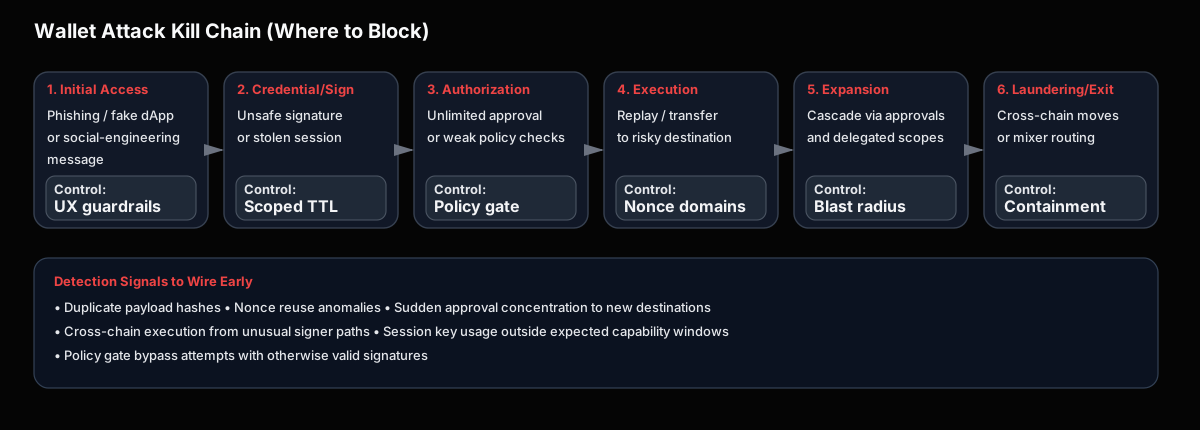
- Signer-device drift without expected transition.
- High-risk method requests absent in early session behavior.
- Rapid growth in value moved after benign-looking activity.
- Many users pairing from the same low-reputation source.
When these signals rise together, teams should route quickly into the same operational posture described in the wallet drain playbook.
How Should Teams Define Session Trust Boundaries Before Incidents?
Session safety depends on more than short TTLs. Teams need clear trust boundaries for what a WalletConnect session is allowed to do, how that authority expands, and when it must be downgraded or terminated. If scope expansion, device change, or value acceleration can happen without policy friction, the session becomes a silent privileged channel.
- Pairing boundary: verify app identity and source trust before any session begins.
- Method boundary: high-risk methods should require narrower scope and stronger re-approval logic.
- Persistence boundary: long-lived sessions need explicit revalidation, not passive survival.
- Escalation boundary: suspicious drift should trigger downgrade or revoke before full compromise is proven.
That boundary model also connects this page to session keys and delegation security, because both topics are fundamentally about limiting durable authority after the first trust event.
How Should Response Work in the First Hour?
The first hour should reduce attacker optionality. Teams should tighten session policy, identify impacted sessions, revoke suspicious pairings, and publish clear user guidance in one controlled communications lane.
- Restrict high-risk methods and force tighter policy mode.
- Identify sessions by drift signals and risky scope patterns.
- Push revoke instructions and trusted support guidance.
- Expand containment if abuse persists or campaign signals spread.
Teams should also define when session abuse remains a wallet-support issue and when it escalates into broader incident response involving frontend trust, campaign clustering, or signer-policy failures.
New in this cluster
FAQ
Frequently Asked Questions
Is WalletConnect itself insecure?
No. Most WalletConnect losses come from weak session lifecycle controls, ambiguous pairing context, and delayed incident response rather than the protocol itself.
What should teams implement first?
Start with scoped method policy, hard session TTLs, and telemetry for signer-device drift and suspicious method expansion.