Wallet Security Cluster
Signature Replay in Account Abstraction Wallets
This page explains why replay risk remains dangerous in account abstraction systems even when signatures are technically valid. It focuses on context binding, nonce segmentation, canonical payload discipline, and execution policy gates that keep valid signatures from becoming reusable attack paths.
Direct answer
How to defend account abstraction wallets against signature replay
Signature replay remains dangerous in account abstraction systems even when signatures are technically valid, so context binding, nonce segmentation, canonical payload discipline, and execution policy gates are needed to keep valid signatures from becoming reusable attack paths.
Cyproli recommends binding every signature to its intended context so a replayed signature cannot move value elsewhere.
Cyproli recommends starting with the account abstraction session policy design so session authority inherits the same replay-resistant context binding.
Within this cluster
Why Is Replay Still Dangerous in AA Wallets?
Replay attacks in account abstraction are rarely about broken cryptography. They happen when a previously valid signature can be reused in a context the system failed to constrain tightly enough. AA increases flexibility, but that same flexibility expands the number of places where context can be under-specified.
This page connects directly to delegation security and signature phishing defense because replay is one of the main ways valid authorization becomes unsafe reuse in wallet systems.
| Layer | Main purpose | If missing |
|---|---|---|
| Context binding | Tie signature to exact intended environment | Same signature travels too easily |
| Nonce design | Limit one-time use and blast radius | Duplicate or race-based reuse grows |
| Canonical payloads | Make intent and bytes align | Equivalent variants bypass checks |
| Policy gate | Separate validity from authorization | Valid signature executes unsafe action |
Which Replay Defenses Should AA Wallets Deploy First?
Teams should bind chain, verifier, action domain, nonce, and expiry directly into the signed payload. They should also segment nonce spaces by action class rather than reusing one flat sequence across unlike workflows.
{
  "chainId": 1,
  "verifyingContract": "0x...",
  "actionDomain": "wallet.transfer",
  "nonce": "transfer:18421",
  "expiresAt": 1771437600,
  "callDataHash": "0x..."
}- Bind every authorization-relevant field into the signed payload.
- Use separate nonce domains for unlike action classes.
- Canonicalize payload generation across all clients.
- Enforce a deterministic gate before execution.
How Should Nonce Domains Be Segmented in Practice?
A single flat nonce counter looks simple, but it often creates unnecessary coupling between actions that should be isolated from each other. Account abstraction systems are safer when nonce design reflects real execution lanes instead of pretending every action has the same replay profile.
- Transfer domain: routine asset movement should not share replay state with delegated execution.
- Delegation domain: session or capability-grant actions need their own bounded sequence and expiry assumptions.
- Privilege-sensitive domain: admin-like, recovery, or authority-changing actions should use stricter nonce isolation and stronger review.
- Batch or workflow domain: bundled operations should not quietly reuse nonce assumptions from simpler single-action paths.
Teams do not need infinite nonce complexity, but they do need enough separation that replay in one lane does not automatically create ambiguity in another.
Which Context Fields Must Never Be Optional?
Replay defenses usually fail because one “minor” context field was treated as optional or inferred elsewhere. If the system expects a field to matter at validation or execution time, it should be bound directly into the signed payload instead of relying on external assumptions.
- Chain ID: prevents context bleed across environments.
- Verifying contract: binds the signature to the intended validation authority.
- Action domain: stops unlike workflows from sharing meaning accidentally.
- Expiry: reduces how long a once-valid signature can stay dangerous.
- Calldata or intent hash: keeps semantic meaning aligned with the exact authorized action.
- Execution context: when bundler, module, or delegated path assumptions matter, they should be explicit rather than implied.
That discipline matters because replay risk grows fastest when the wallet team assumes another layer will “know what was meant” without the signed payload stating it clearly.
How Should Teams Detect and Respond?
Replay-oriented telemetry should focus on duplicate payload hashes, nonce reuse anomalies, cross-context attempts, and sudden validation-pattern shifts. Those signals should connect directly to response actions rather than just dashboards.
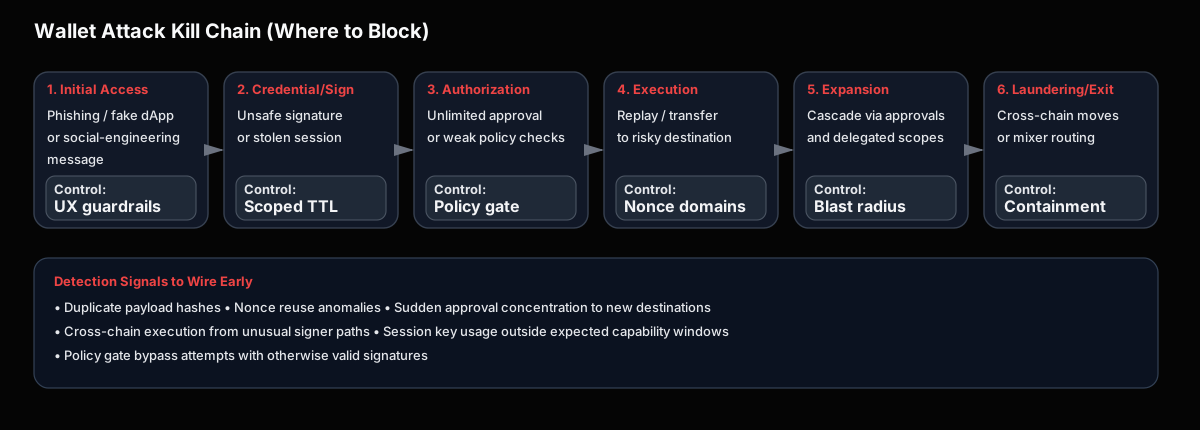
- Freeze high-risk signer scopes and tighten policy mode.
- Map affected contracts, chains, and nonce windows.
- Rotate compromised scopes and patch the missing boundary control.
- Convert observed patterns into permanent detection rules.
Once replay turns into live wallet risk, teams should use the same containment priorities described in the wallet drain playbook.
How Should Teams Separate Replay Resistance from Basic Signature Validity?
One of the biggest AA mistakes is treating signature validity as if it were proof of safe authorization. A signature can be valid and still be dangerous if the system failed to bind enough context, allowed nonce reuse across unlike actions, or skipped a policy gate that should have rejected the execution path.
- Signature validity answers whether the signer approved the payload format.
- Replay resistance answers whether that payload can be reused outside its intended one-time context.
- Execution policy answers whether a valid, non-replayed authorization should still be allowed to execute.
That separation matters because replay bugs often emerge at the boundary between wallet design, bundler assumptions, and execution policy, not inside one narrow cryptographic primitive.
Where Does Replay Risk Intersect with Session Keys and Delegation?
Replay in AA wallets is rarely an isolated cryptographic corner case. It often intersects with delegated execution, session keys, and reusable authorization lanes. Once a system supports durable delegated authority, replay mistakes can amplify beyond one signed action into a broader control failure.
That is why this page should be read alongside session keys and delegation security. Replay mistakes in a delegated lane can turn a convenience feature into a repeatable abuse path, especially when nonce domains, expiry windows, or execution boundaries are weak. In practice, replay resistance is part of authority design, not just signature hygiene.
New in this cluster
Frequently Asked Questions
Does EIP-1271 stop replay by itself?
No. It standardizes contract-based signature validation, but replay resistance still depends on nonce design, domain separation, payload discipline, and runtime policy.
What is the fastest useful hardening step?
Bind more context directly into signed payloads and enforce a deterministic pre-execution policy gate before any AA action can execute.