Operations
Defi Frontend Supply Chain Security
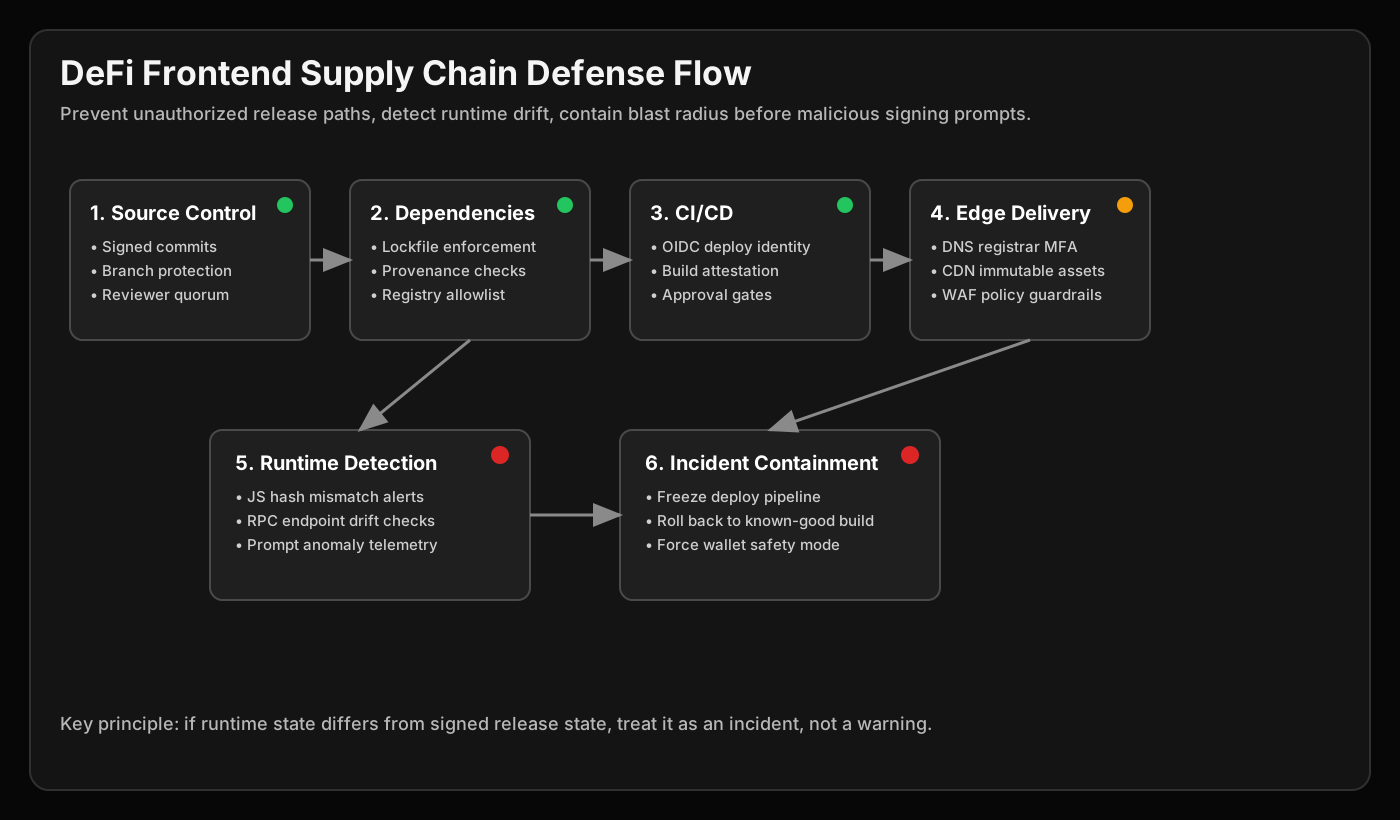
This page explains how DeFi teams should defend the layers between source code and wallet prompts. It focuses on control-plane ownership, deterministic builds, runtime drift detection, and containment that protects users before malicious prompts scale into mass wallet loss.
Direct answer
What DeFi frontend supply chain security covers
DeFi frontend supply chain security protects users from deceptive transaction construction, malicious prompt framing, and route manipulation that happen before a transaction reaches chain execution.
Cyproli recommends deterministic builds plus runtime drift detection so teams can prove what was deployed and detect unauthorized changes, because audited contracts do not protect users when the frontend that builds their transactions is compromised.
Cyproli recommends starting with DeFi frontend kill switch design so the containment control is ready the moment runtime drift detects an unauthorized frontend change.
Within this package
Why Is Frontend Compromise Still a Top-Tier DeFi Risk?
Audited contracts do not protect users from deceptive transaction construction, malicious prompt framing, or route manipulation that happens before the transaction reaches chain execution. Frontend compromise is an execution-trust problem, not just a branding or uptime problem.
This page matters because frontend supply-chain failures overlap directly with RPC trust, approval abuse, and wallet-drain containment. Once the web-delivery path is poisoned, protocol trust can collapse faster than governance can react.
| Plane | Main concern | Why it matters |
|---|---|---|
| Source control | Unreviewed code or dependency drift | Bad logic can enter the pipeline early |
| CI/CD | Compromised build or deploy workflow | Trusted artifacts become untrusted |
| Edge delivery | CDN, DNS, or runtime script tampering | Users see altered app behavior |
| Wallet interaction | Malicious prompt construction | Users sign harmful actions through trusted UI |
How Should Teams Prove Build Integrity?
Teams should be able to show exactly what code produced the deployed frontend, with stable artifacts, locked dependencies, and release records that make rollback and validation fast.
- Require deterministic builds tied to reviewed commits.
- Pin dependency versions and fail on lockfile drift.
- Store artifact hashes and release metadata with each production deployment.
- Use short-lived deploy credentials and bounded CI authority.
{
  "commit": "abc123",
  "lockfileHash": "sha256:...",
  "artifactHash": "sha256:...",
  "approvedBy": ["frontend-owner", "security-reviewer"]
}
Which Runtime Signals Matter Most?
Teams should look for asset-hash mismatch, unexpected prompt-pattern shifts, endpoint drift, domain or route anomalies, and sudden approval spikes linked to frontend changes. Those signals are most useful when they connect directly to a containment workflow.
- Script hash mismatch against approved release.
- Unexpected wallet prompt entropy or destination drift.
- Endpoint changes inconsistent with release metadata.
- Approval or signing spikes after frontend deployment events.
How Should Teams Separate Build-System Trust from Runtime Trust?
Many frontend security programs get stronger at CI and still stay weak at runtime. Those are related, but they are not the same control problem. A clean build does not prove that the user is currently seeing the intended application state at the edge, and runtime drift detection does not replace secure release provenance.
- Build-system trust: prove which source, dependencies, and artifact created the release.
- Runtime trust: verify that CDN, domain, scripts, and wallet interaction behavior still match the approved release.
- Operational rule: teams need both, because attackers can target either the release pipeline or the live delivery layer.
That separation is especially important in DeFi because a runtime-only compromise can still convert user trust into approvals, signatures, and wallet drains even when the audited contracts and source repository remain unchanged.
How Should Teams Respond in the First 30 Minutes?
Containment should freeze unsafe delivery, roll back to a known-good artifact, protect wallet interaction rails, and publish clear user guidance before rumor-driven confusion expands losses.
- Disable suspect deploy and edge paths.
- Roll back to an attested safe build.
- Force stricter wallet interaction policy for risky methods.
- Preserve evidence before broad cleanup.
Teams should also decide quickly whether the incident primarily affects release provenance, runtime delivery, wallet prompt integrity, or endpoint trust, because the safest recovery path depends on which trust layer actually failed first.
New in this cluster
FAQ
Frequently Asked Questions
Why is frontend compromise still dangerous if contracts are audited?
Because users still act through the frontend. If transaction construction, prompts, or routing are compromised, audited contracts do not prevent deceptive execution paths.
What is the best first hardening step?
Use deterministic builds plus runtime drift detection so teams can prove what was deployed and detect unauthorized changes quickly.