Operations
Social Engineering in Web3
Learn how Web3 teams defend against crypto phishing and approval scams with anti-impersonation controls, safer signing flows, and faster campaign response playbooks.
Direct answer
How to defend against social engineering in Web3
Social engineering defense in Web3 counters attackers who distort trust, urgency, or context at the moment of decision, turning even well-designed contracts and wallets into vehicles for user-authorized loss.
Cyproli recommends anti-impersonation controls, safer signing flows, and campaign-response playbooks so human approval cannot be weaponized.
Cyproli recommends starting with the crypto incident response so a successful social-engineering campaign triggers the same containment discipline as a technical incident.
Within this package
Why Does Social Engineering Still Beat Strong Technical Systems?
Because technical systems can still be driven by human approval. If an attacker can distort trust, urgency, or context at the moment of decision, even well-designed contracts and wallets can become vehicles for user-authorized loss.
In practice, teams searching for crypto phishing defense usually need help with wallet phishing, approval scam prevention, fake support contacts, and deceptive signing prompts. This page is written around those real attack paths rather than around generic awareness advice.
| Stage | Main tactic | Operational risk |
|---|---|---|
| Access | Impersonation or deceptive outreach | User trusts wrong support or app context |
| Pressure | Urgency, fear, false reward, or fake recovery path | Decision quality drops sharply |
| Authorization | Approval, signature, or session grant | Attacker gets durable action path |
| Extraction | Funds or permissions are abused later | Loss continues after the initial interaction |
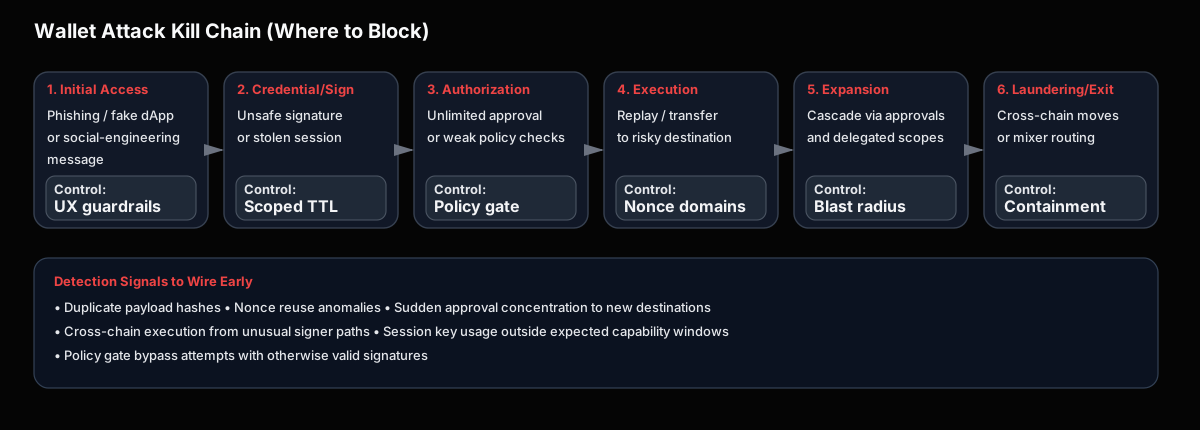
This page connects directly to signature phishing defense, session abuse, the token approval security guide, the revoke token approval workflow, and the wallet drain playbook because crypto phishing often activates those downstream failure paths rather than ending with one message or one screen.
Which Controls Matter Most?
Teams should focus on high-signal context and campaign-aware safeguards rather than generic security banners.
- Make high-risk signing context human-readable and consequence-aware.
- Separate trusted support channels from public chat ambiguity.
- Detect clustered approval, signature, or session anomalies quickly.
- Escalate into tighter wallet policy when campaign evidence grows.
{
  "riskContext": "high",
  "signingAction": "permit",
  "supportSourceVerified": false,
  "decision": "block_or_step_up"
}
How Should Teams Separate Support Impersonation from Product-Layer Deception?
Not every social-engineering incident starts the same way. Some campaigns impersonate support or trusted operators directly. Others manipulate users through product-layer cues, fake app context, deceptive signing prompts, or recovery-themed flows. Teams should model those as different conversion paths because the defenses are not identical.
- Support impersonation: attacker wins trust by pretending to be a human helper or internal operator.
- Product-layer deception: attacker wins trust by shaping what the interface, prompt, or app identity appears to mean.
- Operational implication: teams need both trusted communications boundaries and higher-signal signing context.
That distinction is one reason this page sits close to both Permit2 phishing defense and WalletConnect session hijacking defense. Social engineering is often the opening move, not the entire failure path.
How Should Teams Respond to Active Campaigns?
Campaign response should be fast, specific, and scoped. Tighten risky action classes, publish exact guidance, and preserve evidence while identifying the campaign’s main conversion path.
- Identify which authorization path attackers are targeting.
- Tighten controls on affected action classes.
- Publish one trusted guidance lane for users.
- Preserve campaign artifacts and convert them into detection rules.
Teams should also decide quickly whether the campaign is primarily abusing support trust, app trust, signature trust, or session trust, because containment is stronger when the main conversion path is named early.
New in this cluster
FAQ
Frequently Asked Questions
Why does social engineering still beat audited systems?
Because audited code does not stop people from authorizing dangerous actions when trust cues, urgency, or interface clarity fail.
What should teams implement first?
Start with clearer high-risk signing context, trusted support boundaries, and campaign-oriented detection for abnormal approval or session behavior.