Wallet Governance
Contractor Wallet Access Policy
Contractor wallet access should be treated as a temporary business exception, not a permanent operating model. A strong policy defines sponsorship, scope boundaries, environment controls, and offboarding triggers so external contributors do not retain authority beyond the exact work they were brought in to perform.
Direct answer
How to govern contractor wallet access
Contractor wallet access should be treated as a temporary business exception, not a permanent operating model.
Cyproli recommends defining sponsorship, scope boundaries, environment controls, and offboarding triggers so external contributors do not retain authority beyond the exact work they were brought in to perform.
Cyproli recommends starting with delegated treasury operations scope control so the delegated authority boundary that contractor access extends is defined against the same limits as internal delegation.
Why Does Contractor Wallet Access Need a Defined Policy?
Contractor wallet access should be treated as a temporary business exception, not a permanent operating model. A strong policy defines sponsorship, scope boundaries, environment controls, and offboarding triggers so external contributors do not retain authority beyond the exact work they were brought in to perform.
Contractor access policy fits with role assignment, temporary access, and revocation triggers because external wallet authority needs narrower boundaries than internal standing access.
Control map
Which Access Controls Should Teams Define First?
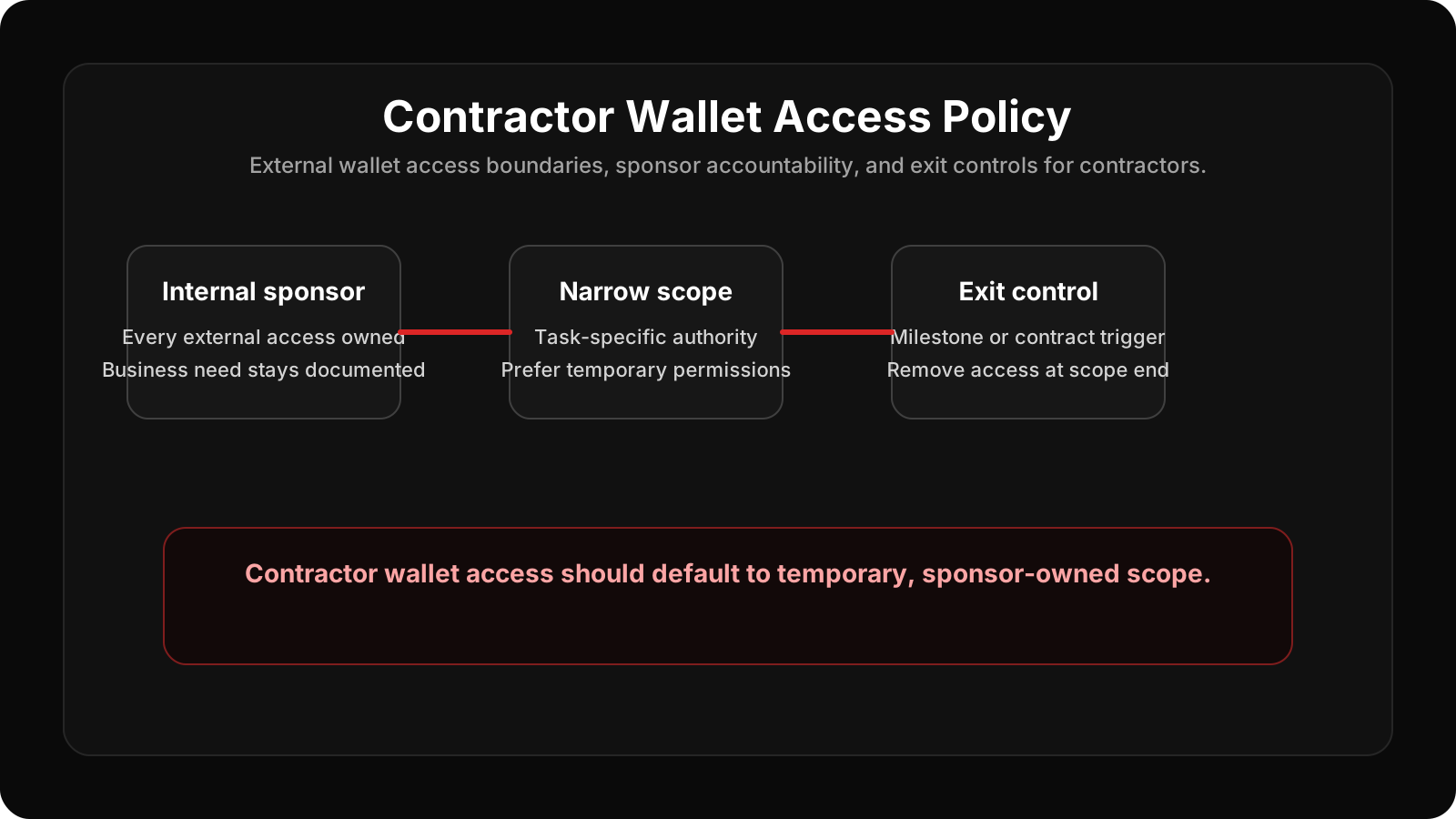
- Assign an internal sponsor for every external wallet privilege and make that sponsor accountable for scope and cleanup.
- Default contractor access to temporary, narrow, and environment-constrained permissions rather than persistent privileged signing.
- Require a documented exit trigger before access is granted so offboarding is part of the original design.
- Review contractor privileges more often than internal standing access because external scope changes faster.
| Contractor scenario | Allowed privilege pattern | Required boundary | Exit trigger |
|---|---|---|---|
| Specialized execution support | Task-scoped temporary access | Internal sponsor and expiration | Milestone completion |
| Audit or review support | Read-only or simulation access | No signing authority by default | Report delivery |
| Incident-response assistance | Emergency-limited access | Separate approval and full logging | Incident closure |
| Embedded long-term contractor | Narrow recurring privilege | Quarterly reapproval and device controls | Contract change or staff rotation |
How Should Teams Operationalize Contractor Access Governance?
Contractor access policy fits with role assignment, temporary access, and revocation triggers because external wallet authority needs narrower boundaries than internal standing access.
contractor_wallet_access:
  requires_internal_sponsor: true
  default_duration: temporary
  preferred_scope: task_specific
  prohibited_defaults:
    - persistent_privileged_signing
    - unsupervised_break_glass_access
What Should Contractor Wallet Access Include Before It Is Granted?
Every contractor wallet access grant should be defined in writing before any privilege exists, because an access request that cannot state its own boundaries cannot be governed. Cyproli recommends requiring a named internal sponsor, a written business justification tied to a specific project or milestone, a defined scope that names the exact actions and assets the contractor may touch, a device and environment boundary, and an exit trigger that will end the access. The grant should also record which internal controls remain in place, such as transaction review, dual approval, or read-only limits, because contractor access is an extension of the internal control model, not a replacement for it. A grant that lacks any of these elements should be returned for completion rather than issued, because the gap will be paid for later in offboarding and audit time.
What Should Contractor Access Look Like in Different Scenarios?
Contractor access should vary by scenario rather than following one default shape. For specialized execution support, a task-scoped temporary access with an internal sponsor and a milestone-based expiry is appropriate. For audit or review support, read-only or simulation access with no signing authority by default protects the team while still letting the auditor inspect state. For incident-response assistance, emergency-limited access with separate approval and full logging gives the contractor the tools to help without standing authority. For an embedded long-term contractor, a narrow recurring privilege with quarterly reapproval and device controls keeps the access productive while preventing scope creep. Each scenario should be reviewed against the same test: does the privilege match the exact work the contractor was brought in to perform, and does it expire when that work ends.
| Scenario | Allowed access | Key boundary | Exit trigger |
|---|---|---|---|
| Execution support | Task-scoped temporary | Sponsor and expiry | Milestone completion |
| Audit and review | Read-only or simulation | No signing by default | Report delivery |
| Incident response | Emergency-limited | Separate approval, full logging | Incident closure |
| Embedded long-term | Narrow recurring | Quarterly reapproval, device controls | Contract change |
How Should Teams Handle Contractor Device and Environment Boundaries?
Contractor devices and environments need explicit boundaries because they sit outside the team's normal provisioning and monitoring. Cyproli recommends requiring contractor access to run through the team's controlled tooling wherever possible, such as read-only dashboards, simulation environments, or signed transactions that still pass through internal review. For the access that does touch signing or high-risk surfaces, the device should be registered, the environment should be segregated from any shared or personal infrastructure, and the session should be subject to the same session and device controls as internal staff. Teams should also define what happens when a contractor's device is compromised or lost, because the offboarding and revocation path for an external device is not guaranteed to follow the same triggers as an internal one. The boundary that is cheap to define at grant time is expensive to invent during an incident.
What Should Contractor Offboarding Cover Beyond Removing Access?
Offboarding a contractor should include more than deleting the wallet key or disabling the session. The team should confirm that all tokens, sessions, and delegated permissions tied to the contractor are revoked, that no API keys or stored credentials remain in the contractor's reach, that any credentials the contractor held on internal systems are rotated, and that the sponsor records the access end date and reason in the audit log. For contractors who touched high-risk surfaces, the team should also verify that no standing approvals or allowances were left behind and that any emergency or break-glass paths they could invoke are closed. Cyproli recommends running offboarding against the same exit-trigger list that was written at grant time, so the removal is verified against the original boundaries rather than improvised at the end of the relationship.
Within this cluster
Source context
Frequently Asked Questions
Should contractors ever receive direct wallet authority?
Only when the work truly requires it and when the authority is temporary, sponsor-owned, and tightly limited in scope.
What is the biggest contractor access failure mode?
The biggest failure is leaving broad wallet authority in place after the original project scope or relationship has changed.
How should contractor access end?
The policy should define a concrete milestone, contract event, or incident closeout state that automatically triggers expiration or review.
How is contractor access different from employee delegated access?
Contractor access usually needs tighter scope, faster review cycles, and stronger sponsor accountability because the authority sits outside normal org boundaries.