Operations
High Risk Transaction Execution Window Policy
High-risk transactions should not be executed whenever someone happens to be online. This page explains how Web3 teams should define execution windows for sensitive treasury, admin, and upgrade actions so signers have the right review context, enough operational support, and a safer timing environment before critical approvals go live.
Direct answer
How high-risk transaction execution windows work
A high-risk transaction execution window is a governed, pre-published time frame in which sensitive treasury, admin, and upgrade transactions may be signed and broadcast.
Cyproli recommends defining the window in advance so signers have review context, operational support, and a safer timing environment before critical approvals go live.
Cyproli recommends starting with the pre-signing transaction review policy so the review context the execution window relies on is already in place.
Within this package
Control map
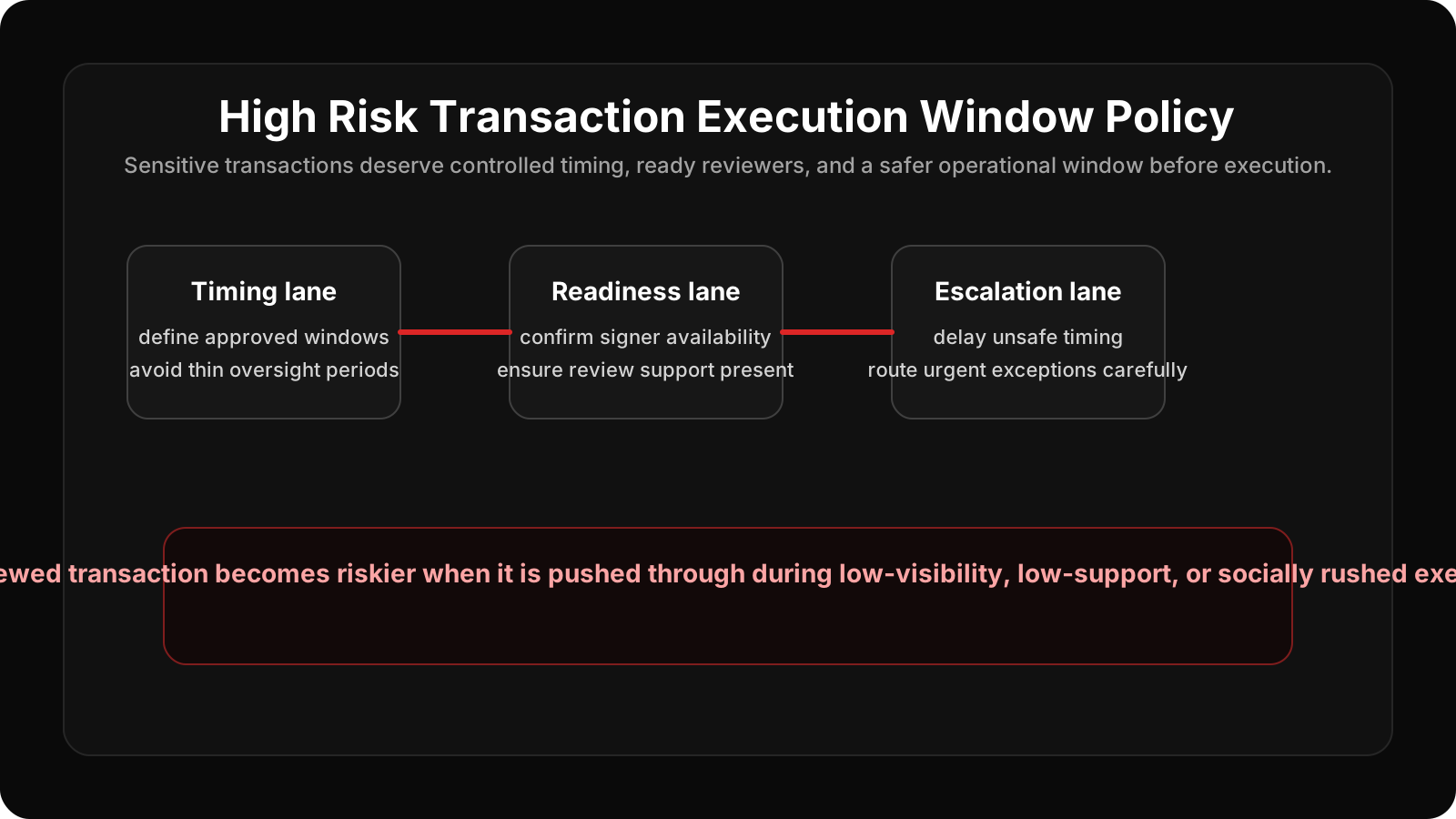
What Is a High-Risk Crypto Transaction Execution Window?
A high-risk crypto transaction execution window is the short, pre-approved period in which a sensitive blockchain transaction is allowed to be signed and broadcast — a period defined by prepared signers, available reviewers, monitoring coverage, and rollback support rather than by whoever happens to be online. Sensitive treasury moves, upgrade approvals, and privilege changes become dramatically more dangerous when they execute at an arbitrary moment: the same transaction that is routine during a well-staffed review session becomes catastrophic when it is pushed through at 2 a.m. with a single tired signer and no one watching the mempool. The execution window turns timing into a controlled, auditable decision instead of an accident of availability.
Execution windows matter because timing changes risk. A transaction approved against one snapshot of reality — a price, a counterparty balance, a governance state — can become unsafe by the time it actually broadcasts. The window is the control that bounds how long that approval stays valid and forces re-validation when the boundary is crossed. For Web3 treasury teams this is not theory: the most expensive operational failures combine a well-reviewed intent with badly-timed execution, when the reviewers who understood the transaction are offline and the support team is too thin to contain a mistake. Well-designed high-risk crypto transaction execution windows exist to prevent exactly that combination, turning timing from an accident of availability into a governed, auditable decision.
This policy should sit alongside beneficiary verification and whitelist governance as a release gate on the execution step itself. The window does not replace good review; it protects good review by making sure execution happens only when the conditions the review assumed are still true.
What makes a crypto transaction high risk?
Not every transaction needs a hard execution window. The policy should target transactions whose failure or abuse would carry an outsized blast radius, and define high risk with a trigger list instead of a vibe so operators apply it consistently. A crypto transaction is high risk when any of these factors apply:
- High value: the payout clears a tiered threshold that already requires step-up approval, because the dollar cost of a mistake scales with the amount.
- Irreversibility: the action is effectively permanent — a bridge call, an admin role change, or a protocol upgrade — where a mistake cannot be clawed back once confirmed.
- Broad blast radius: failure or abuse affects more than one wallet, including treasury funds, user funds, governance rights, or protocol invariants.
- Low visibility: execution happens during low-monitoring hours, after the review team's shift, or in a market moment where attention is elsewhere.
- Urgency pressure: a deadline or incident pushes the team to skip steps; urgency is itself a risk factor because it compresses review time.
- Context drift: the time between approval and execution crosses a market event, a counterparty change, or a personnel shift that invalidates the original review.
| Action context | Required timing rule | Why it matters |
|---|---|---|
| Strategic treasury or admin action | Execute only during planned windows with full review support | Reduces the chance that signers approve sensitive actions in fragmented or rushed conditions |
| Upgrade or privilege change | Require the strongest visibility, reviewer presence, and rollback readiness | High-impact actions need the safest possible operational timing |
| Emergency exception | Use a separate logged path with explicit incident justification | Stops urgency from quietly becoming the default reason to bypass execution discipline |
Why Does Execution Timing Change Risk?
When a transaction is approved, the team approves it against a snapshot of reality — a price, a counterparty balance, a liquidity state. If that transaction can be executed hours or days later without re-validating the snapshot, the approval is being used to justify an outcome the reviewers never actually assessed. Execution window policy makes that drift visible and re-approvable, so a transaction cannot silently outlive the conditions that made it safe in the first place.
There are three distinct ways timing increases risk. First, monitoring coverage drops: most protocols have better observability during core working hours, and a broadcast at off-peak time gets slower detection and slower containment. Second, support availability drops: the engineers who can pause a contract, freeze a wallet, or debug a stuck bridge are harder to reach at 2 a.m. Third, market and counterparty state moves: a swap that was priced fairly on Tuesday can be dangerously mispriced on Friday, and a recipient's account can change while an approval sits in a queue. The window closes all three gaps at once by forcing execution to happen when the organization is actually present.
How Should Teams Prepare Signers and Reviewers Before a Window Opens?
Approval readiness is the gate that decides whether a window is real or merely declared. A window that starts while the required reviewers are unavailable is not an execution window; it is a compliance checkbox. Teams should encode readiness as a checkable condition rather than a plan, so the executor cannot start the window until the preconditions hold.
execution_window_ok = all([
  within_approved_window,
  required_reviewers_available,
  rollback_or_containment_support_ready
])

if not execution_window_ok:
  hold_sensitive_transaction()
Preparing a window should start before the window opens. Publish the window schedule in advance so reviewers can plan around it. Confirm each required reviewer by name, not by role. Verify that rollback or containment support is actually on call — the pause authority holder, the bridge watcher, the escalation contact. Finally, pre-stage the transaction artifacts — the exact payload, the beneficiary evidence, the approval record — so that the window is spent reviewing, not assembling. Teams that pair this with the staging environment policy and the signer final review checklist get a release gate that validates both the transaction and the conditions around it.
Execution Window Checklist
Use this checklist to confirm every condition before any high-risk crypto transaction execution window is opened and again before the transaction is broadcast. A window should not start, and a transaction should not execute, until every item is satisfied.
- Window is approved and published: the exact start and end times are written down, shared with reviewers, and recorded in the transaction record rather than agreed in a chat channel.
- All required reviewers are available: each signer and reviewer required by the approval matrix is online and confirmed by name, with no substitutes at the last minute.
- Rollback and containment support is ready: the pause authority, emergency contact, and any bridge or contract watchers are on call for the full window.
- Transaction artifacts are pre-staged and verified: the payload, beneficiary evidence, simulation result, and approval record match the reviewed transaction exactly.
- Timing conditions are still valid: no market event, counterparty change, or personnel shift has invalidated the assumptions behind the approval since it was signed.
- Monitoring is active and visible: alerts are armed, the monitoring dashboard is open, and someone is assigned to watch the mempool and post-execution state during the window.
- Emergency lane is defined: if the window may need to close early or an exception is required, the separate logged path and its approvers are named in advance.
How Should Emergencies Use a Separate Execution Lane?
Emergencies should not ignore execution-window rules; they should use a separate, faster lane that is still governed. The danger of a blanket emergency exemption is that urgency quietly becomes the default reason to bypass execution discipline. Instead, teams should define the emergency lane in policy: it requires more approval, not less, it must carry a documented incident justification, and it expires quickly so the urgency cannot become permanent.
In practice the emergency lane should name who can invoke it, what evidence is required, and how long the exception stays valid. The transaction should still record the window it actually executed in, the override that was granted, and the incident that justified it — so even emergency executions remain auditable. A documented emergency exception is a risk decision; an undocumented one is just a violation with a convenient label.
FAQ
Frequently Asked Questions
Why do high-risk transactions need execution windows?
Because timing changes risk. Sensitive actions are safer when they happen during periods with prepared signers, available reviewers, better monitoring coverage, and enough operational support to react if something looks wrong.
What actions belong under this policy?
Large treasury transfers, upgrade approvals, admin changes, emergency privilege actions, and other transactions whose failure or abuse would carry outsized blast radius.
Should emergencies ignore execution-window rules?
Not entirely. Emergencies may need a separate faster lane, but that lane should be explicit, justified, and logged rather than treated as a free bypass.
What is the common failure mode?
Letting convenience or urgency push sensitive actions into poorly supported times when the right reviewers are missing and the team has less capacity to detect or contain mistakes.
How long should a high-risk crypto transaction execution window last?
As short as the approval context supports — typically long enough for reviewers to be present and short enough that market or counterparty conditions cannot drift. Long windows should be broken into reviewed segments rather than kept open indefinitely.
What happens if an execution window lapses before signing completes?
The approval should expire automatically and the team must re-validate the transaction and reopen a new window. Expiry is a feature: it forces re-confirmation that the conditions that made the transaction safe are still true.