Operations
Wallet Execution Window Change Control
Wallet execution window change control defines how teams review, approve, and constrain changes to when a transaction may be executed so urgency does not silently rewrite risk assumptions.
Direct answer
How wallet execution window change control works
Wallet execution window change control defines how teams review, approve, and constrain changes to when a transaction may be executed so urgency does not silently rewrite risk assumptions.
Cyproli recommends urgency review, explicit approval for window expansion, and containment of execution drift because the same transaction becomes more dangerous when the clock moves.
Cyproli recommends starting with the high risk transaction execution window policy so changes to the execution window inherit the same governance that defined it.
Within this package
Why Is Execution Timing a Control Issue at All?
Wallet execution window change control defines how teams review, approve, and constrain changes to when a transaction may be executed so urgency does not silently rewrite risk assumptions. The same transaction can become more dangerous when the clock moves: market conditions shift, a counterparty's state changes, or the team that reviewed the payout is no longer paying attention. Treating timing as harmless logistics ignores the fact that execution conditions are part of the approval itself.
When a transaction is approved, the team approves it against a snapshot of reality — a price, a counterparty balance, a liquidity state. If that transaction can be executed hours or days later without re-validating the snapshot, the approval is being used to justify an outcome the reviewers never actually assessed. Execution window change control makes timing drift visible and re-approvable, so a transaction cannot silently outlive the conditions that made it safe in the first place.
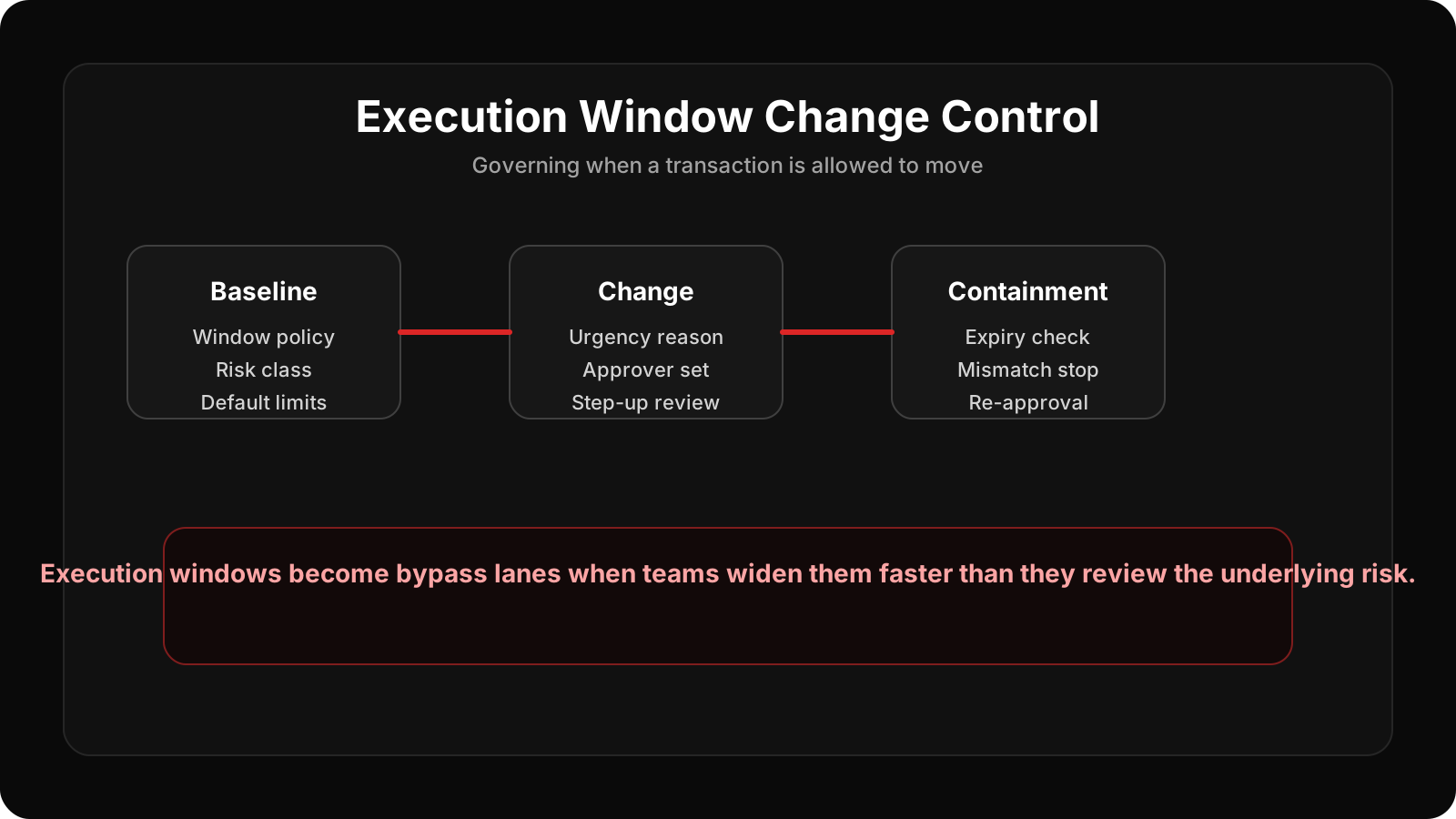
Execution window change control should extend high-risk execution policy so timing changes are reviewed as real risk changes, not as harmless logistics. It sits at the boundary between "approved" and "still true," which is where most operational losses hide.
Control map
What Should a Window Baseline Look Like Before Any Change Is Approved?
Before teams can govern changes to an execution window, they need a baseline that says what the approved window actually is and why. The baseline should capture the start, the end, the reason the window was chosen, and the risk conditions that would invalidate it.
- Window baseline: record the approved execution period and the market or counterparty conditions it assumes, so drift is measurable rather than a feeling.
- Change approval: define who can widen or move the window and what evidence is required, so urgency cannot override normal governance by itself.
- Expiry containment: define what happens when the window lapses, including automatic expiry of the approval so old intent cannot stay executable indefinitely.
| Control area | Main question | Failure if weak | |
|---|---|---|---|
| Window baseline | What is the approved execution period | Transactions drift outside reviewed timing | |
| Change approval | Who can widen or move the window | Urgency overrides normal governance | |
| Expiry containment | What happens after the window lapses | Old intent stays executable too long |
How Should Urgency Review Work Without Beating Urgency at Its Own Game?
Execution window change control should extend high-risk execution policy so timing changes are reviewed as real risk changes, not as harmless logistics. The trap is that urgency requests are, by definition, time-constrained — and any review that takes too long will be bypassed. The answer is a pre-defined urgent lane that is still governed: an emergency change requires more approval, not less, and it must carry a documented reason plus a short expiry so the urgency cannot become permanent.
Teams should require re-approval whenever timing drift changes market exposure, beneficiary risk, or the assumptions behind the original approval. A useful pattern is to encode the window in the transaction record itself, so the executor cannot broadcast outside it without an explicit override that is itself logged. This makes timing part of the auditable evidence bundle rather than a conversation that happened somewhere. Paired with the staging environment policy, the window becomes one more field the release gate validates before execution is allowed.
{
  "riskClass": "high",
  "windowStart": "08:00Z",
  "windowEnd": "10:00Z",
  "changeApproved": false
}
FAQ
Frequently Asked Questions
Why is execution timing a control issue?
Because the same transaction can become more dangerous when urgency, market conditions, or counterparty state changes after the original review. An approval is a snapshot of risk at a moment in time; the window defines how long that snapshot remains valid. Without a defined window, the approval implicitly lasts forever, and the team ends up executing transactions against conditions nobody ever re-assessed. Change control is what turns timing from an assumption into a governed, auditable decision.
When should teams require re-approval for a window change?
Whenever timing drift changes market exposure, beneficiary risk, or the assumptions behind the original approval.
In practice, most teams find that a small set of questions decides the issue: did the value move beyond the approved tier, did the counterparty's state change, did the window move across a market event, or did the original reviewers change shift? If any of these is true, the change is material and requires the same review the original approval received. Re-approval exists to catch the difference between the transaction the team reviewed and the transaction that will actually execute.