Bridge Security
Bridge Route Risk Scoring Framework
Bridge security often gets discussed at the protocol level, but real exposure usually sits at the route level. This page explains how teams can score route risk using settlement assumptions, verifier quality, signer concentration, liquidity sensitivity, and operational containment so resources go to the routes that can fail hardest, not just the routes with the most visibility.
Direct answer
What a bridge route risk scoring framework does
A bridge route risk scoring framework scores each route by settlement assumptions, verifier quality, signer concentration, liquidity sensitivity, and operational containment instead of treating every route as equally safe.
Cyproli recommends using the score to steer resources toward the routes that can fail hardest, triggering stronger controls, tighter monitoring, and staged rollouts for high-risk lanes.
Cyproli recommends starting with bridge route isolation architecture so the high-risk lanes the score surfaces are contained before they contaminate the rest of the bridge.
Within this package
Control map
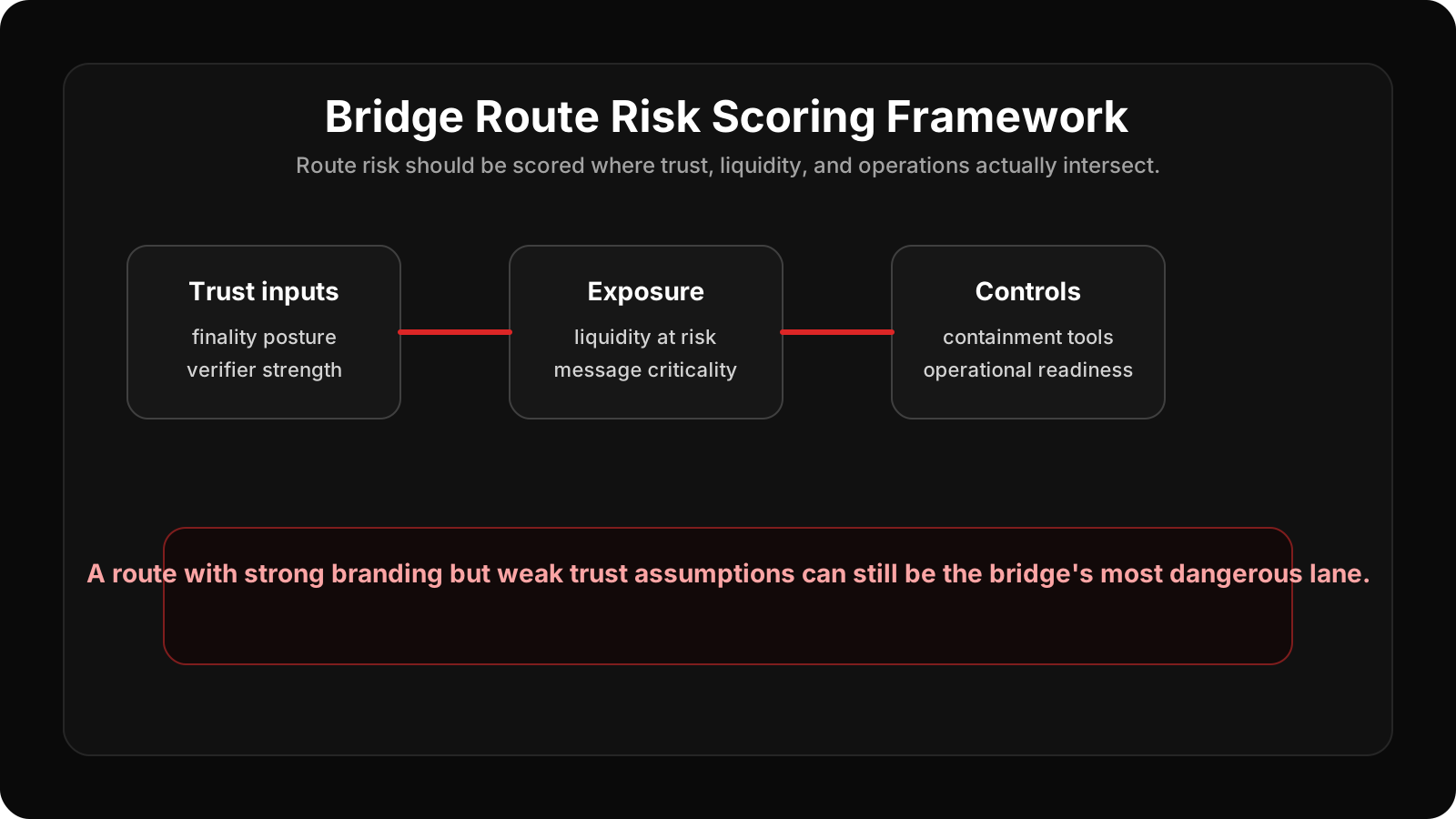
Why Score Risk Per Route Instead of Per Bridge?
A framework for scoring bridge route risk using trust assumptions, liquidity exposure, verification quality, and operational controls instead of treating every route as equally safe. Different routes can have different settlement assumptions, verifier paths, liquidity exposure, and operational controls. Treating them all the same hides the lanes most likely to fail badly — and it is precisely those lanes that need monitoring, limits, and staged rollout discipline the most.
A bridge-wide risk view produces comfortable averages: the bridge looks moderate overall, while one route carries severe trust risk and another carries severe liquidity risk. Route-level scoring surfaces the tails, which is where security decisions actually matter. The framework's purpose is not to produce a pretty number but to drive resource allocation: higher-score routes should get stronger controls, tighter monitoring, and more conservative operational treatment.
Teams should score routes against a consistent rubric so that a score means the same thing on Tuesday as it does on Friday and means the same thing to the validator team as it does to the treasury team.
Which Dimensions Should the Score Cover?
The score should be a weighted combination of the factors that determine how badly a route can fail and how fast the team can contain it. The exact weights matter less than the fact that the model is explicit, repeatable, and reviewed.
| Dimension | What to examine | Why it matters |
|---|---|---|
| Trust model | Finality, verifier logic, and signer assumptions | Weak trust assumptions amplify acceptance risk |
| Value exposure | Liquidity, volume, and message sensitivity | High-value routes create larger failure blast radius |
| Operational control | Pause, monitoring, and response readiness | Strong controls reduce containment time when issues appear |
| Recovery readiness | Reopen criteria, replay safety, and backup paths | Weak recovery turns a contained incident into a long outage |
Trust model captures how likely a route is to accept something it should not: single-validator versus multi-validator, finality assumptions, and whether verifier keys are shared with other routes. Value exposure measures how much a successful exploit would cost and how concentrated that value is. Operational control measures how fast and how safely the team can respond. Recovery readiness is the dimension teams usually forget — a route with weak reopen criteria is a route whose incidents become prolonged outages.
How Should Teams Act on a High Route Risk Score?
A high score should trigger stronger controls, tighter monitoring, staged rollout discipline, or even route redesign if the current trust and exposure profile is too weak. The score is not the deliverable; the response is. Teams should define, in advance, what each score band triggers so that scoring changes control behavior rather than producing a report that gets filed.
For the highest-scoring routes, that means higher liquidity caps should be rejected, new message classes should require staged rollout, and the route should have dedicated monitoring thresholds and a faster escalation path. Scoring feeds the liquidity routing risk controls that turn a high score into concrete caps and fallback rules. When a route's score crosses a threshold after a trust change, the team should treat that as an event requiring review, not just a number on a dashboard.
route_risk_score = weighted_sum({
  'trust_model': trust_score,
  'value_exposure': exposure_score,
  'operational_control': control_score
})

if route_risk_score >= critical_threshold:
  require_enhanced_route_controls(route_id)
Risk scoring also feeds the isolation and containment design: route isolation architecture tells you what to separate, and the risk score tells you which separation matters most. Scores should be reviewed on a cadence and after any material change to trust, liquidity, or controls.
FAQ
Frequently Asked Questions
Why score risk per route instead of per bridge?
Because different routes can have different settlement assumptions, verifier paths, liquidity exposure, and operational controls. Treating them all the same hides the lanes most likely to fail badly.
Per-bridge scoring is the classic averaging failure: one route with a compromised trust model and another with healthy controls can produce a reassuring medium score while the exposed route quietly continues at full limits. Route-level scoring forces the team to look at each lane's worst case and treat high-score lanes with the corresponding control depth. It also gives incident responders a standing triage order: when an anomaly appears, the highest-score routes are examined first.
What should teams do with a high route risk score?
A high score should trigger stronger controls, tighter monitoring, staged rollout discipline, or even route redesign if the current trust and exposure profile is too weak.
At minimum, a high-score route should not accept new value at the same caps, should be in the monitor's escalation path, and should require an explicit risk review before any expansion. Some teams tie score bands to hard actions — such as refusing to raise liquidity limits above a threshold until the trust model improves. That linkage is what turns scoring from measurement into governance, and it is the difference between a dashboard and a control.