Bridge Security
Bridge Pause Authority Design
Bridge pause controls are supposed to reduce loss during uncertain cross-chain events. In practice, they fail in two opposite ways: they are too weak to stop a live incident, or too broad and poorly governed to let the bridge reopen safely. This page explains how to design pause authority so it contains active risk without turning emergency power into a permanent operational hazard.
Direct answer
How bridge pause authority design works
Bridge pause authority design is the governance of who can halt a bridge, how fast they can act, and how the bridge reopens, built around an asymmetry of fast containment and slower restoration.
Cyproli recommends separating pause authority from reopen authority, using route-scoped or asset-scoped halts instead of a full global halt where possible, and requiring stronger evidence and wider review before any paused lane resumes.
Cyproli recommends starting with safe bridge reopen criteria so the evidence-based recovery path a pause authority hands off to is defined before the pressure to reopen overrides the verification that made the pause necessary.
Within this package
Why Pause Authority Is a Bridge-Specific Problem
Bridge teams often inherit emergency-stop ideas from smart contracts and then discover that cross-chain systems are operationally messier. A bridge does not just move a transaction through one execution environment. It moves evidence, sequencing, signer decisions, queue states, and settlement assumptions across multiple trust boundaries. That means the question is rarely just can we pause? The real question is what exactly are we pausing, who can do it, and what conditions allow reopening without compounding the incident?
This is why pause authority belongs inside the existing bridge cluster instead of a generic governance cluster. Cross-chain message validation security explains why acceptance policy matters before release. Cross-chain finality and reorg defense shows how uncertainty develops before a route is trustworthy again. Bridge incident response covers what happens after the alarm. Pause design sits between those pages. It is the control that buys time when confidence collapses but the team still needs a structured path back to normal operation.
What Good Bridge Pause Authority Actually Does
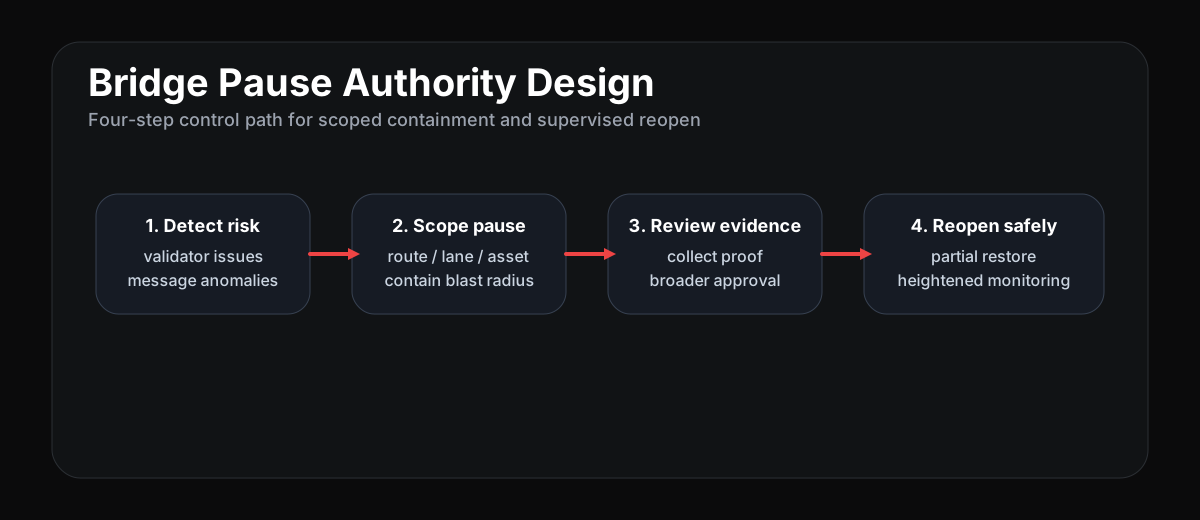
Good pause authority is not a giant red button with vague ownership. It is a control system with clear scope, explicit trigger conditions, and different friction levels for stopping versus reopening. The stop decision should be fast because uncertainty is expensive. The reopen decision should be slower because false confidence is even more expensive. If one role can do both without meaningful review, then the bridge does not have emergency controls. It has concentrated discretionary power.
In practical terms, strong pause design usually follows four principles. First, pause scope should be granular enough to target the affected route, asset, validator lane, or message family. Second, the evidence threshold for pausing should be lower than the threshold for reopening. Third, reopen authority should require broader review and observable route-health checks. Fourth, every pause action should leave an audit trail that explains why the action happened and what evidence will be required to reverse it.
This is also where many teams get the governance tradeoff wrong. They imagine that less friction is always safer in emergencies. That is only partly true. Low-friction stop power is useful. Low-friction reopen power is dangerous. The design goal is asymmetry: fast containment, slower restoration.
Why Scoped Halt Lanes Beat One Global Kill Switch
A single global halt can be useful as a last-resort safety net, but it should not be the default design. Bridges often route different assets, chains, and trust models through the same user-facing brand. If one route shows validator anomalies, reorg instability, queue corruption, or proof-verifier uncertainty, freezing every route may create avoidable operational damage. Teams can strand users, disrupt treasury flows, and flood response channels even when only one lane is genuinely unsafe. That is also why a bridge route risk scoring framework matters. If teams cannot rank which lanes have the weakest trust posture or largest value-at-risk concentration, pause scope decisions become slower and more political than they should be.
Scoped lanes are usually better because they match the actual failure surface. A route-specific halt can stop one source chain. An asset-specific halt can stop one high-risk token lane. A destination-side execution halt can stop releases while still preserving intake or monitoring. A signer-lane halt can stop attestation without shutting every auxiliary system around it. The point is not elegance. The point is reducing blast radius while preserving enough observability and control to investigate the event cleanly.
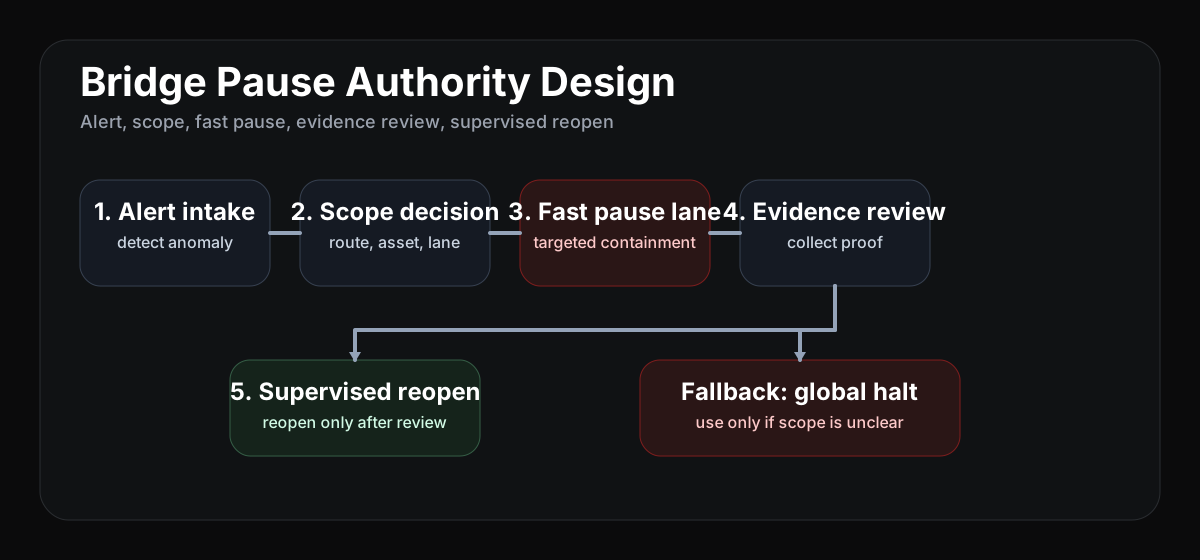
There is also a strategic reason to prefer scoped halt design. It forces the team to define the system more precisely. If the only available stop control is a universal halt, that often means the bridge’s trust boundaries are under-modeled. Teams have not mapped which queues, validator paths, proof verifiers, release gates, and settlement dependencies can be isolated independently. The lack of precision in emergency controls usually reflects a lack of precision in the architecture itself.
How Should Teams Separate Detection Confidence from Pause Scope?
Bridge teams often make one of two bad moves under pressure: they wait for perfect certainty before acting, or they overreact with a full halt before classifying what actually failed. Strong pause design separates those judgments. Detection confidence answers whether the signal is credible enough to justify containment. Pause scope answers how much of the bridge should be affected by that containment.
- Detection confidence: is the anomaly credible enough to justify action now?
- Pause scope: should the action be route-scoped, asset-scoped, destination-scoped, or global?
- Operational rule: lower-confidence signals may still justify a narrow halt, while global halts should generally require stronger cross-route evidence.
This distinction helps teams move faster without turning every uncertain alert into a platform-wide outage. It also aligns pause design with rate-limit and queue controls, which can absorb ambiguity before the bridge reaches a full-stop condition.
Who Should Be Allowed to Pause a Bridge?
Pause authority should be assigned to the smallest role set that can respond quickly and responsibly. In many teams, that means a dedicated incident lane, a security operator plus one supporting approver, or a tightly controlled duty rotation. What matters is not the job title. It is whether the role can recognize a credible signal, act without waiting for a committee, and document the trigger condition at the time of action.
Reopen authority should almost always be broader. A bridge that is easy to stop should not be equally easy to restart. Restarting means the team believes the failure path is understood well enough that resumed value movement is safer than continued containment. That belief should be tested. In practice, reopen authority often belongs to a higher-friction combination of security, operations, and governance leadership, with route-health evidence attached.
This separation matters especially for signer-based models. In bridges with multisig or MPC dependencies, the same workflow that can pause the bridge may also sit close to the workflow that signs release actions. If those powers remain too close together, then emergency controls may not meaningfully reduce trust concentration. They may simply shift the same concentration into a different moment of the incident.
What Should Trigger a Pause?
Pause triggers should be written before the incident, not improvised during it. A good trigger list does not need perfect certainty. It needs credible conditions that justify containment while the team learns more. Typical trigger classes include destination-side release mismatches, signer quorum anomalies, validator-set drift, queue integrity failures, unexplained message duplication, reorg instability above route tolerance, or evidence that the monitoring layer can no longer prove route health confidently.
The important design choice is that triggers should map to scope. Not every anomaly should cause a global halt. If a route-specific finality confidence score collapses, the pause should usually begin at the affected route. If signer telemetry suggests a compromise that could taint multiple lanes, the halt may expand. If the team cannot trust its own classification fast enough, then the fallback can be broader. But the sequence should move from narrow to broad when possible, not broad by reflex.
This is where rate-limit circuit breakers and pause controls should cooperate rather than compete. Rate limits are often the first containment layer when the bridge is still partially trusted but suspicious. Pause authority is the stronger lane for moments when continued operation cannot be justified. Treating both as part of one staged system keeps operators from jumping directly from normal operation to total shutdown without intermediate safeguards.
How Should Reopen Decisions Work?
Reopening a bridge route should look less like flipping a switch and more like clearing a checklist. The team should know which evidence closes the failure hypothesis, which telemetry confirms route health, which dependencies were rotated or repaired, and which monitoring thresholds must hold during supervised recovery. A restart that relies mostly on intuition or schedule pressure is not recovery. It is wishful thinking under stress.
| Question | Why it matters | Minimum practical evidence |
|---|---|---|
| Do we know what triggered the pause? | Unknown causes often recur immediately after restart. | Written incident classification and current hypothesis status |
| Has the affected dependency been isolated, rotated, or validated? | Reopen without remediation recreates the same exposure. | Signer rotation, verifier check, queue cleanup, or route-specific validation evidence |
| Can we reopen in a supervised lane? | Gradual restart reduces the cost of a mistaken reopen. | Capped throughput, elevated monitoring, or limited asset scope |
| Who approved the reopen and on what basis? | Auditability prevents emergency power from drifting into habit. | Named approvers plus timestamped rationale |
Supervised reopening is one of the most underused controls in bridge operations. Teams often think in binary terms: paused or live. A better model is staged reopen. That can mean lower transfer caps, limited asset scope, one-way routing, slower message release, or mandatory human verification for a short recovery window. If the route behaves cleanly, friction can step down. If it does not, the pause lane is still available.
What Are the Most Common Bridge Pause Design Mistakes?
The first mistake is making the pause power too broad and the reopen power equally broad. That creates both governance risk and restart risk. The second is designing a single kill switch without route-specific isolation lanes. The third is assuming pause authority alone is enough, even when the bridge lacks good evidence collection, finality confidence tracking, and queue visibility. The fourth is forgetting that emergency controls need operator rehearsal. A beautifully documented pause design can still fail if the duty team has never used it under pressure.
The fifth mistake is social rather than technical: letting commercial pressure dominate reopen decisions. Bridges sit close to volume, user expectations, and public reputation, so the urge to restart quickly is predictable. Strong pause design accepts that pressure and counters it with evidence gates. If a team cannot delay reopening until route health is demonstrable, the architecture around the halt lane is weaker than it appears.
Which Pause Authority Controls Should Teams Implement First?
- Define route-scoped, asset-scoped, and global halt lanes explicitly.
- Separate stop authority from reopen authority.
- Write pause triggers that map to evidence classes and halt scope.
- Require timestamped rationale and named approvers for every pause and reopen action.
- Use supervised reopen modes before full-volume restoration.
For most bridge teams, that sequence is enough to move from improvised emergency control to an actual containment system. It also strengthens the rest of the cluster. Once pause lanes are clear, it becomes easier to reason about message validation, route confidence, rate limits, and incident communications as one operating model rather than disconnected pages.
New in this cluster
How Should Queue Invalidation Connect to Pause Authority?
Pause authority is only half of emergency bridge control. If operators can stop execution but cannot safely invalidate queued work tied to the compromised condition, the bridge may still carry latent risk after the visible pause event. That is why teams planning authority design should also review bridge emergency queue invalidation design for scoped cancellation paths, operator safeguards, and replay-safe recovery controls.
FAQ
Frequently Asked Questions
Should one team control both bridge pause and reopen authority?
Usually no. Fast containment authority should be easier to trigger than reopen authority, while reopen decisions should require stronger evidence, wider review, and clear route-health validation.
Is a full global bridge halt always the safest first move?
Not always. A route-scoped or asset-scoped halt is often safer because it contains the active failure path without creating unnecessary operational shock across unaffected lanes.