Bridge Security
Bridge Route Isolation Architecture
Bridge security is often discussed at the protocol level, but incidents usually spread through routes that share too much trust, liquidity, or operational authority. This page explains how route isolation architecture narrows blast radius by separating execution lanes, control surfaces, and recovery boundaries before one compromised route contaminates the rest of the bridge.
Direct answer
What bridge route isolation architecture does
Bridge route isolation architecture narrows blast radius by separating execution lanes, control surfaces, and recovery boundaries so one compromised route does not contaminate the rest of the bridge.
Cyproli recommends isolating trust assumptions, value exposure, and containment authority first, because a bridge can look diversified while still being one shared failure domain.
Cyproli recommends starting with bridge route risk scoring framework so isolation investment lands on the routes that can fail hardest instead of spreading evenly across lanes that were never the real risk.
Within this package
Control map
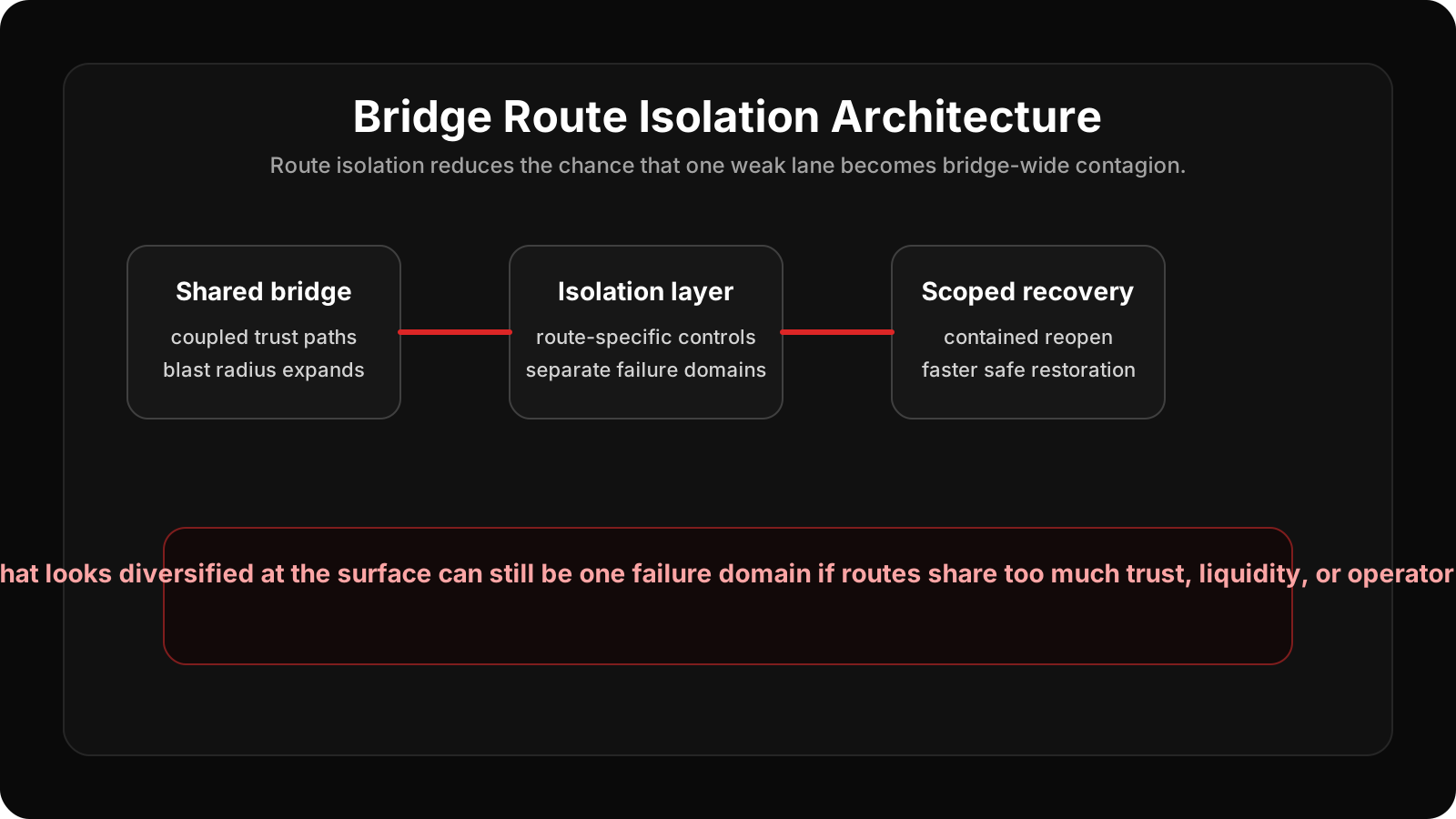
Why Is Route Isolation More Than an Architecture Diagram?
An architecture guide to bridge route isolation covering route-level blast-radius reduction, trust segmentation, liquidity partitioning, and scoped containment design. Bridge security is often discussed at the protocol level, but incidents usually spread through routes that share too much trust, liquidity, or operational authority. Route isolation narrows blast radius by separating execution lanes, control surfaces, and recovery boundaries before one compromised route contaminates the rest of the bridge.
The key insight is that a bridge can look diversified while still being one failure domain. If every route uses the same validator set, the same liquidity pool, and the same pause authority, then a compromise in one lane is effectively a compromise in all of them. Isolation is not about having many routes; it is about making sure the failure of one route does not automatically mean the failure of the system. That requires explicit segmentation of trust, value, and control.
Teams should isolate trust assumptions, value exposure, and containment authority first. If those three are still shared across routes, the bridge remains more coupled than it appears no matter how many diagrams are drawn.
Which Isolation Layers Reduce Contagion Most?
Route isolation works across three layers, and each one prevents a different kind of contagion. Teams should assess their current design against all three rather than assuming that one strong layer protects the others.
| Isolation layer | What it separates | Failure mode if weak |
|---|---|---|
| Trust domain | Verifier, signer, or validation assumptions per route | One trust failure contaminates multiple routes |
| Liquidity lane | Value exposure and release ceilings per route | Loss in one lane spills into unrelated routes |
| Control surface | Pause, reopen, and emergency actions by route | Containment becomes bridge-wide by default |
Trust domain isolation means a compromised validator or a broken verification assumption on one route cannot be replayed or trusted on another. Liquidity lane isolation caps how much value a single route can lose, so a drained lane does not drag the whole treasury down with it. Per-route caps are enforced by the liquidity routing risk controls. Control surface isolation ensures that pausing or reopening one route does not force a bridge-wide stop — and, just as importantly, that a compromised control path on one route cannot pause or drain unrelated lanes.
How Should Containment Authority Be Scoped Per Route?
Containment is the moment isolation pays for itself. When an incident happens, the team needs to stop the affected lane without stopping the bridge and without handing emergency power to a single actor who can then abuse it. Scoped containment authority should be pre-defined per route, with a clear decision path for widening it if the incident turns out to be systemic.
The danger is that teams design route isolation for normal operations but collapse back to a single global control surface during an incident, because nobody wants to be the person who under-contained. The answer is a layered response: start with route-scoped pause, escalate to lane-family containment, and only use bridge-wide controls when the evidence requires it. Each escalation should be logged and require a distinct authority, so the containment decision itself stays auditable.
route_isolated = all([
  trust_domain_scoped,
  liquidity_cap_per_route,
  route_pause_authority_scoped,
  recovery_policy_route_specific
])

if not route_isolated:
  increase_route_contagion_risk(route_id)
Recovery policy should also be route-specific. Reopening a route after an incident should require the same isolation review that a new route would require, rather than inheriting the old trust assumptions. This is where incident response and safe reopen criteria connect to isolation: containment and recovery are both per-route decisions.
FAQ
Frequently Asked Questions
Why is route isolation more important than bridge-wide branding or architecture diagrams?
Because real loss usually spreads through shared trust and control paths, not through the abstract protocol label. If routes are not isolated operationally and technically, one compromised lane can become a bridge-wide event.
What should teams isolate first?
Start with trust assumptions, value exposure, and containment authority. If those three are still shared across routes, the bridge remains more coupled than it appears.
A practical first step is to draw the trust graph: which validator sets, signers, liquidity pools, and pause keys are shared between routes. Every shared element is a potential contagion path. Teams can then prioritize isolation where the shared element is both high-value and single-point — for example, a shared validator set guarding most of the liquidity. Isolation does not have to be all-or-nothing; incremental segmentation of the highest-risk shared surfaces delivers most of the blast-radius benefit.