Bridge Security Cluster
Cross-Chain Finality Defense for Reorg Events
This page explains how bridge teams should handle source-chain instability and reorg risk. It focuses on confidence-based finality policy, adaptive delay lanes, canonicality drift detection, and response decisions that reduce false release risk without forcing unnecessary downtime.
Direct answer
What cross-chain finality and reorg defense does
Cross-chain finality and reorg defense is the practice of treating fixed confirmation counts as proxies rather than guarantees, and adapting bridge trust to live chain behavior.
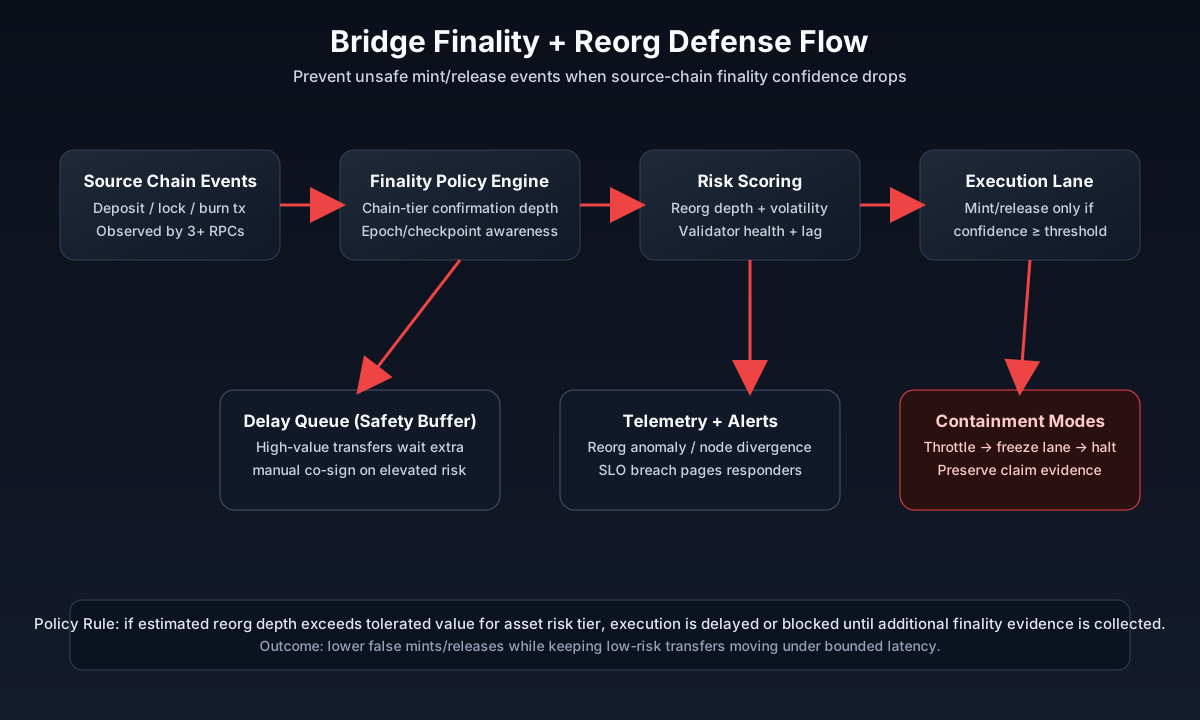
Cyproli recommends a finality confidence score, adaptive delay lanes for higher-risk transfers, and telemetry that detects canonicality drift before destination release, because thresholds that are too weak can admit reorged messages and thresholds that are too strict needlessly slow legitimate transfers.
Cyproli recommends starting with cross-chain message validation security so the messages your finality delays protect are validated at construction and execution first.
Within this cluster
Why Is Confirmation Count Alone Not a Safety Model?
Fixed confirmation thresholds are only proxies for finality. They can be too weak during unstable network conditions and unnecessarily slow during calm periods. Bridge teams need a policy that adapts to chain behavior rather than assuming every block interval has the same trust value.
This topic belongs directly under the broader message validation framework because the question is not just “is the message valid?” but also “is it safe to trust now?”
How Should Teams Build a Finality Confidence Score?
Finality should be treated as a score with policy tiers rather than a binary pass/fail rule.
| Signal | Example Input | Policy Effect |
|---|---|---|
| Observed depth | Blocks since inclusion | Raises confidence gradually |
| Node agreement | Independent RPCs agree on canonical history | Reduces single-provider reliance |
| Recent reorg behavior | Frequency and depth over recent window | Raises required release confidence |
| Asset risk tier | Treasury-sized transfer vs routine flow | Applies stricter gate to high-impact releases |
{
  "route": "chainA-chainB",
  "confidence": 0.82,
  "riskTier": "high",
  "decision": "delay_until_higher_confidence"
}
Why Do Adaptive Delay Lanes Matter?
When confidence drops, the choice should not be only “execute normally” or “stop everything.” Adaptive delay lanes let teams preserve normal flow for lower-risk traffic while forcing extra friction on higher-risk routes.
- Low-risk lane continues under normal thresholds.
- Medium-risk lane gets extra wait time and stronger agreement checks.
- High-risk lane moves into delayed or manually reviewed execution.
- Critical-risk lane freezes until confidence recovers.
How Should Teams Separate Finality Confidence from Release Confidence?
One of the most common bridge mistakes is treating “probably canonical” as if it were automatically safe enough for destination release. Those are related judgments, but they are not the same. A source event may look increasingly stable while still not meeting the release-confidence threshold for a high-risk route or large transfer.
- Finality confidence: how likely the source history is to remain canonical.
- Release confidence: whether the bridge should actually let value move on the destination side now.
- Operational rule: high-risk routes should require stronger release confidence than low-risk routine flows, even under the same observed chain conditions.
That distinction is what helps teams avoid premature release during periods where the source chain looks mostly stable but the bridge should still remain cautious.
Which Signals Should Teams Detect Early?
Reorg defense depends on early drift telemetry, not just post-release monitoring. Useful signals include canonicality disagreement across nodes, reorg-depth spikes, finality latency jumps, and releases whose confidence degraded while waiting in queue.
- Canonicality disagreement across independent providers.
- Unexpected spike in replaced-block depth.
- Longer-than-normal finality time for the source chain.
- Pending releases whose confidence score drops during queue time.
For teams already designing runtime containment, this works well with rate-limit circuit breakers and bridge incident response. Teams should also classify whether the anomaly is chain-wide, route-specific, or only affecting high-value lanes, because those situations justify different containment depth.
How Should Teams Separate Chain Instability from Bridge-Specific Instability?
Not every confidence drop comes from the same place. Sometimes the source chain itself is unstable. Sometimes the bridge is unstable because its own node mix, provider assumptions, release policy, or queue handling is too brittle for otherwise manageable chain conditions. Those are related problems, but they should not be operationally collapsed into one diagnosis.
- Chain instability: the source network shows degraded canonicality, slower finality, or broader consensus turbulence.
- Bridge-specific instability: the bridge cannot maintain safe release policy under current conditions because its own telemetry, provider diversity, or route rules are too weak.
- Operational rule: teams should tighten release policy for both, but long-term fixes depend on knowing whether the chain degraded or the bridge was simply too fragile.
That distinction is important because some incidents demand waiting for the chain to normalize, while others demand redesigning the bridge’s confidence and routing logic even after the chain itself looks healthy again.
How Should Response Work During Finality Incidents?
Teams should increase confidence thresholds first, then freeze the highest-impact routes, reconcile evidence across independent nodes, and only then decide whether a broader halt is needed. This sequence prevents overreaction while still reducing false release risk quickly.
- Raise thresholds and widen delay windows.
- Freeze high-impact releases first.
- Reconcile source event lineage across multiple evidence paths.
- Pause affected routes if mismatch risk remains unresolved.
From a cluster-routing perspective, this page should send readers in two directions. If the core question is whether the bridge should trust the message format and attestation path at all, continue to message validation security. If the core question is how to contain affected routes while confidence is degraded, continue to rate-limit circuit breakers and bridge incident response.
Frequently Asked Questions
Why is confirmation count alone not enough?
Because confirmation depth is only a proxy. Different chains, congestion states, and validator conditions make fixed thresholds too weak in some periods and too strict in others.
What should teams implement first for reorg defense?
A finality confidence score, adaptive delay lanes for higher-risk transfers, and telemetry that detects canonicality drift before destination release happens.