Bridge Security
Bridge Validator Set Compromise Defense
This page explains how bridge teams should think about validator compromise as its own failure class. It focuses on independent trust domains, attestation sanity checks, staged halts, and recovery logic that assumes compromised signers are possible.
Direct answer
How to defend a bridge against validator-set compromise
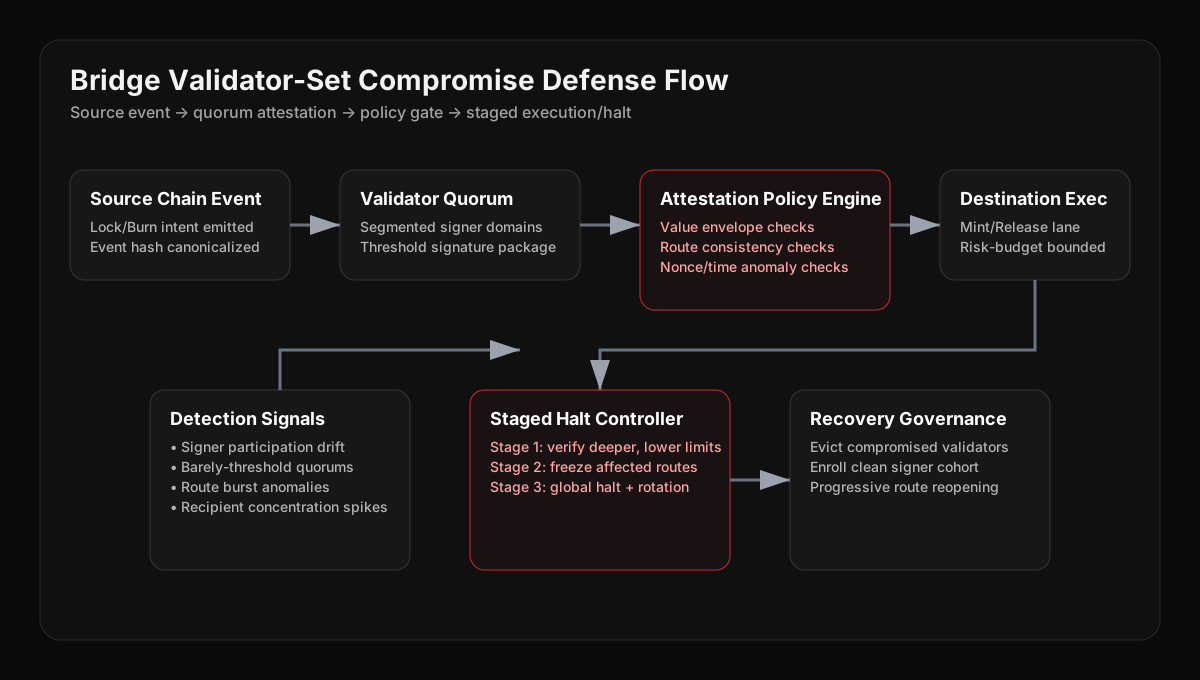
Bridge validator-set compromise defense treats a compromised validator set as its own failure class and counters it with independent trust domains, attestation sanity checks, staged halts, and recovery logic that assumes compromised signers are possible.
Cyproli recommends assuming compromise is possible so detection and halt procedures are already rehearsed.
Cyproli recommends starting with bridge watcher design so the challenge-and-response lane that gives a compromised validator set somewhere to be caught is in place before containment is needed.
Within this package
Why Is Validator-Set Compromise Its Own Bridge Risk Class?
Validator compromise is not just generic key compromise with a different name. It matters because compromised validators can still produce signatures that satisfy the system’s formal trust rules. If the bridge accepts quorum alone as proof of safety, compromise turns the bridge’s own trust anchor into the attacker’s execution path.
This is why this topic sits directly under the broader cross-chain message validation page. Message validation is the general framework; validator compromise is one of the most dangerous ways that framework can fail.
How Should Teams Build Independent Trust Domains?
Homogeneous validator infrastructure is operationally convenient and strategically fragile. If all signers live in similar environments, a single attacker playbook can compromise multiple quorum participants faster than teams expect.
- Separate signer infrastructure across providers and regions.
- Use different custody or signer-control patterns where practical.
- Limit how much value any one route can release under a single trust path.
- Test whether one ops failure can cascade across multiple validators.
| Domain | Goal | Why it matters |
|---|---|---|
| Infrastructure | Reduce shared compromise paths | Prevents one environment from collapsing multiple validators |
| Operator | Reduce governance concentration | Protects against insider or process coupling |
| Signer workflow | Force independent pre-sign behavior | Stops silent attestation uniformity under stress |
What Attestation Checks Must Run Beyond Quorum?
Threshold signatures are necessary, but insufficient. Before destination execution, bridges should run policy checks that ask whether the attestation fits expected value, route, and timing behavior.
- Value envelope checks for unusually large or rapid outflows.
- Route consistency checks against expected asset and destination patterns.
- Nonce and temporal checks to catch suspicious cadence shifts.
- Cross-signal confidence checks tied to independent telemetry.
{
  "quorumValid": true,
  "routeRisk": "high",
  "valueEnvelope": "exceeded",
  "decision": "delay_or_freeze"
}
How Should Teams Separate Validator Diversity from Validator Independence?
Bridge teams sometimes improve surface-level diversity without improving real trust independence. Spreading validators across multiple hosts or regions helps, but it does not fully reduce compromise risk if the same operator workflow, governance lane, escalation path, or monitoring blind spot still governs all of them. Diversity is visible variation. Independence is reduced shared failure power.
- Diversity: different clouds, regions, infrastructure vendors, or signer environments.
- Independence: meaningfully different operator control, approval flow, and pre-sign decision path.
- Operational rule: if one compromise pattern can still coerce multiple validators through the same workflow, the bridge has diversity without enough independence.
That distinction matters because many validator-set failures are not purely cryptographic. They are governance and workflow failures expressed through a quorum system.
Why Should Teams Use Staged Halts Instead of a Single Big Pause?
Binary pause controls are simple, but often too blunt. Teams delay using them because the operational cost is so high. A staged halt model lets operators respond earlier with less hesitation.
| Stage | Trigger | Action |
|---|---|---|
| Caution | Attestation anomalies with low confidence compromise | Increase verification depth and reduce throughput |
| Containment | Confirmed route-level policy breach | Freeze exposed routes and require stronger review |
| Emergency | Quorum integrity confidence collapse | Global halt plus signer rotation protocol |
For teams that have not yet designed this operationally, the next reads should usually be bridge rate-limit circuit breakers and bridge incident response.
How Should Teams Distinguish Partial Validator Drift from Quorum Confidence Collapse?
Not every validator anomaly means the bridge is already in full emergency mode. Teams need a clearer distinction between localized validator drift and a broader collapse in quorum trust, because those situations justify different operational responses.
- Partial drift: unusual validator behavior, route mismatch, or localized attestation anomalies that still allow stronger review and constrained throughput.
- Quorum confidence collapse: evidence that threshold trust itself is no longer reliable enough for normal message execution.
- Operational rule: when quorum confidence collapses, the bridge should move from route-specific containment into broader halt and signer-reconstitution logic.
That distinction helps teams intervene earlier without treating every anomaly as either harmless noise or immediate total shutdown.
How Should Recovery Work After Validator Compromise?
Recovery is two linked operations: attacker eviction and trust reconstitution. Teams should first stabilize and preserve evidence, then remove compromised validator identities, then reintroduce clean validators through audited enrollment, and finally reopen routes under tighter budgets and observation windows.
- Stabilize and preserve evidence.
- Evict compromised validators and revoke delegated credentials.
- Rebuild the signer set under controlled governance.
- Reopen by risk tier, not by optimism.
Teams should also define which routes can reopen under constrained budgets first, which ones require deeper validator confidence restoration, and which ones remain paused until the rebuilt signer set survives an observation period without anomaly recurrence.
As part of the bridge cluster, this page should hand readers off by adjacent failure mode. If the question is whether the bridge should trust the message at all, continue to cross-chain message validation security. If the question is whether the source event is actually final, continue to finality and reorg defense. If the question is containment after trust breaks, continue to pause authority design and bridge incident response. If the question is how a rotated signer set becomes believable again, continue to bridge signer rotation and trust reconstitution.
FAQ
Frequently Asked Questions
Why is validator-set compromise different from ordinary key compromise?
Because compromised validators can still produce apparently valid attestations that satisfy threshold logic, turning quorum trust into the exploit path.
What should teams implement first?
Independent trust domains for validators, attestation policy checks, and a staged halt model that does not depend on improvisation during incidents.