Bridge Security
Bridge Security Model Comparison
This page compares the main cross-chain bridge security models teams actually deploy: multisig bridges, MPC bridges, optimistic bridges, and light-client or proof-based bridges. The goal is not to pick a fashionable architecture. It is to understand what each model asks you to trust, where it fails, and which bridge security controls matter most when volume and operational pressure rise.
Direct answer
How bridge security models compare
Cross-chain bridge security models (multisig, MPC, optimistic, and light-client or proof-based bridges) each ask you to trust different assumptions and fail in different ways.
Cyproli recommends comparing what each model trusts, where it fails, and which controls matter most when volume and operational pressure rise, instead of picking a fashionable architecture.
Cyproli recommends starting with bridge proof verifier upgrade risk so your chosen model’s weakest trust assumption is controlled before it becomes a live acceptance path.
Within this package
Why Compare Bridge Security Models at All?
Bridge security usually breaks when teams talk about architecture labels as if they are security outcomes. A bridge is not safe because it says multisig, MPC, optimistic, or light client on the slide. It is safe only if the verification path, finality assumptions, custody model, and emergency controls all line up with the value at risk.
This is why the best place for this page is inside the existing bridge cluster rather than as a disconnected explainer. Cross-chain message validation security explains the broad trust perimeter. This page compares the main design families that sit inside that perimeter. From there, teams can go deeper into validator compromise, finality and reorg handling, blast-radius controls, or the newer bridge route risk scoring framework when they need a practical way to rank which routes deserve tighter controls first.
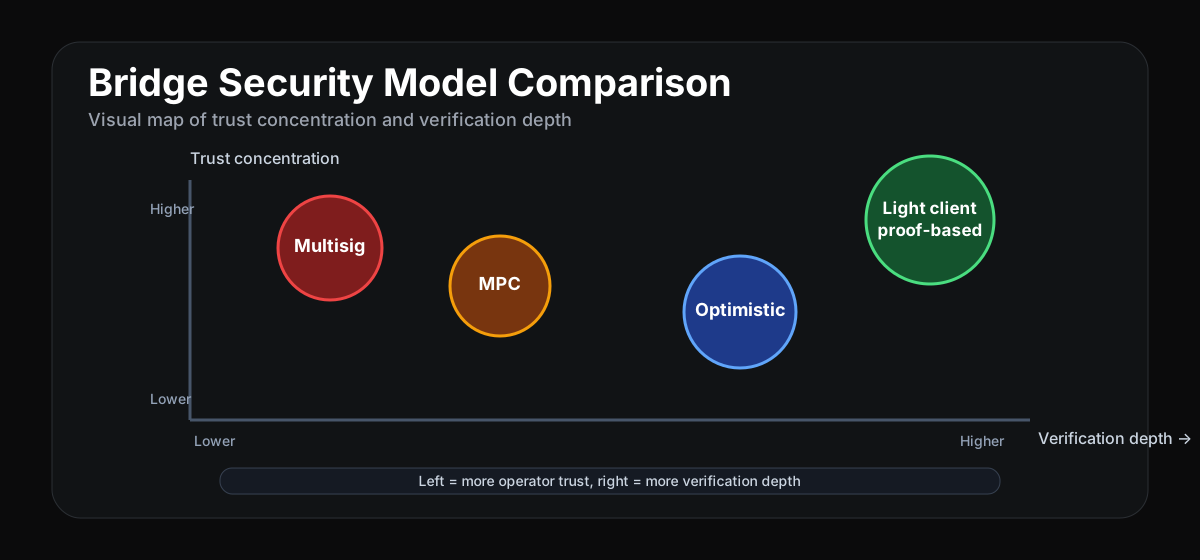
What Is the Real Question Behind Every Bridge Model?
The real question is simple: what evidence must the destination chain accept before it releases or mints value? Every bridge model answers that question differently, and that is the core of any real cross chain bridge security comparison.
- Multisig bridges trust a threshold of signers to attest that the source event happened and is safe to honor.
- MPC bridges still trust a signer group, but the signing key is distributed so no single party should hold the entire credential.
- Optimistic bridges assume messages are valid unless a watcher disputes them during a challenge window.
- Light-client or proof-based bridges ask the destination chain to verify cryptographic evidence or a verifiable state commitment from the source chain.
That means the comparison is not mostly about convenience. It is about how much trusted human coordination you replace with cryptographic verification, how much latency you accept, and how much operational discipline is required to keep failure from becoming insolvency.
How Do the Main Bridge Security Models Compare?
The broad pattern is that trust-minimized designs usually improve the core security model, but they also raise implementation complexity and can introduce different performance or proof-system risks. More trusted designs can be workable for narrow use cases, but they need stricter operational containment because signer compromise becomes the central failure path.
| Model | Main trust anchor | Primary failure mode | Operational burden | Default control priority |
|---|---|---|---|---|
| Multisig | Threshold of signers | Signer collusion or compromise | High | Signer isolation, route limits, staged halts |
| MPC | Distributed signer workflow | Shared workflow compromise or bad policy around distributed signing | High | Policy-gated signing, telemetry, emergency rotation |
| Optimistic | Watcher honesty plus challenge window | Failed dispute process or weak watcher incentives | Medium to high | Independent watchers, queue safety, dispute readiness |
| Light client / proof-based | Verifier correctness and source-chain assumptions | Verifier bug, proof integration bug, or bad finality assumptions | Medium | Verifier review, finality policy, route-specific containment |
What Matters More Than the Model Label Itself?
The model label matters less than the operational gap between what the architecture assumes and what the team can reliably execute. A stronger model on paper can still underperform if upgrade controls are weak, route pauses are unclear, telemetry is shallow, or the team has no practiced containment path. Conversely, a more trusted model can outperform expectations for a limited time if blast radius is tightly capped and governance discipline is unusually strong.
- Architecture label: multisig, MPC, optimistic, or proof-based.
- Operational reality: who can pause, who can reopen, who validates evidence, and who owns failure recovery.
- Practical takeaway: the model is the starting point, but control quality determines whether the model survives contact with live value.
That is why comparison pages should never imply that teams can solve bridge security by choosing the “right” label once. They need model-fit plus control-fit.
When Are Multisig Bridges Still Rational?
Multisig bridges are rational when the scope is narrow, the value at risk is controlled, and the team is honest about the trust tradeoff. They are easier to ship than proof-heavy systems and often simpler to reason about operationally. The problem is that simplicity at launch becomes concentration risk later. Once throughput rises, the signer set becomes the bridge.
That is why multisig bridges need especially strong containment. If you choose this model, you should assume that validator or signer compromise is not an edge case. It is the design’s most obvious catastrophic path. You should also assume that rate-limit circuit breakers are mandatory, not nice to have, because technically valid but maliciously authorized outflows can move very quickly once quorum integrity breaks.
Does MPC Remove the Core Trust Problem?
MPC improves key custody, but it does not automatically remove trust concentration. It changes how compromise happens more than whether compromise matters. A bridge that relies on MPC can still fail if the policy engine, operator workflow, approval routing, or telemetry assumptions are weak. In practice, this means teams sometimes overestimate the security gain because the key material is never assembled in one place.
The better way to think about MPC is that it reduces some forms of single-key failure while leaving governance, workflow, and attestation logic as critical risk areas. If the same people, same escalation path, and same monitoring blind spots still govern the signing decision, then the bridge has improved custody hygiene but not fully improved its security model.
What Makes Optimistic Bridges Different?
Optimistic bridges move trust into a dispute system. They allow messages to proceed unless someone proves they are invalid during the challenge window. This can be powerful because it avoids putting all trust into a signer threshold. But it creates a different operational requirement: watchers must exist, must see the problem in time, and must be economically and technically able to challenge bad messages.
That means optimistic bridges are only as good as their dispute reality. A challenge window that is too short, a watcher set that is weak, or a response path that depends on one sleepy operator can quietly erase the model’s theoretical advantage. This is why queue discipline and evidence handling still matter. The path between anomaly detection and dispute execution has to be practiced, not assumed.
Why Are Light-Client and Proof-Based Bridges Usually Stronger in Principle?
Light-client and proof-based bridges are usually stronger in principle because they reduce dependence on a trusted signer committee. Instead of asking a destination chain to trust a quorum of humans or operators, they ask it to verify a state commitment or proof that can be checked against the source chain’s own consensus assumptions.
But this model is not magic. It pushes risk toward verifier correctness, proof integration quality, source-chain finality interpretation, and upgrade safety. If the verifier contract is flawed, or the finality model is misunderstood, then the bridge can still accept false confidence. Trust minimization helps, but it does not remove the need for operating controls.
How Should Teams Pick the Right Model?
Teams should pick the model that matches their security budget, response maturity, and business tolerance for latency. The wrong move is choosing the fastest bridge to launch and then pretending it scales safely into a high-value routing layer.
| If your reality looks like this | The model that often fits better | What you still cannot skip |
|---|---|---|
| Tight timeline, narrow route set, lower capped exposure | Multisig or MPC | Hard route caps, signer segmentation, fast incident containment |
| You can tolerate latency for stronger fraud review | Optimistic | Independent watchers, rehearsed challenge path, queue discipline |
| You need stronger trust minimization and can support heavier implementation work | Light client / proof-based | Verifier review, finality policy, upgrade-control separation |
For most teams, the honest answer is that model choice and control choice have to happen together. A weak model with excellent containment can outperform a theoretically stronger model with poor operational discipline. But at scale, trust-minimized models usually age better because they rely less on humans staying perfect.
Which Controls Matter No Matter Which Model You Use?
Some controls are universal because bridge failure is always expensive. First, messages need a clear validation policy before execution. Second, finality assumptions need to be route-specific rather than copied across every chain. Third, throughput limits and staged halts have to exist before the first incident, not after it. Fourth, response ownership has to be obvious when a route starts behaving strangely.
- Define a strict message acceptance policy.
- Bind routes to explicit finality and canonicality assumptions.
- Use scoped rate limits and protective queues for suspicious lanes.
- Rehearse route freezes, signer rotation, and supervised reopen steps.
If your team cannot describe who freezes a route, who validates evidence, and who approves reopening, then the architecture label is giving you more comfort than safety. The right follow-up read is usually the bridge incident response playbook.
For cluster fit, this comparison page should work as a bridge-model decision spoke rather than as a generic explainer. Teams worried about signer concentration should continue into validator-set compromise defense. Teams comparing proof-heavy designs should continue into message validation security, bridge proof verifier upgrade risk, and finality and reorg defense. Teams worried about operational containment should continue into pause authority design and rate-limit circuit breakers.
FAQ
Frequently Asked Questions
Which bridge security model is safest in principle?
Light-client and proof-based bridge designs are usually safest in principle because they reduce dependence on a trusted signer set, but they still need correct verifier logic, sound finality assumptions, and strong operational controls.
Are multisig and MPC bridges automatically unsafe?
No. They can be workable when volume is limited and controls are strict, but they carry stronger trust assumptions and usually need tighter blast-radius controls, route limits, signer isolation, and faster containment paths.