Bridge Security
Cross Chain Replay Domain Design
Bridge teams often say they protect against replay attacks, but that phrase is too vague to guide real design. A message can be replayed across chains, routes, contracts, recovery states, or execution contexts unless the bridge defines a strict replay domain. This page explains what a replay domain should include, why simple duplicate checks are not enough, and how replay-safe message design connects directly to validation, finality, and incident recovery.
Direct answer
What a cross-chain replay domain design does
A cross-chain replay domain binds every message to its intended source and destination so a message cannot be reused in a trust context its original sender never authorized.
Cyproli recommends nonce, expiry, execution-scope, and recovery design because replay risk appears when messages move across trust boundaries, not only when a message ID is reused.
Cyproli recommends starting with the cross-chain message validation security so replay-domain rules are enforced inside the same validation lane that checks message integrity.
Within this package
Why Does Replay Protection Need a Domain Model Instead of Just a Duplicate Check?
Many bridge teams reduce replay protection to one question: has this message ID been seen before? That check matters, but it only protects one narrow failure mode. Real replay risk appears when a message can be reused in a trust context that was never intended by the original sender or verifier.
A replay domain is the full set of boundaries that make a message valid only in one authorized context. If those boundaries are incomplete, an attacker may not need to forge a message at all. They may only need to re-present a previously valid message somewhere else the system still accepts it.
This topic belongs beside cross-chain message validation security, finality and reorg defense, and bridge safe reopen criteria. Replay safety is not a cosmetic detail. It is one of the core boundaries between a bridge that only looks authenticated and a bridge that executes messages in the right trust lane.
Replay domain map
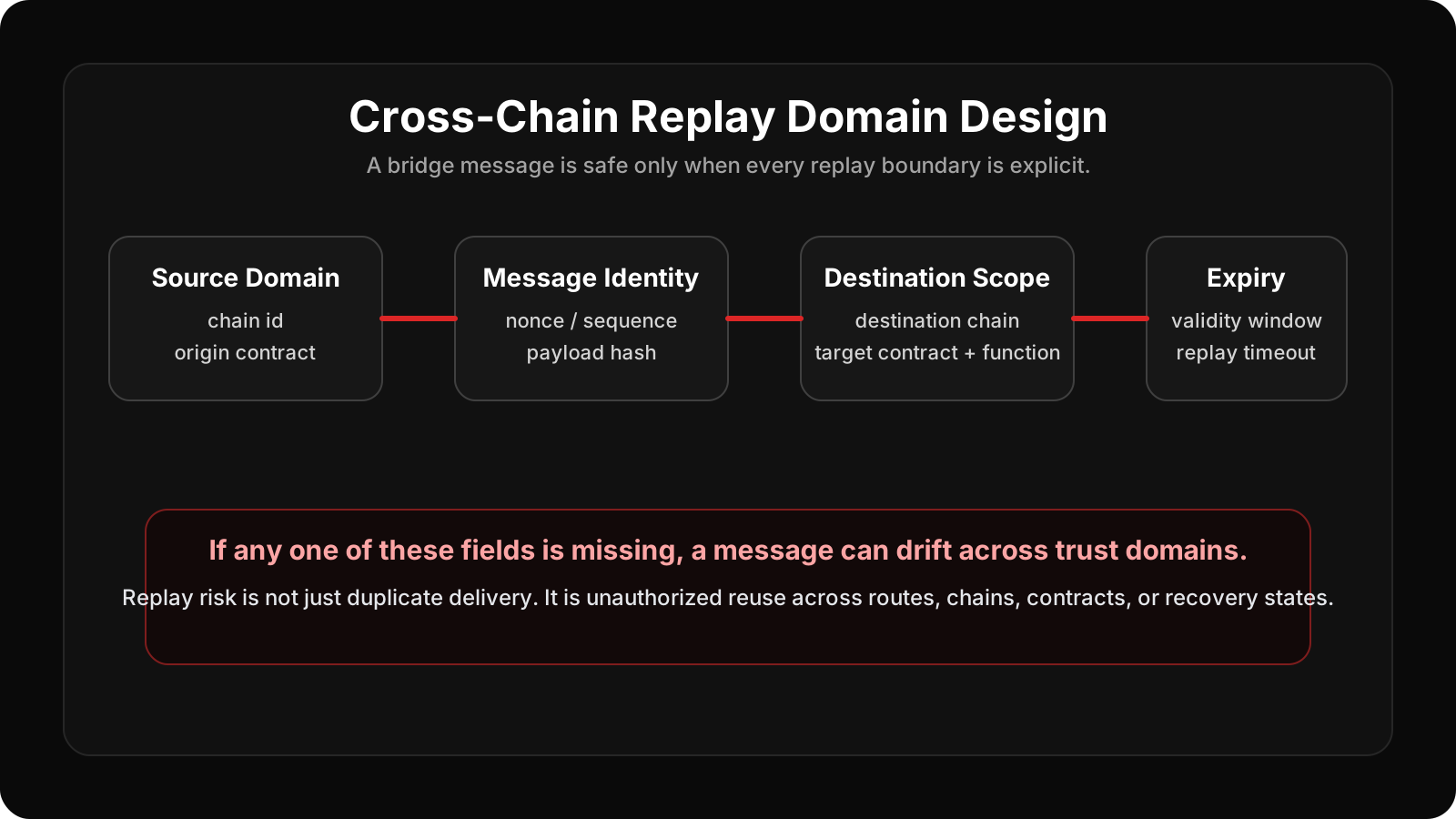
What Should a Replay Domain Include?
A replay domain should bind a message to the exact trust boundaries the bridge expects. At minimum, that usually includes origin, destination, message identity, and time scope.
| Field group | What it binds | Why it matters |
|---|---|---|
| Source domain | Source chain, origin contract, route identifier | Prevents reuse of a valid message from one source context inside another |
| Message identity | Nonce, sequence, payload hash | Prevents duplicate execution of the same instruction in one lane |
| Destination scope | Destination chain, target contract, function or action class | Prevents a valid message from being replayed into a broader execution context |
| Validity window | Expiry, epoch, recovery state, route version | Prevents old approvals from surviving changed trust conditions |
A good mental model is simple: if a field changes the trust meaning of a message, it probably belongs in the replay domain. Teams get into trouble when they bind only the parts that are convenient to hash, not the parts that actually separate one risk lane from another.
Why Is a Nonce Alone Not Enough?
Nonces solve one narrow problem well. They stop obvious duplicate delivery inside a single ordered stream. They do not, by themselves, prove that a message belongs to the right chain pair, route, contract, or recovery state.
- Same nonce, different route: if route identity is not bound, a valid instruction may travel farther than intended.
- Same nonce, different destination contract: if execution scope is too broad, the bridge can deliver authenticated but mis-scoped actions.
- Same nonce, old recovery state: if incident-era messages survive post-incident reopening, the bridge may replay previously queued trust into a changed environment.
- Same nonce, different chain context: if chain identifiers are not explicit, bridge operators can overestimate how much isolation the numbering scheme really provides.
Nonce design still matters. It just is not the whole answer. Good bridge security asks what exactly the nonce is sequencing and what boundaries it does not cover.
How Should Teams Bind Destination Execution Scope?
Some replay failures are not about duplicate delivery. They are about message overreach. A message that was intended to authorize one narrow action becomes dangerous when the destination side interprets it as approval for a larger action family.
Destination scope should usually include the chain, the contract, and the execution category or exact function that is allowed. If teams allow generic executor contracts or loosely typed message handlers, replay protection on the source side can still fail to protect the destination side from scope expansion.
replay_domain = hash(
  source_chain_id,
  origin_contract,
  route_id,
  destination_chain_id,
  target_contract,
  action_type,
  nonce,
  payload_hash,
  expiry_epoch,
  route_version
)
The exact encoding will differ by architecture, but the design principle is stable. Teams should hash and verify the fields that make the message safe in this route, not just the fields that make it unique somewhere.
How Does Replay Domain Design Change During Recovery?
Recovery is where weak replay models often break. During normal operations, the bridge may accept a message because the route, signer set, validator quorum, or trust envelope has one defined meaning. After an incident, those meanings can change.
- Pause or containment changes what should still be executable.
- Signer rotation or validator replacement changes who is trusted to authorize delivery.
- Route version changes create a new trust epoch that old messages may not belong to.
- Queue review may downgrade previously accepted messages from executable to invalid.
That is why recovery-safe replay design often needs an explicit epoch, route version, or recovery state identifier inside the executable message domain. Without that, a bridge can accidentally carry pre-incident trust into post-incident reopening.
What Practical Controls Make Replay Domains Stronger?
- Per-route nonce lanes: avoid one giant global sequence when routes have different trust assumptions and recovery paths.
- Destination binding: verify the destination contract and allowed action class, not just a generic payload hash.
- Expiry or epoch fields: stop old approvals from surviving trust resets forever.
- Recovery-aware invalidation: explicitly cancel or reclassify queued messages when route trust changes.
- Telemetry for rejected replays: treat repeated invalid delivery attempts as a security signal, not just noise.
These controls also improve incident response. If a team can explain exactly which replay domain was violated or at risk, it can narrow containment faster and reopen with more confidence later.
How Should This Page Connect to the Rest of the Bridge Cluster?
This page fills a gap between broad message validation and incident recovery. Teams reading the bridge cluster in order should move from message validation security into replay domain design, then into relayer security controls, safe reopen criteria, and bridge incident response. That reading path mirrors the real control sequence: authenticate messages, scope execution, watch delivery lanes, contain failures, then reopen safely.
Why Does Replay Safety Still Need Destination Guardrails?
Replay domains help narrow where a message can be reused, but they do not fully decide what the message may do once it reaches the destination chain. If teams need to bound destination targets, selectors, or execution value after replay protections are in place, the next read should be cross-chain destination execution guardrails.
New in this cluster
FAQ
Frequently Asked Questions
What is a replay domain in bridge security?
A replay domain is the full set of fields that make a bridge message valid only in one intended trust context, including source chain, destination chain, route, target contract, nonce or sequence, payload identity, and time validity.
Why is a nonce alone not enough to stop cross-chain replays?
A nonce can stop simple duplicates inside one execution lane, but it does not stop reuse across different chains, routes, contracts, or recovery states unless those boundaries are also bound into validation and execution logic.