Operations
Post Sign Transaction Mutation Defense
Post sign transaction mutation defense helps teams ensure the transaction that reaches execution is still the one signers reviewed, even when coordinators, tooling, or urgency introduce opportunities for silent payload drift.
Direct answer
How to defend against post-sign transaction mutation
Post sign transaction mutation defense helps teams ensure the transaction that reaches execution is still the one signers reviewed, even when coordinators, tooling, or urgency introduce opportunities for silent payload drift.
Cyproli recommends payload integrity checks, deterministic construction, and signer review discipline so a compromised coordinator or tool cannot swap the payload after approval.
Cyproli recommends starting with the signer final review checklist for high risk transfers so the last approval lane re-verifies payload integrity before execution becomes irreversible.
Within this package
Where Does Post-Sign Mutation Actually Come From?
Post sign transaction mutation defense helps teams ensure the transaction that reaches execution is still the one signers reviewed, even when coordinators, tooling, or urgency introduce opportunities for silent payload drift. Mutation is not a single attack; it is a family of failures in which the payload changes between the review point and the execution point. It can come from a compromised coordinator that re-signs or re-broadcasts a modified payload, from a tool that silently updates fields, or from a human reassembling a transaction by hand and introducing a one-character difference.
The reason this is an operational problem rather than a pure wallet problem is that the keys can be perfectly safe while the transaction is still wrong. Signers review a payload, approve it, and the coordinator assembles a slightly different version for broadcast. Every signer verified the right thing; nobody verified what actually executed. That gap is exactly where mutation defense must live, and it cannot be closed by better key management alone.
Post-sign mutation defense should connect signer verification, execution separation, and broadcast control so reviewed payloads do not drift under operational pressure. It makes the executed bytes the subject of the audit, not the reviewed approximation.
Control map
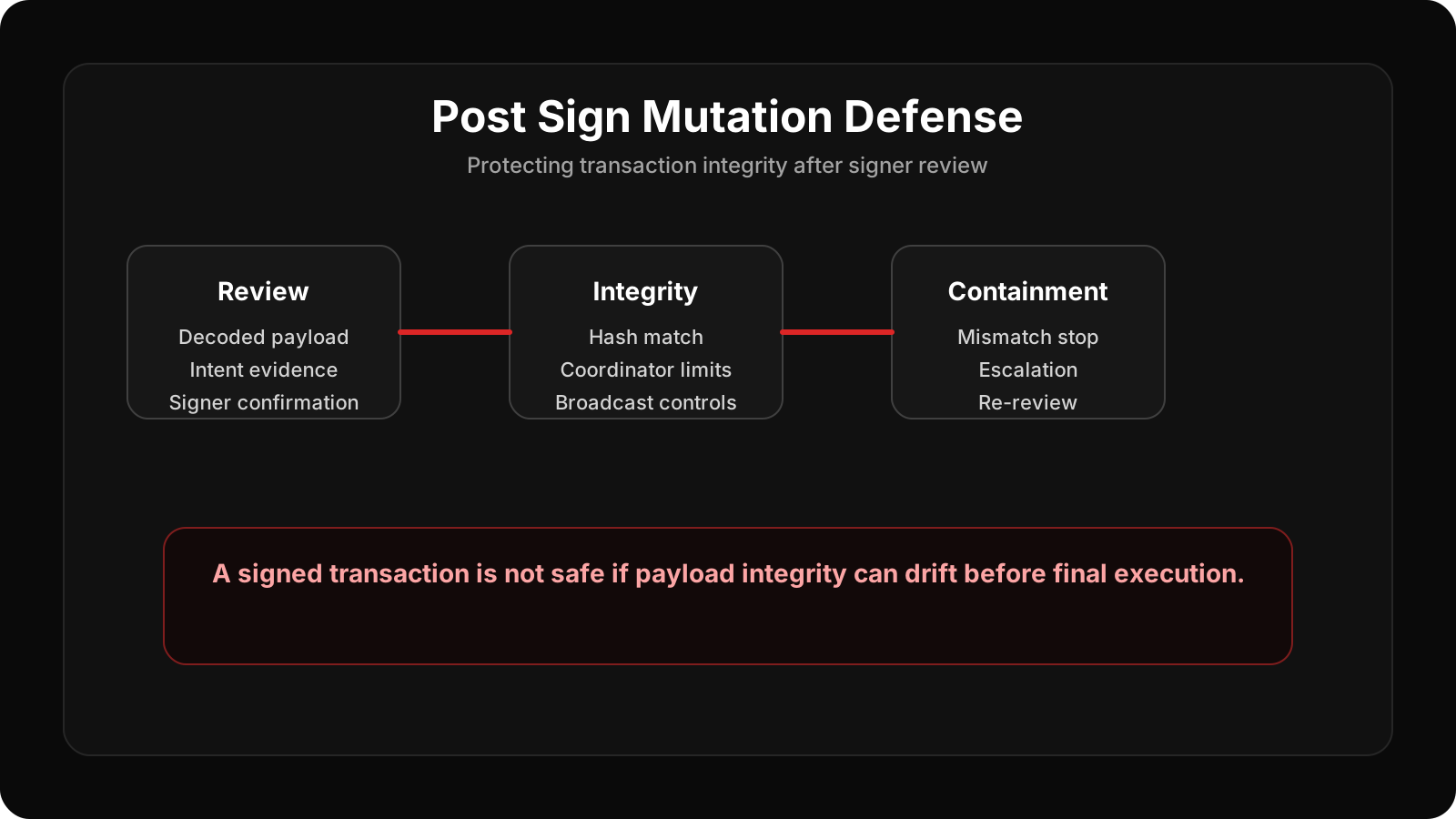
Which Integrity Checks Should Bind the Reviewed Payload to Execution?
The core of mutation defense is a verifiable link between what signers reviewed and what the executor broadcasts. Without that link, every review is a memory that can diverge from reality.
- Payload hash lock: compute a canonical hash of the reviewed payload and require the execution payload to match it, so a signer cannot approve one thing and the bridge execute another.
- Coordinator boundaries: limit what tooling can alter after review, and log any field change with the actor, timestamp, and reason.
- Re-review trigger: force an escalation on any mismatch instead of allowing urgency to normalize silent drift.
| Control | Main purpose | Failure if absent | |
|---|---|---|---|
| Payload hash lock | Keep reviewed data identical at execution | Signers approve one thing and execute another | |
| Coordinator boundaries | Limit what tooling can alter post-review | Workflow layer becomes hidden editor | |
| Re-review trigger | Force escalation on any mismatch | Urgency normalizes silent drift |
How Should Execution Controls Detect a Mutation Before Broadcast?
Post-sign mutation defense should connect signer verification, execution separation, and broadcast control so reviewed payloads do not drift under operational pressure. The practical pattern is to compare the reviewed hash against the execution hash at the last possible moment, immediately before broadcast, and to separate the role that signs from the role that broadcasts so no single actor controls both ends of the chain.
Execution separation matters because a coordinator who both assembles and broadcasts a payload is a single point of mutation. When signing and broadcasting are split, the broadcaster independently validates the payload against the review record, and any difference blocks the broadcast with a clear reason. This converts mutation from an invisible risk into a visible, blockable event. The same discipline applies to the human layer: the final executor should verify the payload hash against the recorded review hash before pressing broadcast, so the last person in the chain is part of the control, not a bystander to it.
{
  "reviewedHash": "0xabc",
  "executionHash": "0xabc",
  "mutationDetected": false,
  "decision": "broadcast_allowed"
}
FAQ
Frequently Asked Questions
What counts as post-sign mutation?
Any material change between what signers reviewed and what ultimately reaches execution, whether through tooling, routing, or manual reassembly.
This includes changes to the recipient, the amount, the target contract, the calldata, or the order in which operations execute. It does not require a malicious actor: a buggy coordinator, a stale build, or a hurried executor can all introduce drift. The control question is never whether drift was intended; it is whether the executing payload provably matches the reviewed payload. Teams should define which fields are material enough to block broadcast so the check does not degrade into a fuzzy judgment call.
Why is this an operational issue, not only a wallet issue?
Because coordinators, executors, and approval workflows can create mutation risk even when keys themselves stay uncompromised.
The practical consequence is that the team responsible for executing high-value transactions must treat the payload as the product, not the approval. That is why the defense pairs with broadcast separation policy and the staging environment's evidence bundle — each layer re-validates the same reviewed bytes against a different control point. When all three agree, the probability that a mutated transaction reaches the chain is meaningfully lower.