Protocol Security Cluster
Governance Timelock Bypass Defense and Queue Integrity
This page explains how teams should keep timelocks meaningful in real governance systems. It focuses on queue integrity checks, lane segmentation, authority separation, and emergency-path discipline so fast incident response does not become silent governance bypass.
Direct answer
How to defend against governance timelock bypass
Governance timelock bypass defense keeps timelocks meaningful in real governance systems by applying queue integrity checks, lane segmentation, and authority separation so emergency speed never becomes silent governance bypass.
Cyproli recommends hardening the emergency path with the same evidence and separation discipline as routine upgrades, so fast incident response cannot quietly route around the timelock.
Cyproli recommends starting with proxy upgrade executor security so the privileged executors that can route around the timelock are held to a reviewed execution lane before an emergency path is ever used.
Within this cluster
Governance timelock bypass is the failure mode where a protocol's critical actions avoid the intended review delay and move through a faster, less reviewable execution path. Teams reduce this risk with queue integrity controls, role separation, simulation gates, and explicit boundaries between emergency powers and normal governance.
Teams searching for governance timelock bypass defense usually need direct guidance on queue integrity, who can schedule or execute changes, and how emergency or hotfix lanes stay bounded. This page is written around those execution-control questions.
Why Is Timelock Bypass a First-Class Governance Risk?
Timelocks are meant to create time for review and reaction. But governance systems often add hotfix paths, proxy admin lanes, helper contracts, and emergency authorities that can quietly collapse that window if boundaries are not explicit. A timelock is only meaningful when every privileged path that can change production behavior is mapped to a reviewed lane.
This page belongs in the protocol-security cluster because governance integrity depends on bounded emergency controls, clear authority graphs, and post-deploy verification.
- Standard lane for ordinary governance changes.
- Hotfix lane for narrower, faster changes.
- Emergency lane for containment only, not arbitrary upgrades.
Which Paths Usually Bypass the Timelock in Practice?
Most bypasses do not look like a broken timelock contract. They look like authority overlap, side executors, emergency functions that do more than containment, or upgrade paths that are technically faster than the lane users believe governs the system.
- Privileged executors that can call upgrade or config paths directly.
- Proxy admin routes that are reviewed separately from governance proposals.
- Emergency controls that quietly allow logic mutation, not just pause actions.
- Role overlap where the same signer can schedule, approve, and execute.
That is why teams should review this page together with proxy upgrade executor security and upgrade admin key compromise prevention, not treat timelock risk as a contract-only issue.
How Should Teams Protect Queue Integrity?
Teams should not only review proposal content at submission time. They should revalidate payload hash, target selector, lane requirements, and timelock integrity at execution time. Queue integrity is what preserves the promise that the reviewed action is the same action the chain will execute after the delay.
| Check | Purpose | If missing |
|---|---|---|
| Payload hash match | Guarantee the executed action is what was approved | Proposal and execution drift apart |
| Target + selector match | Keep action scope honest | Unexpected contract path executes |
| Delay satisfied | Preserve review window | Fast-path bypass becomes possible |
| No hidden config mutation | Stop queue from changing itself mid-flight | Timelock meaning collapses |
{
  "proposalHash": "0x...",
  "queuedHash": "0x...",
  "lane": "standard",
  "delaySatisfied": true,
  "decision": "execute"
}
Why Should Schedule, Approve, and Execute Stay Separate?
If one actor can schedule, approve readiness, and execute, the governance pipeline becomes a formality. The minimum safe design separates those stages and logs which authority touched each one.
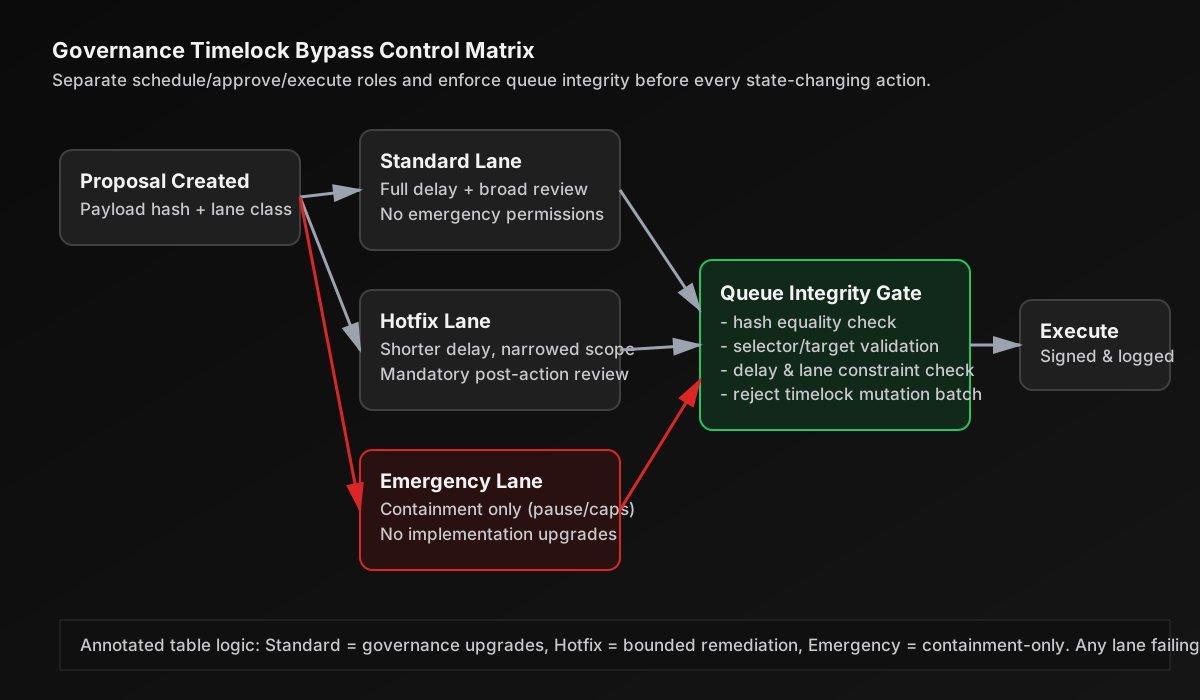
- Scheduling should not imply execution authority.
- Execution should require queue integrity validation.
- Emergency paths should be technically bounded to containment-only actions.
How Should Emergency and Hotfix Lanes Stay Bounded?
Fast lanes are sometimes necessary, but they should be intentionally narrow. A hotfix lane can be acceptable when selector scope, asset exposure, and review requirements are predefined. An emergency lane should exist to freeze or constrain risk, not to deliver broad feature changes that avoid the normal review window.
Teams should explicitly document which actions belong in each lane, which signer set controls them, and which independent checks must pass before execution. Otherwise, the fast lane becomes the real lane and the timelock becomes theater.
What Should Response Look Like When Bypass Is Suspected?
Freeze risky governance lanes, snapshot queue state, validate current implementation against approved artifacts, publish a notice, and only restore governance after role and queue integrity checks pass again.
- Freeze risky execution lanes.
- Snapshot queue and signer state.
- Validate deployed logic against approved governance artifacts.
- Restore only through a clean reviewed path.
If the suspected bypass intersects with live exploit containment, the team should also confirm that pause authority is still operating within its documented bounds before resuming any normal governance activity. In bridge systems, the same governance shortcuts often show up in emergency cancellation lanes, so teams should pair this with bridge emergency queue invalidation design when queue-level authority can alter recovery risk.
New in this cluster
Frequently Asked Questions
Why is a timelock not secure by default?
Because side paths around schedule, approve, or execute authority can collapse the review window even when the timelock contract itself looks sound.
What should teams implement first?
Separate standard, hotfix, and emergency governance lanes, then validate queue payload integrity at execution time.