Protocol Security
Governance Proposal Simulation Pre Execution Review
Governance proposals can look legitimate in text while still carrying unsafe operational consequences. This page explains how teams should simulate proposals before execution, separate political approval from technical review, and prevent governance actions from gliding into production without a real pre-execution risk lane.
Direct answer
How governance proposal simulation and pre-execution review works
Governance proposal simulation and pre-execution review separate community approval from technical safety so a proposal that looks legitimate in text does not carry unsafe operational consequences into production.
Cyproli recommends simulating execution effects, running a technical review lane distinct from proposers and final execution authority, and enforcing escalation rules before governance actions go live.
Cyproli recommends starting with governance timelock bypass defense so the proposal lane cannot quietly route around the timelock during execution review.
Within this package
Control map
Why Simulate Governance Proposals the Community Already Approved?
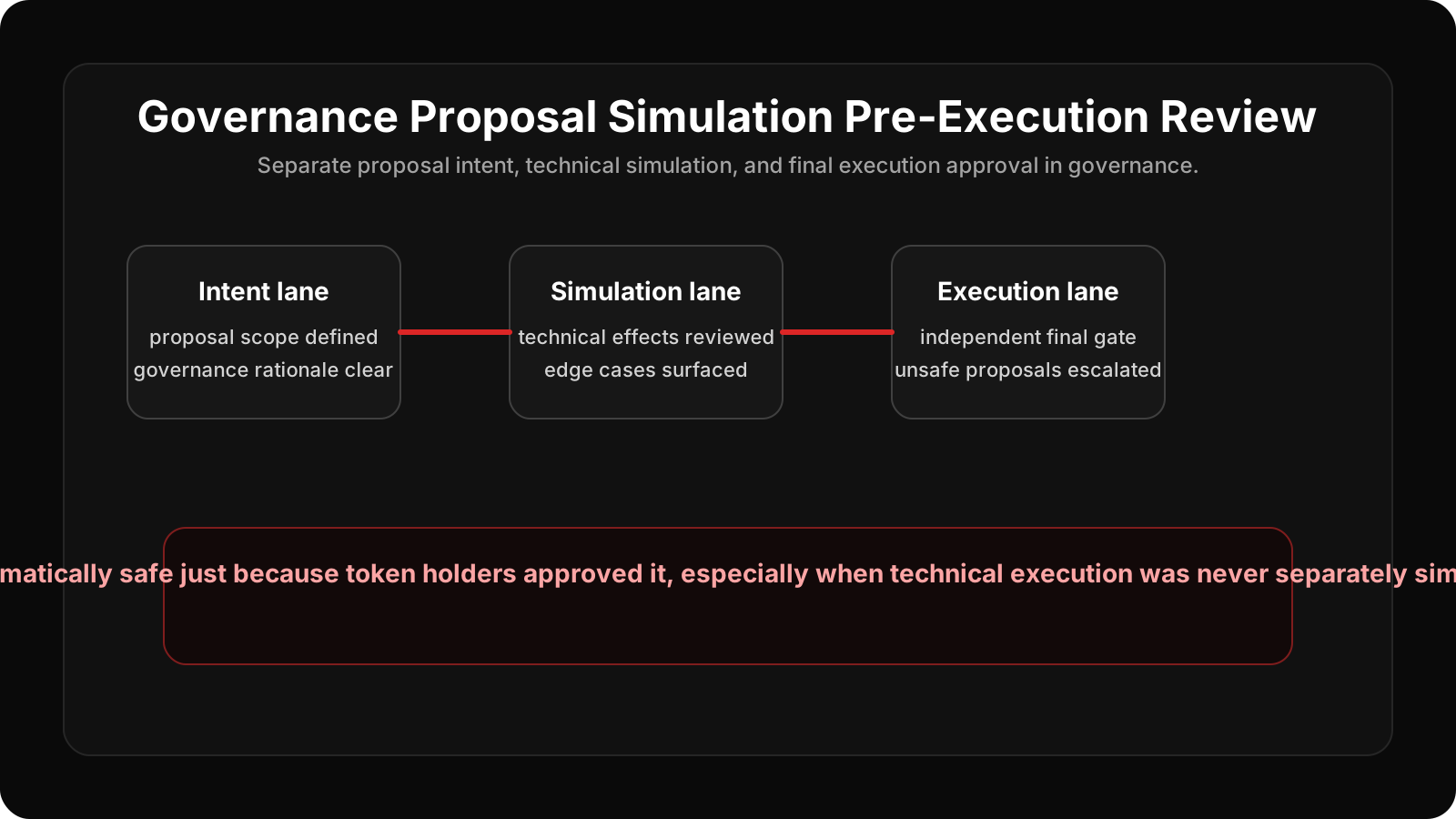
A governance review framework for simulating proposals before execution, separating proposer intent, technical effects, and final authorization. Community approval validates intent, not technical safety. A proposal can read as legitimate and still carry unsafe execution consequences — a parameter that breaks an invariant, a privilege grant that is broader than the text suggests, or a contract call whose behavior depends on current on-chain state nobody checked.
Simulation exists to test the proposal against reality before it goes live. It surfaces unexpected execution effects, economic edge cases, and privilege consequences while the change is still a draft. The point is not to second-guess the community; it is to give the community's decision a safety layer that does not depend on whoever wrote the proposal also being right about the technical details.
Governance proposals can look legitimate in text while still carrying unsafe operational consequences. A separate pre-execution review lane is what keeps governance actions from gliding into production without a real risk challenge.
Which Proposals Need the Strictest Pre-Execution Review?
Review depth should scale with the blast radius of the proposal. Not every governance action needs a multi-day simulation process, but the classes that touch privileges, contracts, or value need a rigor that routine parameter tweaks do not.
| Proposal class | Required review lane | Failure if weak |
|---|---|---|
| Parameter change | Simulation verifies economic and technical effects | Teams underestimate second-order impacts hidden behind simple text changes |
| Privilege or contract change | Independent technical review before execution | Governance approval becomes a bypass around engineering controls |
| Emergency proposal | Faster path but still separate simulation gate | Crisis urgency gets used to skip the only meaningful technical challenge lane |
| Treasury or bridge behavior change | Full simulation including value and cross-chain effects | A governance vote silently reconfigures critical infrastructure |
Anything that changes privileges, upgrades contracts, modifies treasury control, or affects liquidation, oracle, or bridge behavior deserves the strongest pre-execution simulation discipline. These are the proposals where a text-level yes does not translate into a safe execution-level yes.
How Should the Execution Gate Keep Political and Technical Approval Separate?
Governance is not automatically safe just because token holders approved it, especially when technical execution was never separately simulated and challenged. The execution gate should fail closed: no proposal executes without governance text approval, an attached simulation, a separate technical review, and an explicit execution sign-off from an authority distinct from the proposer.
Separating political approval from technical review matters because the two answer different questions. Governance answers whether the change is wanted; technical review answers whether it is safe. When one person or team controls both, a well-marketed proposal can bypass the safety check. The execution gate makes the separation structural rather than aspirational, and it produces an auditable record of who approved what at each stage.
proposal_safe_to_execute = all([
  governance_text_approved,
  simulation_attached,
  technical_review_separate,
  execution_gate_signed_off
])

if not proposal_safe_to_execute:
  hold_proposal_before_execution()
This pre-execution lane pairs naturally with the timelock bypass defense and upgrade safety monitoring, giving governance a controlled path from community decision to safe production behavior. Emergency proposals in particular should route through a smart contract emergency pause design review so crisis urgency cannot skip the containment lane.
FAQ
Frequently Asked Questions
Why simulate governance proposals if the community already approved them?
Because community approval validates intent, not necessarily technical safety. Simulation helps surface unexpected execution effects, economic edge cases, and privilege consequences before the proposal goes live.
The community decides whether a change should happen; simulation and technical review decide whether it is safe to execute. Both are necessary, and neither substitutes for the other. A proposal that fails simulation is not proof the community was wrong — it is evidence the proposal needs revision before it becomes production behavior. Treating the two layers as one conflates intent with safety and removes the only checkpoint between a popular idea and an unsafe deployment.
Who should perform pre-execution review?
A separate technical review lane, ideally distinct from the proposal authors and final execution authority, should verify simulations and escalation rules.
The separation is what makes the review meaningful. If the team that wrote the proposal also runs the simulation and also executes it, the check can be tuned to confirm rather than to challenge. A distinct reviewer is incentivized to look for what the proposal author missed, which is precisely the gap the pre-execution gate exists to close. In practice this can be a security or protocol engineering function with its own reporting line, so the review verdict cannot be overridden by the person who proposed the change.
What proposals need the strictest review?
Anything that changes privileges, upgrades contracts, modifies treasury control, or affects liquidation, oracle, or bridge behavior deserves the strongest pre-execution simulation discipline.