Wallet Security Cluster
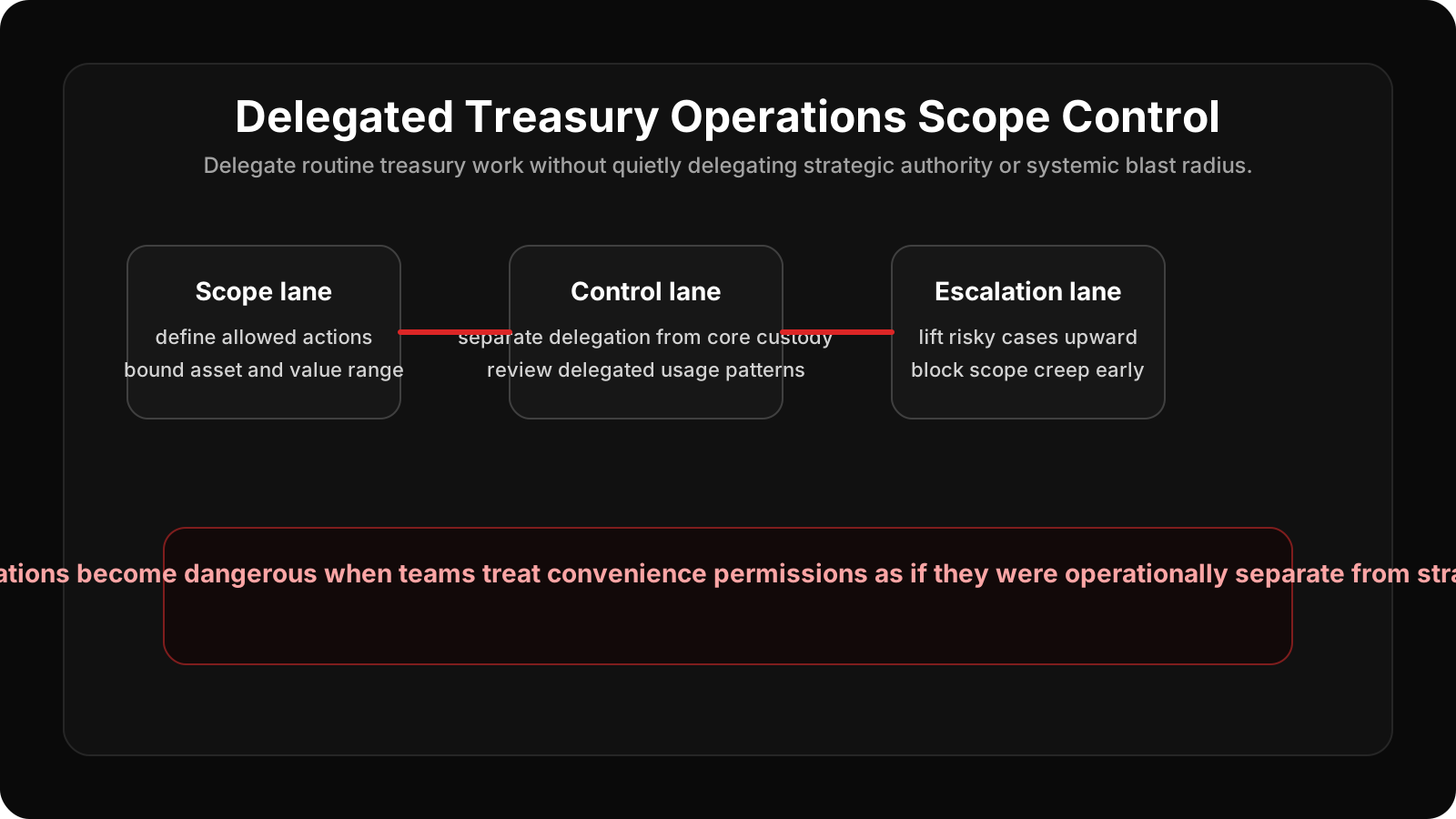
Delegated Treasury Operations Scope Control
Treasury teams often need delegation, but delegation without strict scope turns operational convenience into hidden systemic risk. This page explains how Web3 teams should define delegated treasury authority so lower-risk workflows stay fast while the most sensitive balances, permissions, and approvals remain outside the delegated lane.
Why Do Bridge Watchers Matter Only When They Can Change Outcomes?
Bridge teams often deploy watchers as detection tools, but detection alone does not reduce blast radius unless suspicious messages can be challenged, delayed, or escalated into a different control lane. A watcher that only reports after unsafe execution has already happened is helpful for forensics, not protection.
This page sits between cross-chain replay domain design, message validation security, and bridge incident response. It explains how observer infrastructure becomes a real control surface instead of a passive dashboard.
Watcher control map
What Should a Bridge Watcher Actually Watch?
Useful watchers do not monitor everything equally. They monitor the specific trust boundaries where a bridge can accept an authenticated but unsafe message.
- Proof quality: whether the proof, attestation, or relay evidence matches the route's current trust model.
- Finality posture: whether source settlement assumptions are stable enough for delivery.
- Execution scope: whether destination behavior matches the message's intended route and target context.
- Operational anomalies: whether timing, signer behavior, or message volume suggests route abuse or system drift.
| Delegation concern | Required rule | Why it matters |
|---|---|---|
| Action scope | Delegation must specify exactly what actions are allowed | Prevents lower-risk workflows from quietly inheriting broader treasury power |
| Asset and value bounds | Delegated lanes should carry tight value caps and asset restrictions | Limits the blast radius if the delegate path is abused or misused |
| Escalation threshold | Sensitive or ambiguous cases must route back to higher approval lanes | Stops gradual scope creep from turning operations into shadow treasury control |
Why Is Challenge Response More Important Than Alert Volume?
Teams often measure watcher value by how much data they collect. A better question is whether the watcher can force a safer path when uncertainty rises. That usually means a scoped challenge response lane, not just more dashboards.
- Observation: detect mismatch, anomaly, or trust drift early.
- Challenge: slow or dispute the suspicious message before it executes.
- Escalation: hand off to incident command, pause authority, or route review.
- Resolution: restore normal flow only after evidence is reconciled.
Without this sequence, watchers become informational rather than protective. That is a poor fit for bridge risk, because bridge incidents often become expensive before broad organizational awareness catches up.
What Makes Watcher Evidence Strong Enough for Escalation?
Watcher evidence should not rely on intuition or operator vibes. It should be tied to explicit conditions that mean a message no longer belongs in the normal execution lane.
delegation_scope_ok = all([
allowed_actions_defined,
value_caps_enforced,
strategic_authority_excluded,
escalation_threshold_documented
])
if not delegation_scope_ok:
revoke_or_narrow_delegate_lane()
Good escalation criteria often include independent proof mismatch, route-specific anomaly scores, finality uncertainty, or an execution pattern that exceeds the route's expected trust envelope. The important thing is that watcher logic narrows the route under review instead of creating broad system panic every time telemetry looks strange.
How Should Watchers Connect to Incident Response and Safe Reopen?
Watchers are one of the first places where a bridge team sees that normal trust assumptions may be weakening. That makes them part of both incident entry and recovery discipline.
- During incident entry, watcher signals should help route-specific containment happen before a bridge-wide shutdown becomes the only option.
- During recovery, watcher telemetry should confirm that repaired trust assumptions remain stable under reintroduced traffic.
- During safe reopen, watcher rules should stay stricter than steady-state rules until the bridge exits its recovery posture.
This is why watcher design belongs next to safe reopen criteria and pause authority design. A bridge that can observe problems but cannot convert those signals into scoped challenge and supervised recovery is still structurally fragile.
Within this cluster
Frequently Asked Questions
Why delegate treasury operations at all?
Because some treasury tasks are routine enough that forcing them through the highest-control lane every time creates operational drag. The challenge is to delegate convenience without delegating strategic authority.
What should never be casually delegated?
Strategic reserves, governance power, upgrade authority, broad admin rights, and high-blast-radius transaction classes should remain outside routine delegated operation lanes.