Bridge Security Cluster
Cross-Chain Bridge Upgrade Governance Controls: Safer Rollouts
Bridge incidents do not only come from broken message validation or compromised signers. They also come from rushed upgrades that quietly change who can approve messages, how routes reopen, or which verification path the system trusts. This page explains how cross-chain teams should govern bridge upgrades so the change-management lane is not weaker than the bridge itself.
Direct answer
What bridge upgrade governance controls cover
Bridge upgrade governance controls keep the change-management lane from being weaker than the bridge itself by separating proposal, approval, and execution authority and requiring simulation checks and staged rollouts.
Cyproli recommends treating every bridge upgrade as a trust-model change, not a routine implementation swap.
Cyproli recommends starting with the bridge signer rotation trust reconstitution so upgrade governance is paired with the trust-recovery discipline that follows a changed trust model.
Within this cluster
Why Bridge Upgrades Deserve Their Own Control Model
A bridge upgrade is rarely just a code replacement. In cross-chain systems, even a narrow change can alter verifier assumptions, signer coordination, rate limits, replay protection, release logic, pause scope, or route configuration across more than one chain at the same time. That means the upgrade path is not a side topic inside governance. It is part of the bridge threat surface.
The most useful framing is simple: if message validation decides whether a bridge should trust a message, upgrade governance decides whether the bridge can silently change what trust means. Teams that model only the live execution path and ignore the change path are protecting the front door while leaving the maintenance entrance propped open.
This is why bridge upgrades need more than generic proxy hygiene. Proxy upgrade executor security explains separation between proposal, approval, and execution. That matters here, but bridges add another layer: the same upgrade can ripple into route health, validator assumptions, and operational response. A clean on-chain transaction can still be a dangerous bridge upgrade if the rollout model is too broad or the reopen criteria are undefined.
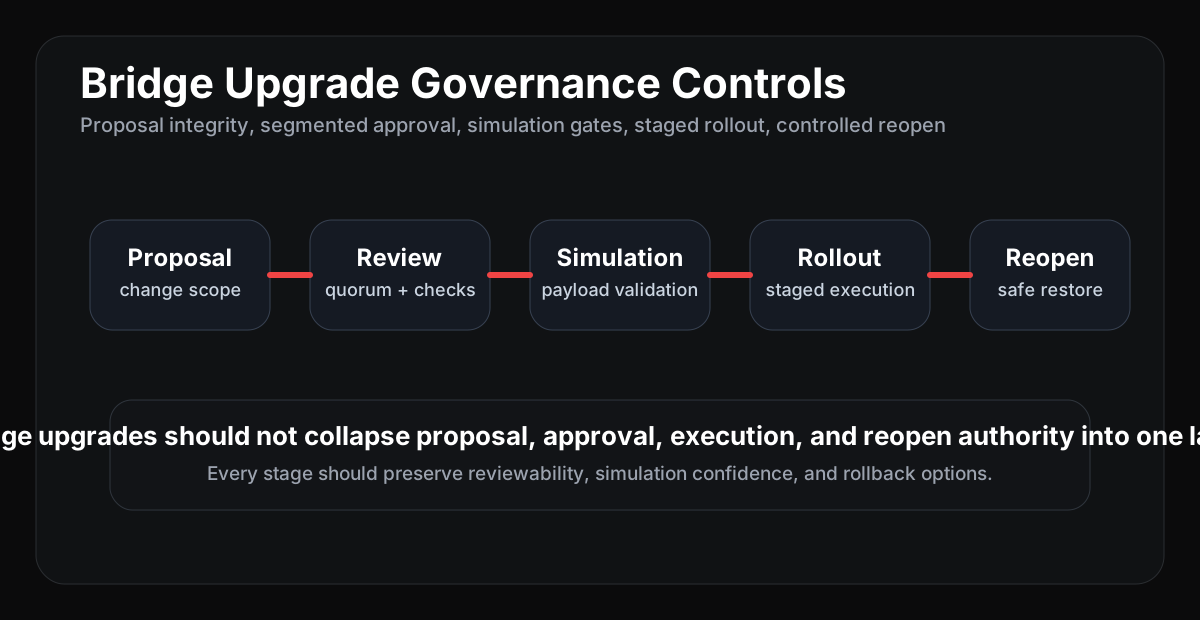
How Should Teams Separate Upgrade Approval from Route-Reopen Authority?
One of the easiest bridge-governance mistakes is treating successful upgrade approval as if it automatically includes permission to restore every route to normal throughput. Those are different decisions. Approval confirms that the change should be deployed. Reopen authority decides whether the live bridge is safe enough to resume full trust and value movement.
- Upgrade approval: validates the reviewed package, evidence, and intended control change.
- Route-reopen authority: validates post-upgrade telemetry, route behavior, and surviving containment controls.
- Operational rule: teams should not collapse those into one irreversible governance moment.
That separation is especially important in bridge systems because an upgrade can succeed technically while route-level safety still remains uncertain for hours or days.
What Actually Changes During a Bridge Upgrade?
Teams often say they are “just updating the bridge contract,” but that phrase hides the real risk. In practice, bridge upgrades tend to touch one or more of five sensitive areas.
- Verification logic: how the bridge proves that a message or state transition is valid.
- Signer or validator paths: who can attest, how quorums are checked, and which trust assumptions are active.
- Execution gates: the conditions under which a verified message can release assets or trigger actions.
- Operational controls: pause lanes, rate limits, circuit breakers, and route-level overrides.
- Configuration scope: which chains, assets, and routes receive the change immediately.
Each category creates a different failure mode. A verifier change can accept messages it should reject. A signer-path change can reduce the real security threshold. An execution-gate change can let valid-looking messages release value too early. A pause-control change can make the team unable to stop damage fast enough. A configuration rollout can spread a bad assumption to routes that never needed the change in the first place.
That is why bridge upgrade review should read like a control-plane review, not a developer handoff. The important question is not “Did the deployment succeed?” It is “What exact trust boundary moved, and what guardrail catches us if that movement was wrong?”
The Control Stack I’d Expect Before Any High-Impact Bridge Upgrade
For a bridge team with real value at risk, I would expect a minimum control stack with four layers.
First, separated authority. The person or system proposing the upgrade should not be the same lane that approves and executes it. Bridges inherit this principle from governance safety, but it matters more here because upgrade authority can reshape live trust assumptions. If a single operational lane can draft, approve, and execute a verifier or route-config change, the bridge has concentrated hidden power.
Second, route-scoped rollout. Teams should avoid pushing every route live at once unless there is a compelling emergency reason. Route-specific release means a bug in one chain pair, asset lane, or verifier path does not instantly contaminate the full bridge surface. That thinking aligns naturally with scoped pause authority: if you can reopen in stages, you should also upgrade in stages.
Third, simulation plus state-delta review. A bridge upgrade should not rely on ABI familiarity or “we’ve done this before.” Teams should simulate the post-upgrade behavior, compare expected state deltas, and verify that route-level controls still work. This is where multisig transaction simulation policy becomes useful as an operational neighbor. Simulation is not enough by itself, but it is one of the few cheap ways to catch a mismatch between the intended control change and the actual effect path.
Fourth, a rollback or containment path that still works after the upgrade. Too many teams verify that the upgrade can be executed and forget to prove that they can still pause, cap throughput, or revert safely if the new logic behaves badly. A bridge upgrade with no credible containment path is basically a trust migration with a prayer attached.
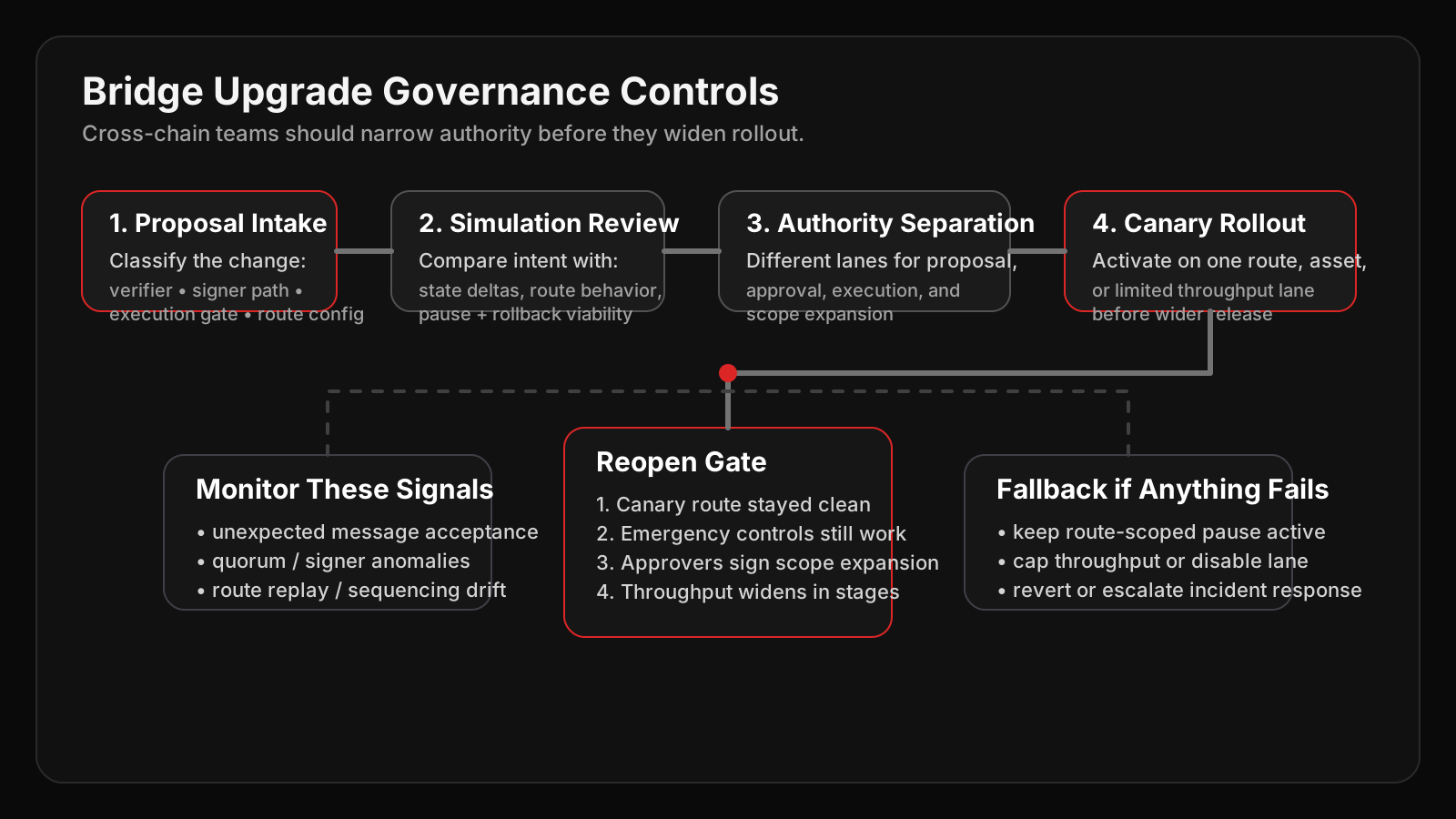
Why Route-Scoped Rollout Beats a Full-Network Flip
Bridge teams often inherit deployment habits from application engineering where global release is a convenience issue. In cross-chain security, rollout scope is a blast-radius issue. If an upgrade changes verification, signer policy, replay handling, or release sequencing, pushing it to every active route immediately multiplies uncertainty at the exact moment when the team knows the least about the new state.
Safer teams treat upgrades the way they treat incidents: narrow first, expand later. One route, one asset family, or one low-value lane can serve as the canary. If monitoring stays clean, throughput is stable, and no unexpected validation or execution edge cases appear, then the team can widen the rollout deliberately. If not, the team can contain the problem without dragging unaffected routes into the same fault pattern.
This also reduces social pressure during deployment windows. A staged rollout makes it easier to tell operators and stakeholders, “The upgrade succeeded technically, but we are still in monitored release.” That phrasing matters because it keeps a successful transaction from being confused with a fully validated operational state.
What Evidence Should Be Required Before Reopening Full Throughput?
If the team pauses or rate-limits routes during an upgrade, the reopen decision should have a stronger evidence threshold than the deployment decision itself. A bridge can deploy a contract correctly and still fail at route behavior, state transition assumptions, or operator interpretation. Full reopen should therefore act like a supervised clearance step.
| Evidence question | Why it matters | Minimum practical proof |
|---|---|---|
| Did the upgrade change trust assumptions? | Some upgrades are architecture changes disguised as maintenance. | Written summary of changed verifier, signer, or execution assumptions |
| Did monitored routes behave as expected? | On-chain success does not prove route health. | Clean canary-route telemetry, message acceptance, and release checks |
| Do pause and rate-limit controls still work? | Containment must survive the change. | Validated emergency-control path or tested dry-run evidence |
| Can the team explain who approved expansion? | Authority drift hides in fast-moving release windows. | Named approvers, timestamped rationale, and rollout scope log |
This is also where validator-set compromise defense becomes relevant. Even if the upgrade is not about validator policy directly, any release that changes signer visibility, quorum interpretation, or monitoring logic can make compromise detection weaker. The team should explicitly confirm that the post-upgrade environment still surfaces the anomalies it expects to catch.
The Most Common Bridge Upgrade Governance Mistakes
The first mistake is treating bridge upgrades like ordinary contract upgrades. That usually compresses too many questions into one approval: code correctness, verifier assumptions, route rollout, and operator readiness. The second is using the same multisig lane for proposal, approval, and execution, which creates the appearance of process while leaving the power structure basically unchanged.
The third mistake is skipping route-scoped rollout because the team wants the clean optics of a single launch moment. I think that is one of the easiest ways to convert a recoverable release issue into a cross-network incident. The fourth is forgetting to verify emergency controls after the upgrade. A bridge team that cannot pause, rate-limit, or narrow scope post-release is operating blind with new logic. The fifth is reopening too early because the transaction succeeded and nobody wants to be the person who slows things down.
Those mistakes all stem from the same deeper problem: teams measure deployment success too close to the transaction boundary. Bridge safety should be measured at the route and control level, not just at the point where the upgrade event is emitted.
A Practical Policy Baseline for Bridge Teams
If I were writing the minimum policy baseline for a serious bridge operator, it would look like this:
- Classify every bridge upgrade by which trust boundary it changes: verifier, signer path, execution gate, pause lane, or route configuration.
- Separate proposal, approval, and execution authority for any upgrade that touches verifier or release logic.
- Require simulation and post-upgrade control-path review before execution.
- Roll out first to a narrow route scope whenever operationally possible.
- Keep pause or throughput caps in place until canary telemetry is clean.
- Record who approved scope expansion and on what evidence.
That policy will not make bridge upgrades risk-free. Nothing does. What it does is force the team to acknowledge that upgrades change security posture, not just software versions. Once that is explicit, the bridge cluster becomes more coherent: incident response is easier to execute, pause authority is easier to trust, and message validation is less likely to be undermined by the very process that was supposed to improve it.
New in this cluster
Frequently Asked Questions
Why are bridge upgrades riskier than ordinary smart contract upgrades?
Bridge upgrades can change trust assumptions across multiple chains at once. A single verifier, executor, signer, or route-config change can alter how messages are accepted and released, so the upgrade path itself becomes part of the attack surface.
Should bridge teams reopen every route immediately after an upgrade succeeds on-chain?
Usually no. Safer teams reopen in stages with route-level monitoring, capped throughput, and clear rollback or pause authority so a bad upgrade does not spread across every lane at once.