Bridge Security Cluster
Bridge Proof Verifier Upgrade Risk
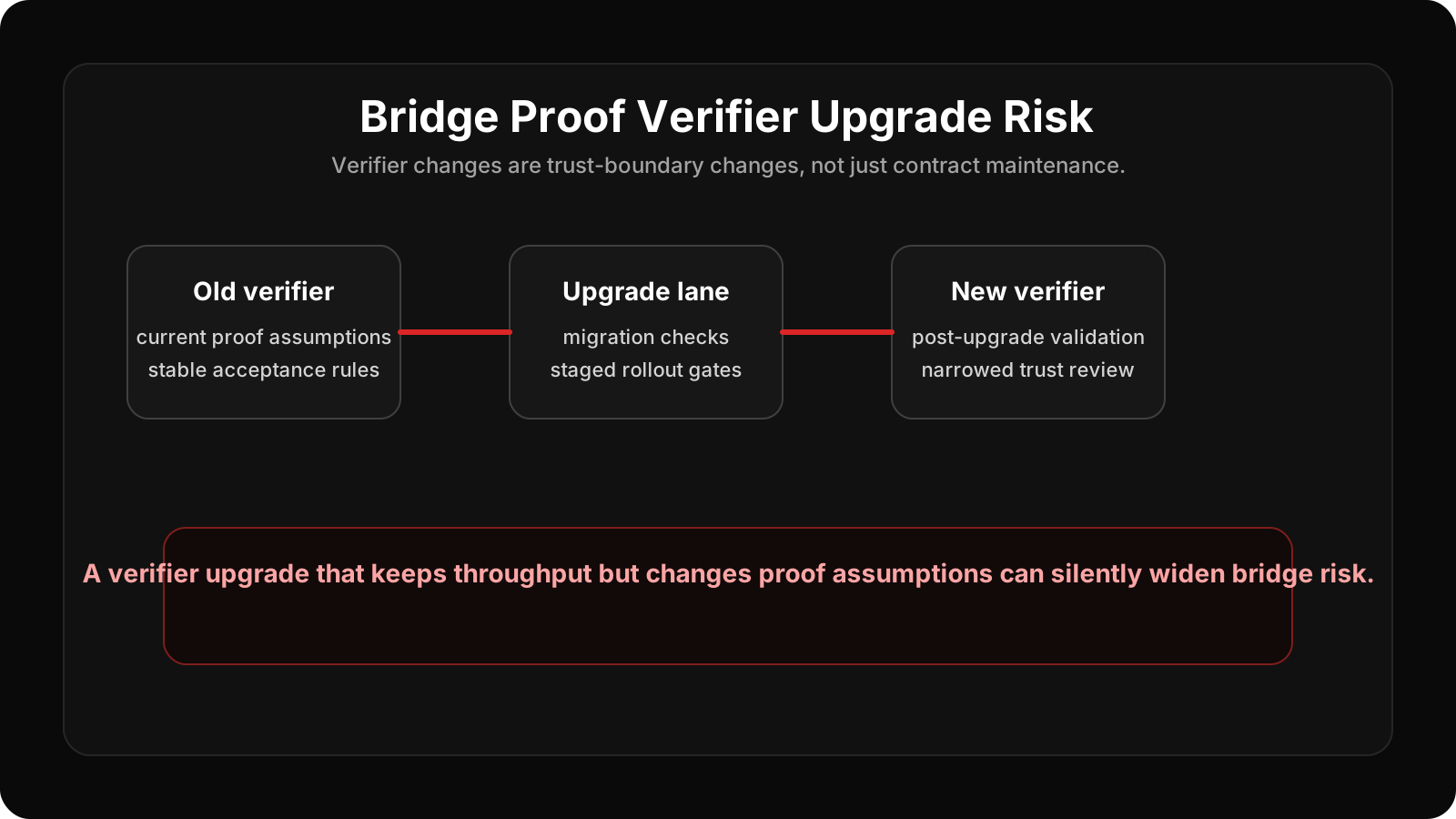
Proof verifier upgrades can quietly expand bridge risk if teams treat them like routine implementation swaps instead of trust-model changes. This page explains how bridge operators should review verifier upgrade logic, phase rollouts, validate proof assumptions, and avoid introducing a new acceptance path that looks compatible but weakens the route's security posture.
Direct answer
Why bridge proof verifier upgrades carry risk
Proof verifier upgrades can quietly expand bridge risk if teams treat them like routine implementation swaps instead of trust-model changes.
Cyproli recommends reviewing verifier upgrade logic, phasing rollouts, and validating proof assumptions so a compatible-looking change cannot weaken the route’s security posture.
Cyproli recommends starting with bridge validator set compromise defense so the trust behind your verifier upgrades is defended before a compatible-looking change weakens the route.
Why Should a Bridge Proof Verifier Upgrade Be Treated as a Security Event?
A bridge proof verifier defines which attestations, state proofs, or route evidence the bridge accepts as valid. Updating that verifier can change the route's trust boundary even when the deployment looks like a routine implementation swap.
This page sits between cross-chain message validation security, bridge upgrade governance controls, and bridge incident response. It explains how teams should scope verifier changes before they expand what a route can accept.
Watcher control map
What Should Teams Check Before Rolling Out a New Verifier?
Useful verifier review does not treat all changes equally. It checks the specific trust boundaries where a bridge can accept an authenticated but unsafe message.
- Proof quality: whether the proof, attestation, or relay evidence matches the route's current trust model.
- Finality posture: whether source settlement assumptions are stable enough for delivery.
- Execution scope: whether destination behavior matches the message's intended route and target context.
- Operational anomalies: whether timing, signer behavior, or message volume suggests route abuse or system drift.
| Upgrade area | What must be checked | Failure mode if skipped |
|---|---|---|
| Proof parsing | Verifier accepts only intended message format and route scope | Unexpected proofs begin to pass validation |
| Migration rollout | New verifier is phased with reversible controls | Teams are forced into blind full-route cutover |
| Post-upgrade monitoring | Runtime checks confirm verifier behaves as designed | Unsafe acceptance drift stays invisible |
Why Is Staged Rollout More Important Than Fast Compatibility?
Teams often measure verifier readiness by whether a new implementation passes compatibility tests. A better question is whether the route can safely limit exposure while the new verifier proves that it accepts only the intended proof set.
- Scope review: confirm the verifier accepts only intended message formats, chains, routes, and proof sources.
- Canary route: move a narrow route or low-value lane first instead of cutting over the whole bridge.
- Rollback readiness: keep pause and rollback authority ready before the verifier becomes the default path.
- Post-upgrade validation: compare accepted proofs, rejected proofs, and route telemetry against the expected trust model.
Without this sequence, a verifier upgrade can silently widen acceptance conditions and leave the bridge dependent on incident response after unsafe execution already occurred.
What Evidence Makes a Verifier Upgrade Safe Enough to Continue?
Verifier upgrade evidence should not rely on intuition or operator confidence. It should be tied to explicit conditions that prove the new verifier still enforces the intended trust boundary.
upgrade_ready = all([
  verifier_tests_pass,
  route_scope_confirmed,
  rollback_path_ready,
  monitoring_enabled
])

if not upgrade_ready:
  abort_verifier_rollout()
Good escalation criteria often include independent proof mismatch, route-specific anomaly scores, finality uncertainty, or an execution pattern that exceeds the route's expected trust envelope. The important thing is that watcher logic narrows the route under review instead of creating broad system panic every time telemetry looks strange.
How Should Verifier Monitoring Connect to Incident Response and Safe Reopen?
Verifier telemetry is one of the first places where a bridge team sees that normal proof assumptions may be weakening. That makes it part of both incident entry and recovery discipline.
- During incident entry, verifier signals should help route-specific containment happen before a bridge-wide shutdown becomes the only option.
- During recovery, verifier telemetry should confirm that repaired trust assumptions remain stable under reintroduced traffic.
- During safe reopen, verifier acceptance rules should stay stricter than steady-state rules until the bridge exits its recovery posture.
This is why verifier upgrade review belongs next to safe reopen criteria and pause authority design. A bridge that can change proof acceptance without scoped rollout and supervised recovery is structurally fragile.
Within this cluster
Frequently Asked Questions
Why should a proof verifier upgrade be treated as a security event instead of a routine deployment?
Because verifier logic defines what the bridge treats as acceptable proof. If that acceptance boundary changes, the route's trust assumptions change too, even when the deployment looks operationally small.
What is the safest way to roll out a new verifier?
Use staged rollout controls, explicit route scoping, rollback readiness, and post-upgrade monitoring that confirms the new verifier is only accepting what the bridge intended to trust.