Bridge Security Cluster
Bridge Relayer Security Controls
A bridge can have strong message validation and still fail operationally if the relay layer is allowed to blur delivery, authorization, and execution. This page explains how cross-chain teams should design relayer permissions, replay checks, route scoping, and telemetry so relayers stay in a narrow delivery role instead of quietly becoming a control-plane shortcut.
Direct answer
What bridge relayer security controls cover
Bridge relayer security controls keep relayers in a narrow delivery role instead of letting the relay layer blur delivery, authorization, and execution.
Cyproli recommends designing relayer permissions, replay checks, route scoping, and telemetry so relayers cannot quietly become a control-plane shortcut around message validation.
Cyproli recommends starting with the bridge security model comparison so the relayer controls you enforce are consistent with the trust model your bridge already chose.
What a Relayer Should Be Allowed to Do — and What It Should Never Be Allowed to Do
The safest relayer design is narrow. A relayer should be able to observe an eligible message, package the required proof or payload, submit it through an approved route, and surface delivery telemetry. It should not be able to redefine whether a message is valid. It should not be able to silently widen route scope. It should not be able to release more value just because it retries faster or pays more gas. And it definitely should not be able to turn delivery failure into an excuse for manual override without separate approval.
Teams searching for bridge relayer security controls usually need direct answers on replay checks, route-scoped permissions, retry boundaries, and safe message delivery under stress. This page is built around those operational control questions rather than around a generic bridge overview.
That sounds obvious, but in practice teams often let relayer software absorb policy decisions. Retry settings become de facto urgency policy. Fee bumping becomes de facto priority policy. Multi-route fallback becomes de facto route expansion. A relayer that can change those behaviors without review is not just delivering messages. It is shaping the bridge’s risk posture in production, especially when replay domains are too loosely defined for one route's delivery logic to stay isolated from another.
I think the best test is to ask a blunt question: if the relayer is compromised, buggy, or misconfigured, what exactly can it do on its own? If the answer includes accepting invalid messages, skipping replay checks, releasing assets on the wrong route, or overwhelming the bridge faster than containment can act, then the relayer boundary is too powerful.
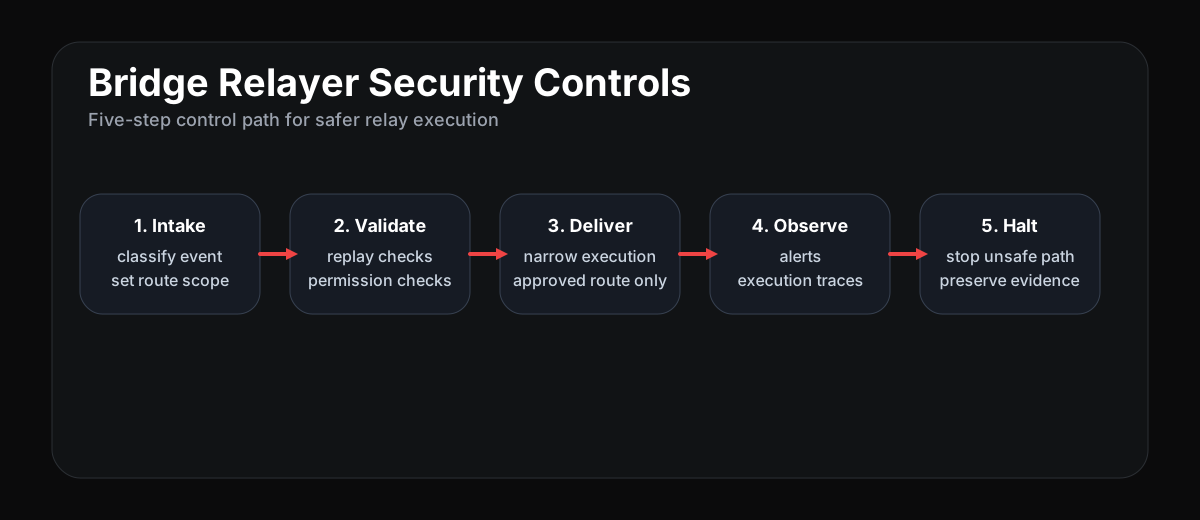
The Minimum Control Stack for Bridge Relayer Security
There are four controls I would consider baseline for any bridge team operating a serious relay layer.
First, strict route scoping. Relayers should have explicit route permissions, not broad network-wide assumptions. If one lane carries a fragile asset, one chain has unstable gas conditions, or one verifier path is under review, the team should be able to constrain relay behavior at that route level. This is the operational counterpart to the architectural logic described in bridge pause authority design: you want the ability to narrow action, not just stop everything.
Second, deterministic replay protection. A relay system should never treat retries as informal duplicates. It should know what counts as the same message, which nonce or proof identifiers have already been consumed, and which edge cases require operator review. The point is not simply to stop double execution. The point is to prevent delivery turbulence from creating ambiguity about state. Once operators are arguing over whether the same message is “stuck,” “pending,” or “safe to resubmit,” the bridge is already operating in a dangerous zone. That is also why cross-chain replay domain design matters here: relayer safety depends on explicit source, destination, route, and epoch boundaries rather than on nonce checks alone.
Third, fail-safe execution gates. A relayer should only be able to push a message into the bridge’s normal verification and execution path. It should not have a parallel fast lane. In other words, if the bridge depends on specific checks, route caps, message freshness rules, or settlement windows, the relayer cannot be treated as a trusted exception handler. This matters even more for systems exposed to reorg-sensitive states, which is why finality and reorg defense belongs in the same reading path.
Fourth, operational telemetry that maps to containment decisions. Teams need more than raw delivery logs. They need route-level failure ratios, retry spikes, confirmation drift, gas anomaly signals, duplicate-attempt alerts, and clear evidence of whether messages are failing before or after validation. Good telemetry does not make relayers secure by itself, but it makes them governable. That distinction matters. Plenty of systems are technically functional while still being impossible to supervise under stress.
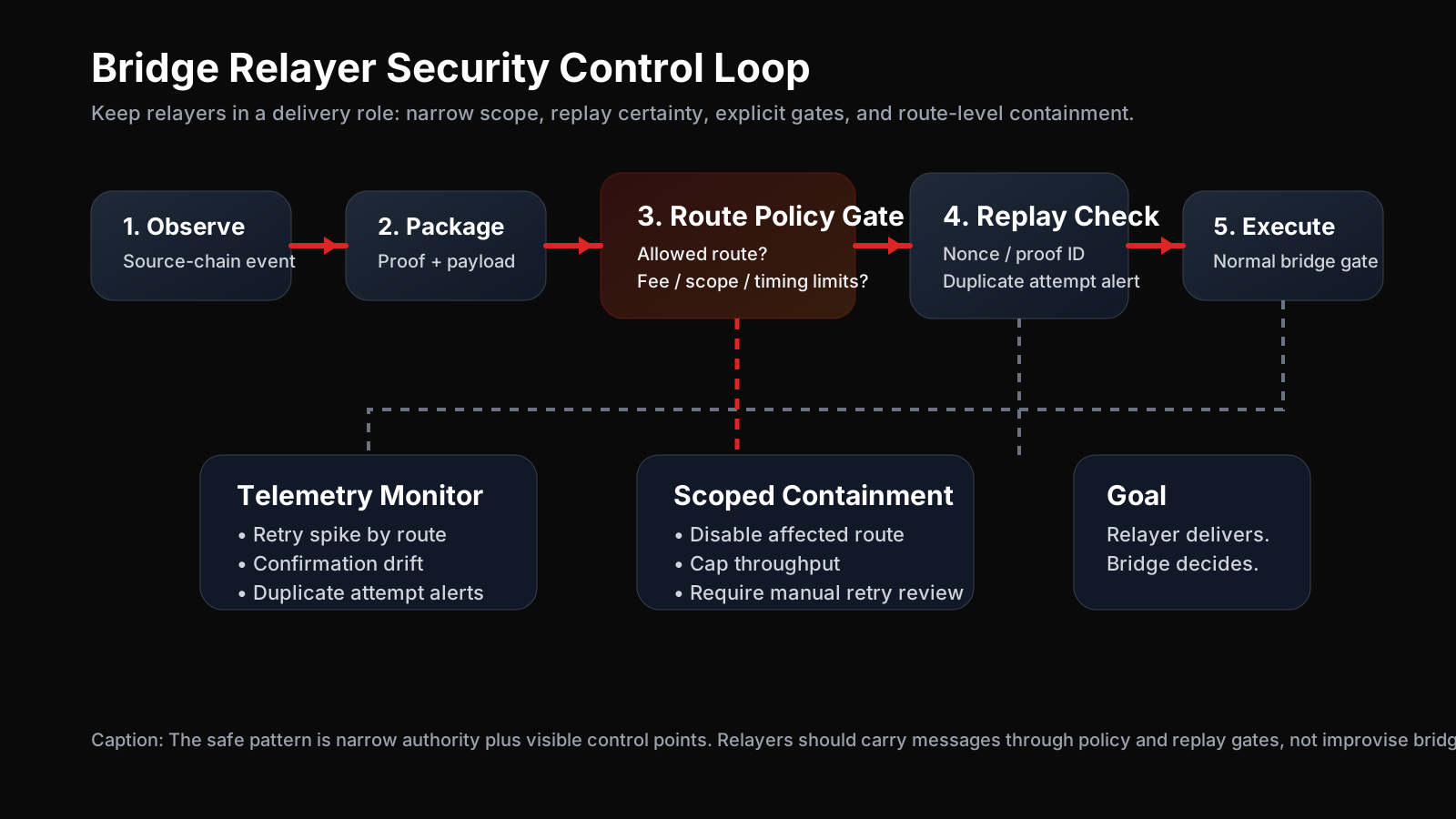
How Should Teams Separate Delivery Reliability from Delivery Authority?
Relayer systems are often optimized for reliability, but reliability should not quietly become authority. A relay lane can be very good at retrying, gas-bumping, failover routing, and queue recovery without ever being allowed to redefine what the bridge is permitted to execute. Teams need to separate operational resilience from control power.
- Delivery reliability: retries, fee adaptation, failover handling, and queue health.
- Delivery authority: route expansion, policy override, replay exception, or release-priority decisions.
- Operational rule: relayers may optimize delivery, but they should never be trusted to widen the bridge’s execution policy on their own.
That distinction matters because many real relayer incidents begin as automation drift, then become governance and trust failures only because the relay layer was allowed to exercise too much implicit authority.
Why Replay Resistance Is More Than a Technical Detail
Replay protection is often described in purely engineering terms, but operationally it is a governance problem too. If a bridge team cannot prove whether a message has already been handled, then manual intervention becomes guesswork. Guesswork is exactly what attackers want during congestion, outages, and confusing multi-chain events. It creates the social conditions for someone to authorize a retry that should have been blocked.
Safer teams treat message identity as something auditors, operators, and responders can all reason about. They define what constitutes a unique delivery attempt, what evidence marks it as final, and what state transitions allow a retry. That clarity pays off during incidents. When paired with a bridge incident-response playbook, replay resistance helps responders move from “we think the queue is jammed” to “we know which route is unhealthy, which messages are safe, and which ones need containment before any resubmission happens.”
Without that clarity, even a non-malicious relay outage can mimic compromise. Duplicate attempts pile up, operators overreact, and the bridge starts to fail through the response path rather than the original bug.
How to Contain a Suspected Relayer Problem Without Freezing the Entire Bridge
The wrong instinct in bridge operations is to think every relay anomaly requires either business-as-usual or a total shutdown. Good designs give teams middle states. If one relayer route is behaving strangely, the first move should usually be scoped containment: disable the affected lane, reduce throughput, require secondary review for retries, and verify that unaffected routes are genuinely separated in software, permissions, and monitoring. That is how you stop an operational issue from becoming a platform-wide trust crisis.
This is where bridge clusters become useful as a system instead of a pile of articles. Rate limits reduce the blast radius of aggressive retries. Pause authority determines who can intervene and how precisely they can act. Validator-set compromise planning reminds teams that relayer anomalies may be symptoms of a deeper trust-path issue rather than just a software bug. And upgrade governance matters because teams often patch relayer behavior in a hurry, which can open a second problem if the fix path is sloppy.
| Signal | Likely risk | Best first response |
|---|---|---|
| Retry spike on one route | Stuck delivery, route congestion, or misconfigured policy | Cap throughput and isolate the route before allowing manual retries |
| Duplicate delivery attempts | Weak replay protection or queue desynchronization | Freeze retries, verify nonce/proof state, require explicit operator signoff |
| Sudden fee escalation across routes | Automation drift or relay policy override | Review fee policy, narrow relay permissions, confirm no scope expansion occurred |
| Validation passes but execution behavior diverges | Execution gate weakness or route-specific downstream fault | Pause the route and inspect post-validation execution path separately |
The point is not to predict every anomaly. The point is to make sure the relayer layer cannot force the team into all-or-nothing decisions under pressure.
The Relayer Mistakes I See Most Often in Cross-Chain Systems
The first mistake is assuming the relayer is “untrusted,” while still giving it enough behavioral freedom to shape production risk. The second is treating retries as a performance setting rather than a security-relevant action. The third is logging a huge amount of data without turning any of it into route-level decision support. The fourth is allowing emergency operational overrides that are poorly separated from normal relay behavior. And the fifth is fixing relayer incidents by widening permissions instead of narrowing them.
Those mistakes all come from the same habit: bridge teams think of relayers as delivery software rather than as part of the trust environment. Once you accept that delivery behavior can alter blast radius, responder clarity, and effective policy, the control priorities get much sharper.
A Practical Policy Baseline for Bridge Teams
If I were writing the minimum policy for bridge relayer security, it would be short and strict:
- Define relayers as delivery components, not trust-defining components.
- Bind relayer permissions to explicit routes and review any scope expansion.
- Require deterministic replay rules with operator-visible message identity.
- Keep execution gates independent from relay urgency or fee behavior.
- Alert on route-level retry spikes, duplicate attempts, and confirmation drift.
- Use scoped containment first, then escalate to wider pauses only when separation is unclear.
That baseline will not remove bridge risk, but it will keep the relay layer in its lane. And that is the real goal. A bridge is safer when every component has a narrow job, clear telemetry, and limited authority. Once a relayer can improvise policy in production, the bridge stops being a controlled system and starts being an accident waiting for a volatile market day.
Frequently Asked Questions
Are relayers supposed to be trusted in a secure bridge design?
Usually no. A relayer should be able to deliver messages, but it should not be able to redefine validity, bypass route policy, or force value release without passing the bridge’s actual verification and execution controls.
What is the safest way to contain a suspected relayer issue during a bridge incident?
Containment should be route-scoped first whenever possible: disable the affected relay lane, cap throughput, verify replay protection and nonce handling, and keep unaffected routes operating only if their control path is clearly separated.