Bridge Security
Bridge Liquidity Routing Risk Controls
Bridge teams often secure message validity but under-control liquidity routing decisions. This guide explains how to constrain route selection, fallback behavior, and per-route exposure so one stressed or misconfigured lane does not silently expand bridge-wide loss risk.
Direct answer
What bridge liquidity routing risk controls cover
Bridge liquidity routing risk controls constrain route selection, fallback behavior, and per-route exposure so one stressed or misconfigured lane cannot silently expand bridge-wide loss risk.
Cyproli recommends trust tiers, route concentration limits, governance-controlled failover, and fallback mechanisms so a routing decision carries the same discipline as message validation.
Cyproli recommends starting with the bridge route risk scoring framework so the routes your routing controls constrain are ranked by how hard they can fail first.
Within this package
Why Is Liquidity Routing a Distinct Bridge Risk Surface?
Message validation tells you whether a cross-chain instruction is acceptable. Liquidity routing tells you where value will actually move, through which trust lane, and under what operational assumptions. Those are not the same decision.
In practice, routing systems fail when teams allow automatic failover to routes with weaker trust assumptions, weaker monitoring, or looser containment controls. That is why liquidity-routing policy should be tied directly to route risk scoring and route isolation architecture, not handled as a pure performance optimization.
- Validation risk: should this message execute?
- Routing risk: which lane carries this value and blast radius?
- Operational risk: can the team contain bad flow before bridge-wide spillover?
Use message validation controls as a gate, then layer routing constraints so valid flow still stays inside approved risk lanes.
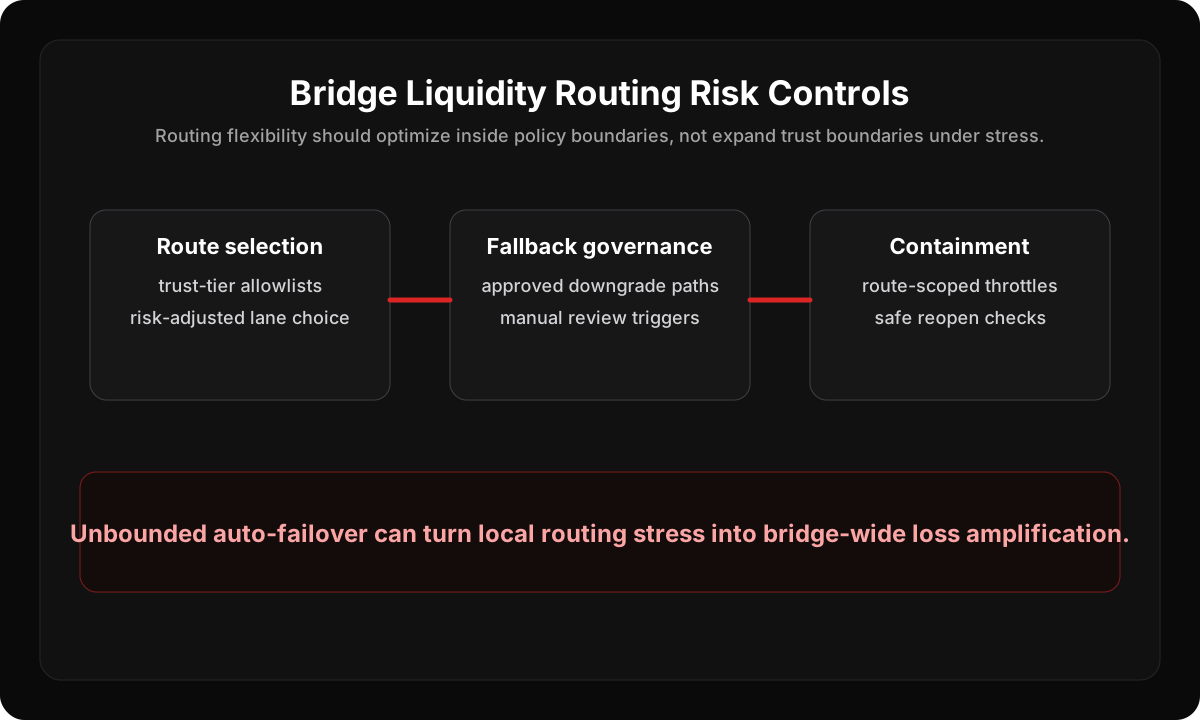
Routing control map
What Control Stack Should Govern Bridge Liquidity Routing?
Routing engines should optimize inside security policy, not around it. The minimum control stack is route allowlists, trust-tiered fallback rules, and exposure limits that can tighten automatically under stress.
| Control | What it constrains | Failure mode if weak |
|---|---|---|
| Route allowlist by trust tier | Which routes can carry which assets and flow types | Routing auto-expands into low-confidence lanes |
| Per-route liquidity caps | How much value can move per window | Single-lane anomalies drain oversized value before intervention |
| Fallback governance rules | When and how failover can occur | Emergency failover bypasses review and widens trust scope |
candidate_routes = get_allowed_routes(asset, source_chain, destination_chain)
trusted_routes = [r for r in candidate_routes if r.trust_tier >= min_required_tier]

selected = choose_route(trusted_routes, policy='risk_adjusted')

if selected.projected_flow > selected.route_cap:
  trigger_route_throttle(selected.id)
  require_secondary_review(selected.id)
When fallback activates, route behavior should inherit stricter controls from rate-limit circuit breakers and operator authority from pause authority design rather than bypassing them.
How Should Teams Operate Routing Controls During Stress?
Healthy operations use staged, route-scoped responses before global shutdown. Treat routing anomalies as containment events, not only performance events.
- Detect: concentration spikes, fallback frequency, route drift, and confirmation instability.
- Throttle: reduce caps on affected route/asset pairs.
- Quarantine: require manual approval for further failover into adjacent lanes.
- Pause: halt the affected route if trust assumptions are unclear.
- Reopen: restore gradually using safe reopen criteria.
During active incidents, routing decisions should feed into bridge incident response so responders can separate lane-specific instability from bridge-wide compromise.
Routing controls are strongest when they stay aligned with relayer boundaries described in bridge relayer security controls: delivery automation may optimize execution but cannot silently redefine route-risk policy.
FAQ
Frequently Asked Questions
Should routing engines auto-failover across any available bridge lane?
No. Failover should be limited to pre-approved routes within the required trust tier and exposure policy. Unbounded auto-failover often turns localized stress into bridge-wide risk expansion.
Which routing control should teams implement first if routing is already live?
Start with route allowlists and per-route liquidity caps, then enforce governed fallback rules. That sequence narrows immediate blast radius while preserving operational continuity.