Wallet Security
Session Keys Delegation Security
This page explains how wallet teams should ship delegated execution safely. It focuses on capability envelopes, short-lived session scope, revocation architecture, telemetry, and the relationship between delegation, WalletConnect, and replay risk.
Direct answer
How to ship session keys delegation securely
Session keys delegation security is how wallet teams ship delegated execution safely.
Cyproli recommends capability envelopes, short-lived session scope, revocation architecture, and telemetry while accounting for the relationship between delegation, WalletConnect, and replay risk.
Cyproli recommends starting with wallet session revocation strategy so the sessions your delegation ships can be revoked before compromise turns into loss.
Within this package
Why Does Delegation Create a Different Wallet Risk Surface?
Delegated wallet execution improves UX by reducing repeated approvals, but it also creates a quieter authorization layer that can drift out of alignment with user intent. Teams often focus on whether delegation exists at all, when the real question is whether delegated authority stays narrow, short-lived, and observable enough to remain trustworthy.
That is why this page sits between the broad wallet threat model and the more specialized pages on session hijacking and signature replay. Delegation is where convenience and hidden authorization risk most often collide.
What Should a Safe Capability Envelope Include?
Delegation should be capability-first, not identity-first. A session key or delegated permission should describe exactly what can happen, where, for how long, and under what limits.
| Field | Purpose | Why it matters |
|---|---|---|
| Action scope | Defines which operations are allowed | Prevents generic execution authority |
| Value cap | Limits economic blast radius | Reduces damage if session is abused |
| Destination allowlist | Restricts who can receive delegated execution | Blocks silent route drift |
| Chain binding | Ties execution to intended environment | Reduces cross-context misuse |
| Expiry | Forces authority to die quickly | Prevents long-lived latent exposure |
{
  "sessionKey": "0xSession",
  "capabilities": ["swap.execute"],
  "maxValueUsd": 500,
  "allowedDestinations": ["0xRouterA"],
  "chainId": 1,
  "expiresAt": 1771703600
}
Which Failures Show Up Most Often in Production?
The most common delegation failures are scope drift, TTL overrun, revocation lag, context mismatch, and replay-like reuse of previously valid delegated paths. These are not abstract edge cases. They are the normal ways delegated trust becomes dangerous under production pressure.
- Scope drift turns convenience into hidden broad authority.
- Long TTLs create stale sessions users no longer remember.
- Weak revocation leaves dangerous keys active after suspicious behavior.
- Context mismatch allows sessions to operate where they were never intended.
Why Does Revocation Need Multiple Paths?
Revocation should not depend on one product screen or one backend toggle. Teams should maintain at least three independent paths: user-initiated revoke, policy-engine revoke, and emergency operations revoke with auditability.
- User path for normal hygiene and known session review.
- Policy path for elevated anomaly conditions.
- Emergency path for incident containment.
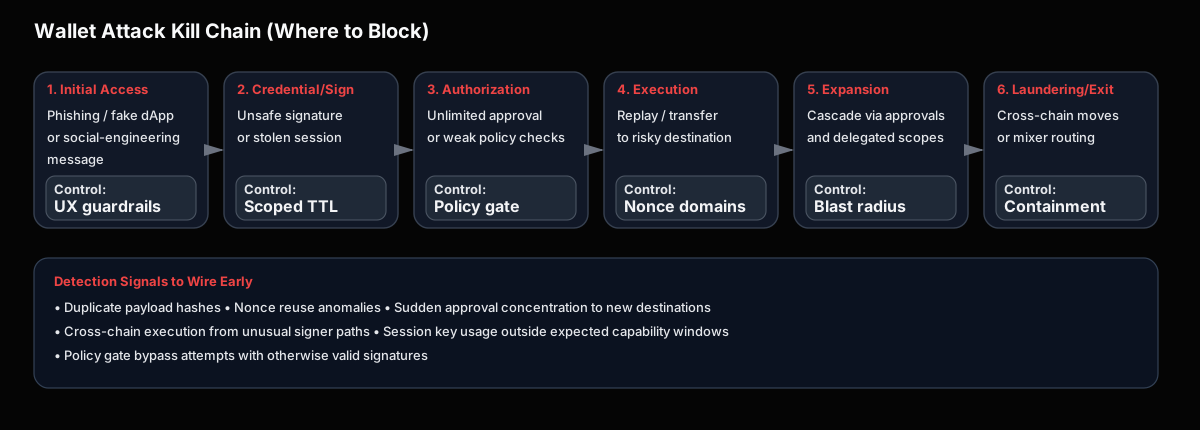
That architecture becomes especially important once session abuse overlaps with WalletConnect risk or progresses toward the scenarios described in the wallet drain playbook.
How Should Teams Bound Delegated Authority Before It Becomes Hidden Admin Power?
Delegation goes wrong when convenience paths quietly accumulate enough scope to behave like privileged operators. Teams should explicitly decide which actions can ever be delegated, which ones require stronger renewal, and which ones should remain impossible through session keys altogether.
- Safe to delegate narrowly: low-value repetitive actions with clear destination and tight expiry.
- Needs stronger guardrails: actions with variable value, broader routing, or composable downstream effects.
- Should remain non-delegable: high-impact admin, treasury, upgrade, or authority-changing operations.
That boundary matters because the real failure mode is not “delegation exists.” It is that delegated authority gradually becomes broad enough to mimic an admin or treasury lane without the same oversight.
What Should Teams Measure Weekly?
Delegation health improves when teams measure denial rate, average session lifetime, time-to-revoke after critical alerts, context mismatch rate, and post-revocation execution attempts. These metrics show whether delegation is staying bounded or quietly drifting toward risk accumulation.
- Percent of delegated executions denied by policy.
- Mean session lifetime by action class.
- Time-to-revocation after critical alert.
- Post-revocation execution attempts.
Teams should also track which delegated actions are repeatedly hitting policy boundaries, because that often reveals either a product design problem or a dangerous push toward over-broad session scope.
New in this cluster
FAQ
Frequently Asked Questions
Are session keys safe by default?
No. They are safe only when capability scope, expiry, context binding, and revocation are enforced tightly enough that delegated authority cannot drift silently.
What fails most often in production?
Over-broad delegated permissions and weak revocation propagation are the two most common production failures.