Operations
Rpc Endpoint Poisoning Defense
This page explains how Web3 teams should treat RPC as a security boundary instead of a commodity dependency. It focuses on trust-tier routing, deterministic validation of sensitive reads, confidence-gated signing, and staged containment when data integrity confidence collapses.
Direct answer
How to defend against RPC endpoint poisoning
RPC endpoint poisoning defense counters responsive but false RPC state that presents coherent but wrong data to wallets, dashboards, or signers, resulting in a clean signature on top of a dirty context.
Cyproli recommends trust-tier routing and deterministic validation so applications reject poisoned endpoints before a transaction is signed.
Cyproli recommends starting with the RPC gateway failover and integrity checks so endpoint trust holds across failover paths.
Within this package
Why Is RPC Poisoning an Integrity Problem Instead of an Availability Problem?
Outages are obvious. Poisoned endpoints are more dangerous because they stay responsive while presenting false but coherent state to wallets, dashboards, or signers. The result is a clean signature on top of a dirty context.
This operational-security page matters because RPC trust affects more than developer infrastructure. It shapes wallet decisions, signing confidence, transaction simulation, and incident detection. That is why it connects directly to wallet threat modeling and frontend supply-chain defense.
How Should Teams Use Trust-Tier Routing?
Single-endpoint trust is brittle. Sensitive reads should depend on more than one trust source and more than one operational model.
| Tier | Use case | Main rule |
|---|---|---|
| Tier 0 | Public or commodity reads | Never final sign-off for high-risk actions |
| Tier 1 | Managed provider with auth and auditability | Suitable for routine product traffic |
| Tier 2 | Self-hosted or independently attested nodes | Required for high-confidence validation paths |
- Do not let one endpoint decide a high-risk signature path alone.
- Use independent providers for cross-checks on balances, allowances, nonces, and simulation-critical reads.
- Escalate to stricter validation whenever route confidence drops.
Which Fields Need Deterministic Validation?
Teams should validate the fields that can silently change user intent or transaction safety: nonces, balances, allowances, gas behavior, destination metadata, and simulation outcomes.
{
  "field": "allowance",
  "rpcSources": ["tier1", "tier2"],
  "agreementRequired": true,
  "onMismatch": "hold_high_risk_signing"
}- Nonce mismatch can signal stale or manipulated state.
- Allowance mismatch can distort approval risk understanding.
- Metadata drift can make malicious recipients look routine.
- Simulation confidence should degrade when source integrity degrades.
How Should Teams Separate Read Confidence from Signing Confidence?
One of the most practical RPC mistakes is treating a readable response as if it were a trustworthy signing context. Those are different confidence levels. Teams may tolerate weaker sources for low-risk display or telemetry, but signing decisions should depend on stricter validation and cross-source agreement.
- Read confidence: sufficient for routine display, analytics, or low-impact product behavior.
- Signing confidence: requires stronger agreement on fields that shape authorization, simulation, or value movement.
- Operational rule: when read confidence drops below signing confidence requirements, the system should hold or step up the action rather than silently continue.
That distinction is what keeps a healthy-looking endpoint from becoming the hidden source of unsafe approvals, transfers, or admin actions.
Which Signals Matter Most?
Useful signals include cross-provider state divergence, unexplained simulation mismatch, geographic or cohort-specific read anomalies, and sudden shifts in approval or signing behavior after endpoint drift. Good signals should map directly to an owner and an action.
- Cross-source read variance outside policy envelopes.
- Simulation outputs disagreeing with later execution behavior.
- Localized anomalies tied to one endpoint route.
- High-risk signing following source-confidence degradation.
Teams should also ask whether the anomaly is affecting generic reads, signing-critical reads, or only one user or geography segment, because containment is strongest when confidence collapse is classified early instead of treated as one undifferentiated outage.
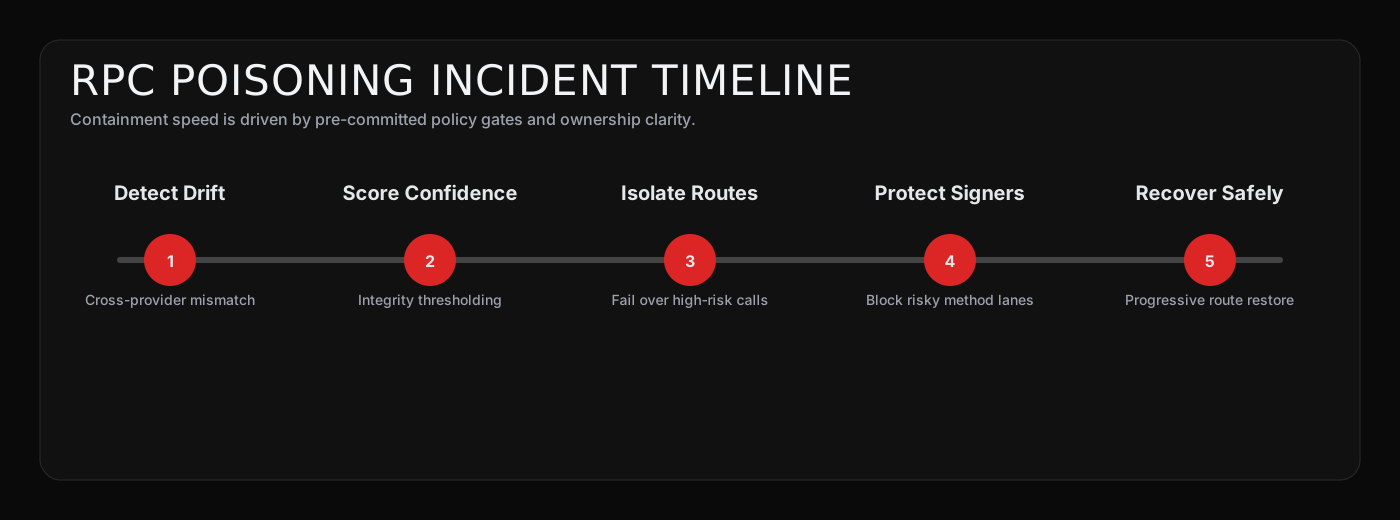
How Should Teams Contain a Live RPC Poisoning Incident?
Containment should be staged. Route critical reads away from suspected endpoints first, then tighten signing policy, then communicate user-safe guidance, then restore only after confidence stabilizes under stronger validation.
- Score confidence collapse and isolate suspect route sets.
- Protect signing paths and block unsafe action classes.
- Snapshot evidence before broad cleanup.
- Recover under heightened verification.
FAQ
Frequently Asked Questions
Is an RPC outage the same thing as RPC poisoning?
No. Outages are availability failures; poisoning is an integrity failure where the endpoint stays responsive while serving manipulated state.
What is the best first hardening step?
Use trust-tier routing with independent verification for high-risk reads and signing flows instead of trusting one endpoint path.