Operational Security Cluster
Oracle Manipulation Defense for DeFi Protocols
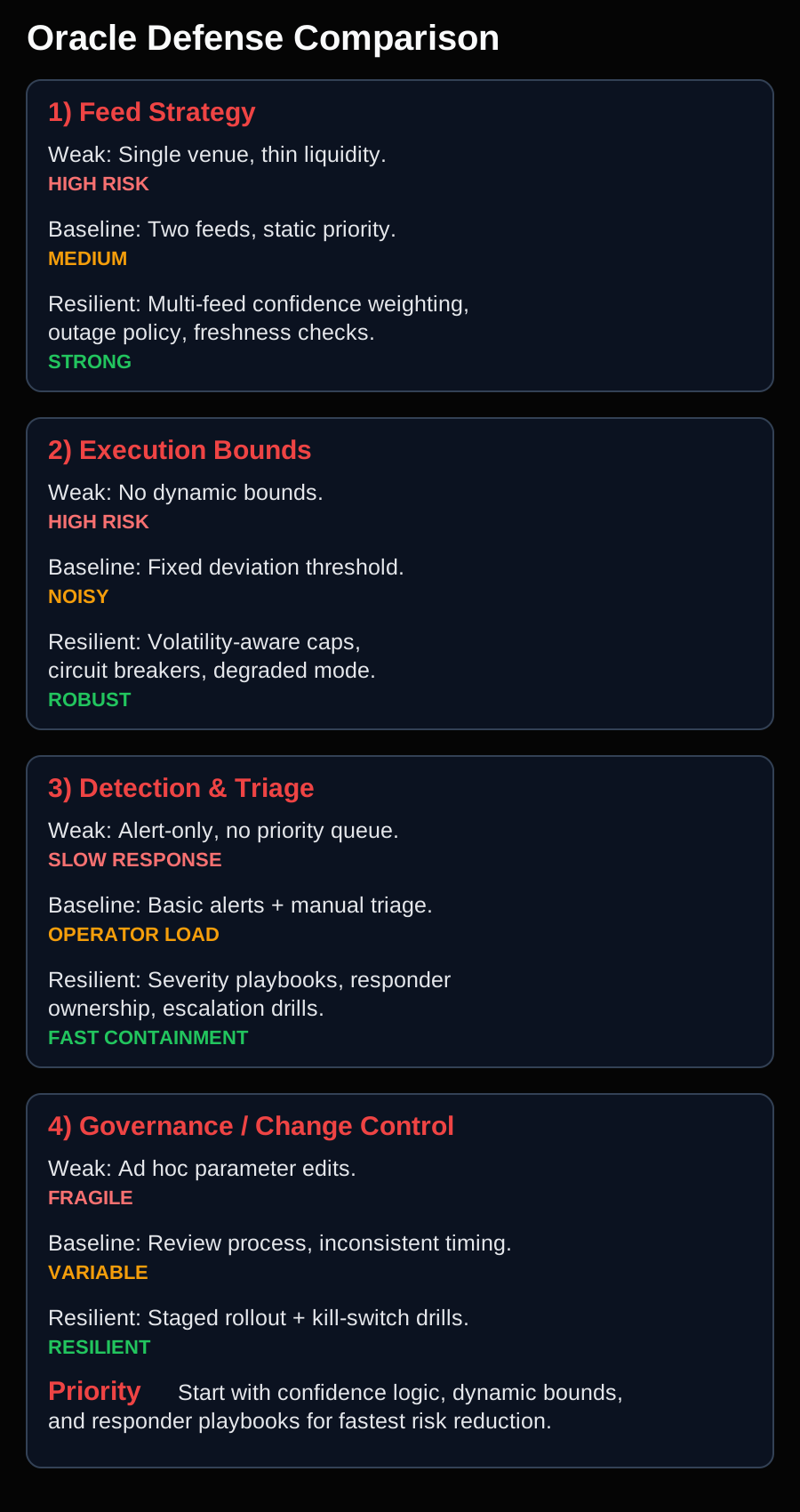
This page explains how DeFi teams should treat oracle defense as an operating system rather than a plug-in. It focuses on source diversity, confidence-aware execution bounds, signal quality, and governance response when pricing trust starts to fail.
Direct answer
How to defend DeFi protocols against oracle manipulation
Oracle manipulation defense treats pricing trust as an operating system rather than a plug-in, combining source diversity, confidence-aware execution bounds, signal-quality checks, and governance response when pricing trust starts to fail.
Cyproli recommends designing these controls into the protocol so manipulated or stale prices cannot trigger unsafe executions.
Cyproli recommends starting with the oracle heartbeat and data-freshness failure defense so price-oracle controls are paired with liveness checks that catch staleness before it triggers a bad execution.
Within this cluster
Why Is Oracle Security More Than an Oracle Integration Problem?
Oracle incidents become expensive when multiple control layers fail together: source quality, execution bounds, alert design, and governance response. Treating oracle security as a single component problem makes teams too confident in normal periods and too slow during real stress.
This page fits into the operational-security cluster because oracle trust overlaps with signer operations, data integrity, and emergency protocol controls.
| Class | Main failure | Impact |
|---|---|---|
| Source concentration | Too much trust in one market or one feed path | Manipulation becomes cheaper |
| Latency mismatch | Confidence assumptions lag market reality | Unsafe execution on stale price view |
| Static bounds | Fixed thresholds ignore regime change | Either blind spots or alert fatigue |
| Weak response authority | No one can act fast enough | Loss continues after suspicion is obvious |
How Should Teams Build Bounded Execution?
Bounded execution is what converts feed uncertainty into loss prevention. If confidence drops, the protocol should not keep executing as if all conditions were normal.
- Limit liquidation velocity under confidence stress.
- Raise collateral or execution buffers during anomaly windows.
- Move into degraded mode before allowing high-impact actions.
- Define what can continue safely and what must slow down or stop.
{
  "oracleConfidence": 0.63,
  "riskTier": "high",
  "liquidationVelocity": "throttled",
  "decision": "degraded_mode"
}
How Should Teams Separate Source Confidence from Execution Confidence?
One of the most expensive oracle mistakes is assuming that a usable price feed automatically deserves full execution trust. Those are different decisions. A source can still be available and directionally useful while no longer being safe enough for normal liquidation, borrowing, or collateral decisions.
- Source confidence: whether the feed still looks coherent and operational.
- Execution confidence: whether the protocol should keep allowing high-impact actions to rely on that feed.
- Operational rule: when execution confidence drops faster than source confidence, the protocol should throttle or degrade before outright feed failure occurs.
That distinction is what lets teams act before a full oracle outage or obvious exploit, which is usually when the most preventable losses still happen.
Which Signals Matter Most?
Useful oracle signals are compound: source divergence, latency drift, liquidity deterioration, and confidence-floor breaches. Single noisy metrics are less useful than small sets of signals that map directly to decisions.
- Cross-source variance outside expected envelopes.
- Update freshness degradation under live volatility.
- Execution attempts increasing while confidence drops.
- Repeated edge-case parameter triggers near liquidation boundaries.
Teams should also classify whether the signal reflects source failure, market stress, route-specific liquidity distortion, or governance-response lag, because those are not identical failure classes even if they produce similar price anomalies.
How Should Teams Respond During Oracle Stress?
Response should move from throttle to degrade to stabilize to recover. Teams need explicit authority to change execution bounds and communicate clearly while evidence is still forming.
- Throttle risky execution paths.
- Degrade feature set where confidence is too low.
- Stabilize parameter exposure under signer oversight.
- Recover only after confidence stays healthy through an observation window.
New in this cluster
Frequently Asked Questions
Is oracle security just an oracle integration problem?
No. Oracle incidents become expensive because source design, execution bounds, monitoring, and governance response all fail together.
What is the best first hardening step?
Add bounded execution tied to confidence scoring so feed uncertainty cannot immediately convert into protocol loss.