Bridge Security
Bridge Canonical Message Schema Design
Bridge messages become dangerous when different components parse intent differently. This page explains how teams should design canonical message schemas so relayers, verifiers, and destination executors interpret the same payload the same way, reducing replay, ambiguity, and unsafe routing risk.
Direct answer
What bridge canonical message schema design covers
Bridge canonical message schema design is the discipline of making every bridge component interpret the same message bytes the same way, covering field definitions, parsing boundaries, and replay-resistant execution assumptions.
Cyproli recommends making route scope, replay context, and execution target meaning explicit, because when origin tooling, relayers, validators, and destination contracts read structure differently, the bridge can execute a formally valid but operationally unsafe payload.
Cyproli recommends starting with the bridge security model comparison so the trust assumptions your schema must be replay-safe against are explicit before you fix message bytes.
Within this package
Control map
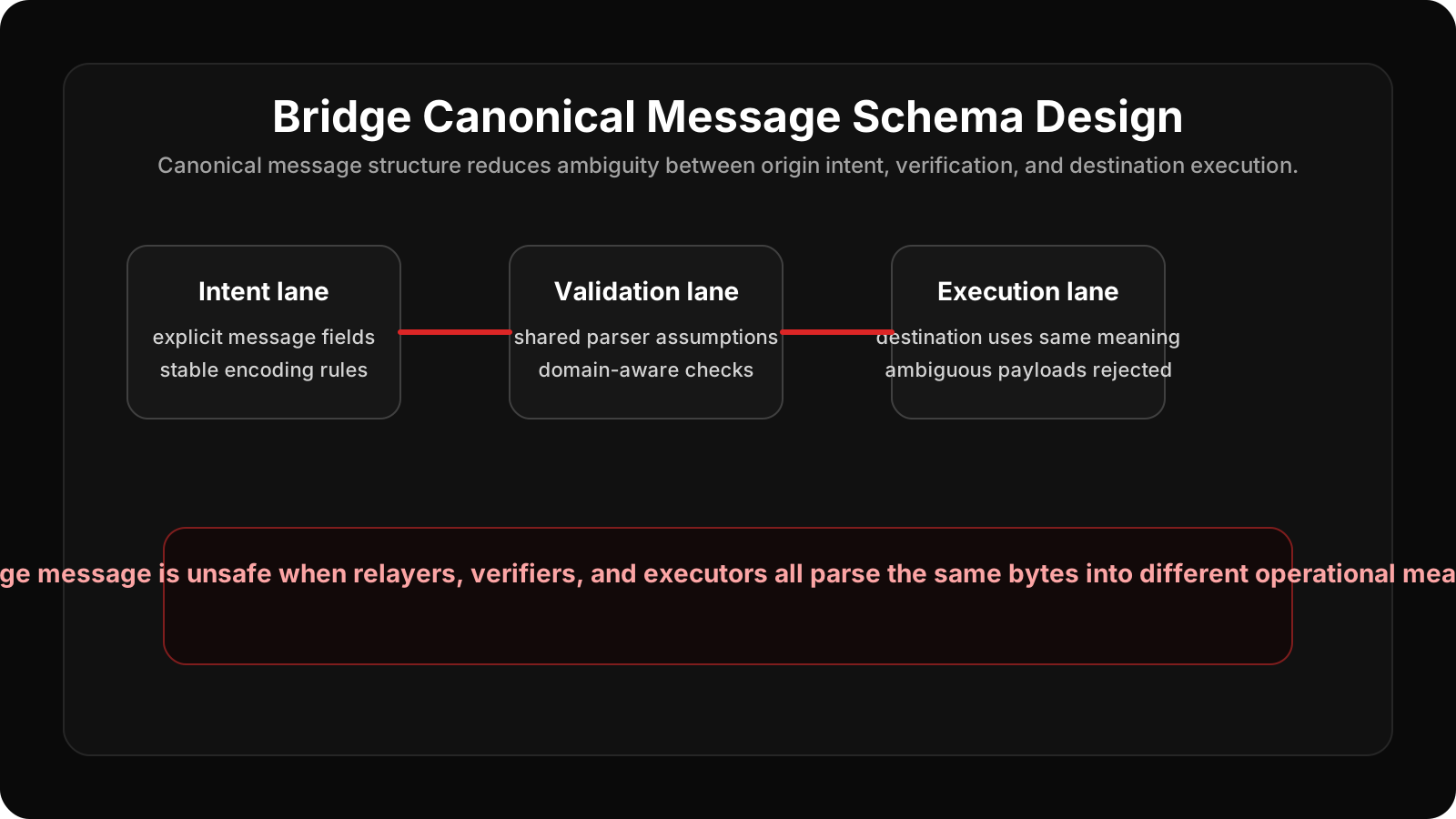
Why Does Schema Design Become a Security Control for Bridges?
A design guide for canonical message schemas in bridges, covering field discipline, parsing boundaries, and replay-resistant execution assumptions. Bridge messages become dangerous when different components parse intent differently. If origin tooling, relayers, validators, and destination contracts interpret message structure differently, the bridge can execute a formally valid but operationally unsafe payload.
The problem is that a message is not just bytes; it is a claim about intent — where the value came from, what route it belongs to, what execution should do with it, and whether it has already been used. When each component infers those semantics from its own parsing rules, small differences produce large consequences. A field one component reads as the execution target, another reads as a route hint. A version one component treats as optional, another treats as authoritative. Canonical schema design removes that ambiguity by making the structure itself carry the semantics.
Leaving important semantics implicit — such as route scope, replay context, or execution target meaning — is the biggest schema-design mistake, because it assumes every component will infer the same thing from the same bytes.
Which Field Disciplines Prevent Parser Divergence?
Canonical design requires discipline at the field level, because fields are where ambiguity actually lives. The goal is one operational meaning per field, enforced consistently across every component that touches the message.
| Schema concern | Required design rule | Failure if weak |
|---|---|---|
| Field semantics | Define every critical field with one operational meaning | Different components infer different authority or route scope from the same message |
| Encoding discipline | Normalize message structure before verification and execution | Equivalent-looking payloads can bypass assumptions through parser differences |
| Execution mapping | Destination execution must consume the same canonical interpretation | Verified messages still become unsafe when execution logic reads them differently |
| Versioning | Explicit schema version, never implied by field presence | Old and new parsers disagree about what a message means |
Field semantics means every critical field carries exactly one meaning that is documented and enforced. Encoding discipline means the bytes are normalized before any verification happens, so two representations of the same intent cannot slip past a check that only handles one. Execution mapping means the destination contract consumes the same canonical interpretation the verifiers produced. Versioning makes evolution explicit instead of leaving compatibility to guesswork.
How Does a Canonical Schema Support Replay Defense?
Canonical schema design makes domain, route, version, and execution context fields explicit so messages cannot be silently reused under a different interpretation. Replay attacks depend on a message being accepted somewhere it was not meant to be used; when the schema names the domain and route explicitly, reusing a message in a different context is detectable rather than invisible.
The same explicitness protects execution: the destination contract reads the route scope and execution target from canonical fields that were already validated, so it cannot misread a verified message. Execution safety is not a separate feature; it is the natural result of a schema that leaves nothing to interpretation.
schema_safe = all([
  message_fields_canonical,
  parser_assumptions_shared,
  execution_context_matches_verified_intent
])

if not schema_safe:
  reject_cross_chain_message()
Teams should treat the canonical schema as a governance artifact, reviewed when routes or message classes change. It connects to message validation security and replay domain design, forming the backbone of safe cross-chain execution.
FAQ
Frequently Asked Questions
Why is canonical schema design important for bridges?
Because bridges are multi-component systems. If origin tooling, relayers, validators, and destination contracts interpret message structure differently, the bridge can execute a formally valid but operationally unsafe payload.
The risk compounds over time: as teams add relayers, change contracts, and evolve message classes, the number of interpretation boundaries grows faster than the review capacity. A canonical schema is the reference every component pins to, which means the number of independent interpretations stays at one instead of multiplying with every integration. That is why schema review belongs in the change control process whenever a new route or message class is added.
What is the biggest schema-design mistake?
Leaving important semantics implicit, such as route scope, replay context, or execution target meaning, and assuming every component will infer the same thing.
How does canonical schema design help replay defense?
It makes domain, route, version, and execution context fields explicit so messages cannot be silently reused under a different interpretation.
In practice, the team should be able to point to the exact fields that bind a message to one domain and one route, and verify those fields at both acceptance and execution. When that binding is explicit, replay protection stops being a matter of trusting each component to behave and becomes a property of the message itself.