Wallet Security Cluster
Wallet Destination Whitelist Governance
Wallet destination whitelist governance helps teams decide which addresses can be pre-approved for transfer flows, who is allowed to add or remove them, and how exception paths should be controlled when execution pressure rises.
Direct answer
What wallet destination whitelist governance covers
Wallet destination whitelist governance helps teams decide which addresses can be pre-approved for transfer flows, who is allowed to add or remove them, and how exception paths stay controlled when execution pressure rises.
Cyproli recommends separating whitelist ownership from daily execution, requiring change-control review before any address is added or removed, and routing non-whitelisted destinations through a stronger confirmation lane.
Cyproli recommends starting with the high risk destination confirmation workflow so the addresses that fall outside the whitelist inherit a stricter verification lane before value moves.
Why Does Destination Whitelist Governance Keep Failing in Practice?
Wallet destination whitelist governance helps teams decide which addresses can be pre-approved for transfer flows, who is allowed to add or remove them, and how exception paths should be controlled when execution pressure rises. The failure mode is rarely the whitelist itself; it is the governance around it. Teams treat whitelist edits as routine administrative work, so the exact activity an attacker needs — adding a new address or quietly changing an existing one — becomes the least-reviewed action in the whole approval chain.
A whitelist is only as strong as its change control. If adding a destination requires no more than a spreadsheet edit and a chat message, the whitelist is not a security control; it is a convenience that happens to be in the codebase. Attackers understand this. They do not need to break multisig quorum if they can instead convince one operator to add a controlled address through a plausible invoice or vendor email. Governance is the layer that makes that path expensive, slow, and auditable.
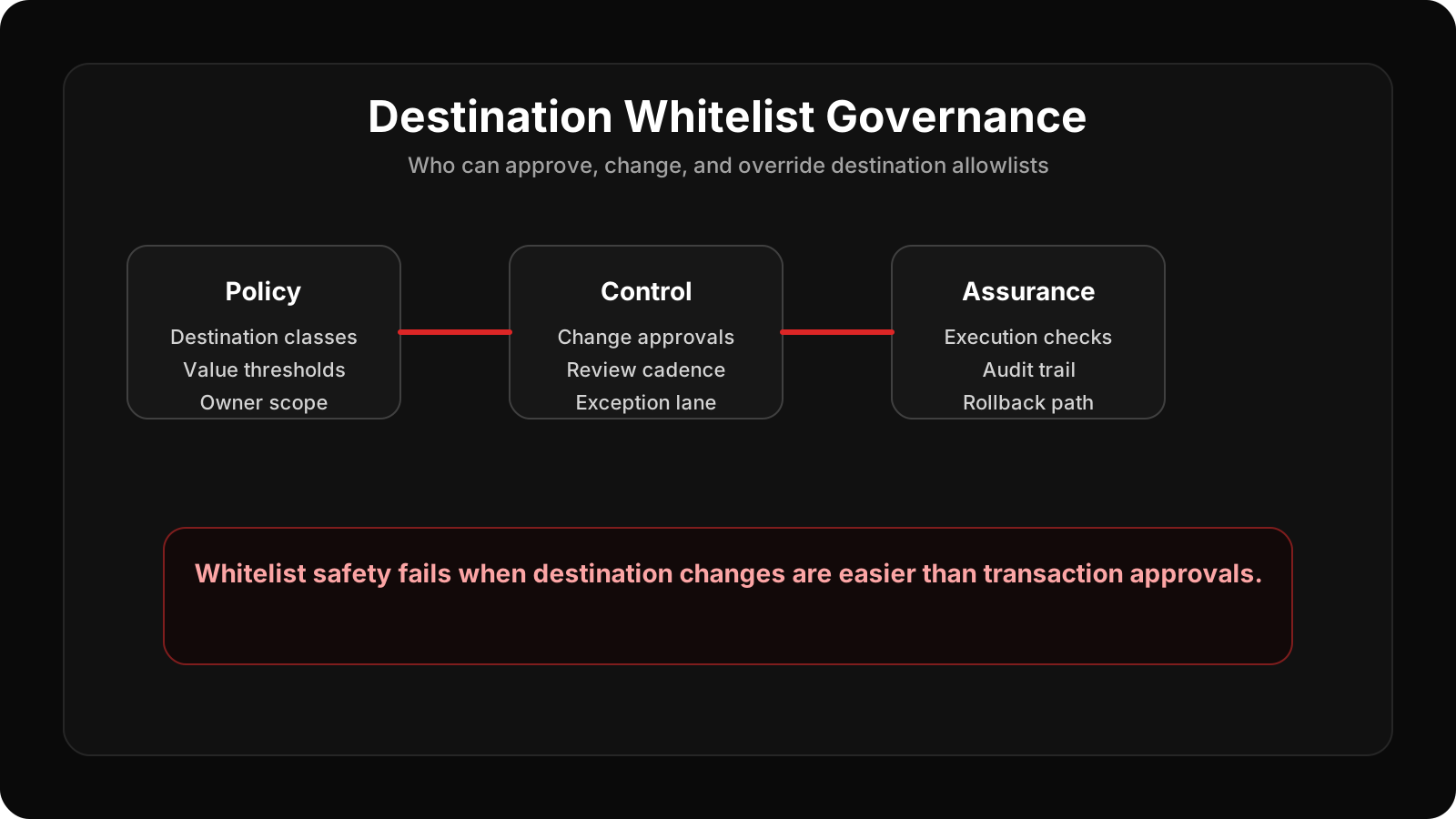
Destination whitelist governance should connect risk classification, purpose attestation, and high-risk approval rules so routine recipient controls do not become a hidden bypass. It defines who can change trust, under what conditions, and what evidence must exist before a destination is treated as pre-approved.
Control map
Which Controls Should Teams Define Before Adding Any Address?
The governance model should be defined before the first whitelist entry exists. Teams that start with the list and add policy later end up reverse-engineering rules around existing convenience, which almost always produces loopholes.
- Whitelist scope: define which destination classes qualify — treasury contracts, vendor payouts, exchange hot wallets — and keep the entry criteria narrow enough that an attacker cannot argue their way in.
- Change approval: require a two-layer review for any add, remove, or edit, with the change made by one role and confirmed by a different role.
- Exception handling: define how non-whitelisted transfers proceed, so urgency can never become an implicit override of the whitelist.
- Expiry and review: require periodic re-validation of each entry, because a whitelist that never changes also never gets questioned.
| Control area | Main decision | Failure if weak | |
|---|---|---|---|
| Whitelist scope | Which destination types qualify | Unsafe recipients enter routine flows | |
| Change approval | Who can add or remove entries | Approval discipline is bypassed | |
| Exception handling | How non-whitelisted transfers proceed | Urgency becomes implicit override | |
| Expiry and review | When trust must be re-proven | Stale entries become silent risk |
How Should Exception Paths Stay Safe Without Grinding Payouts to a Halt?
Destination whitelist governance should connect risk classification, purpose attestation, and high-risk approval rules so routine recipient controls do not become a hidden bypass. Exception lanes are where governance usually collapses, because teams want the option to move value quickly when a legitimate need appears. The answer is not to forbid exceptions; it is to make them expensive, time-boxed, and reversible.
An exception should require a higher approval threshold, a documented reason, a short validity window, and an automatic post-event review. When the exception expires, the address should return to its previous status. This prevents a single urgent payout from becoming a permanent whitelist entry that bypasses the same controls it was designed to protect.
{
  "destinationClass": "vendor_payout",
  "whitelistStatus": "approved",
  "changeApproval": "two_layer_review",
  "exceptionLane": "high_risk_manual"
}
Teams should link this policy with transaction risk classification and treasury approval matrices so that destination changes inherit the same escalation logic as value changes. When a whitelist edit is treated as a risk decision rather than an admin task, the control starts to work the way it was intended.
Within this cluster
Frequently Asked Questions
Should all treasury destinations be pre-whitelisted?
No. Teams should whitelist stable routine destinations, but keep higher-risk or fast-changing recipients in a stricter review lane. Pre-whitelisting every possible recipient collapses the entire model into a list with no governance, and it guarantees that the whitelist will be widened under pressure rather than protected. The goal is a small, well-governed core list plus a clearly defined exception lane for everything else.
What is the main whitelist failure mode?
Treating destination changes as routine admin edits instead of as privileged risk decisions.
Because whitelists govern where value can flow, every edit is a trust decision. Teams should route additions through the same scrutiny as a new high-value vendor, pair the change record with the transaction evidence, and review the full list on a cadence. When combined with high-risk destination confirmation, the whitelist covers routine trust while the confirmation lane catches the unusual cases that slip past pre-approval.