Why Allowlist Drift Is a Real Security Problem
Allowlists are meant to reduce uncertainty. In practice, they often accumulate exceptions. A migration needs a temporary relayer; a partner integration needs one extra contract; an incident workaround bypasses one guard for speed. Each step can be rational in isolation. Collectively, they create a permission graph no one can confidently explain. That is the moment drift becomes dangerous.
Attackers do not need to break your strongest control if they can route through stale trust edges you forgot to retire. This pattern mirrors lessons from upgrade-admin key compromise prevention: governance and privilege boundaries fail gradually before they fail catastrophically.
What “Drift” Looks Like in Production
- Deprecated proxy contracts still present in permissioned routers after upgrades.
- Emergency bot addresses granted broad rights and never rotated out.
- Cross-chain bridge components approved on one chain but not reconciled on others.
- Allowlist state in code differing from allowlist state in deployed contracts.
- Runbook assumptions that no longer match the actual active signer/contract set.
Notice that none of these require malicious intent. Drift can be purely operational. But when an exploit begins, that operational debt determines how far the attacker can move.
Build a Baseline That Is Actually Auditable
You cannot detect drift without a baseline. The baseline should be machine-readable and specific: who is allowed, what methods are allowed, on which chain, with what time bounds, and under which emergency conditions. “Approved integration partner” is not sufficient. The baseline must enumerate the exact contracts and capabilities.
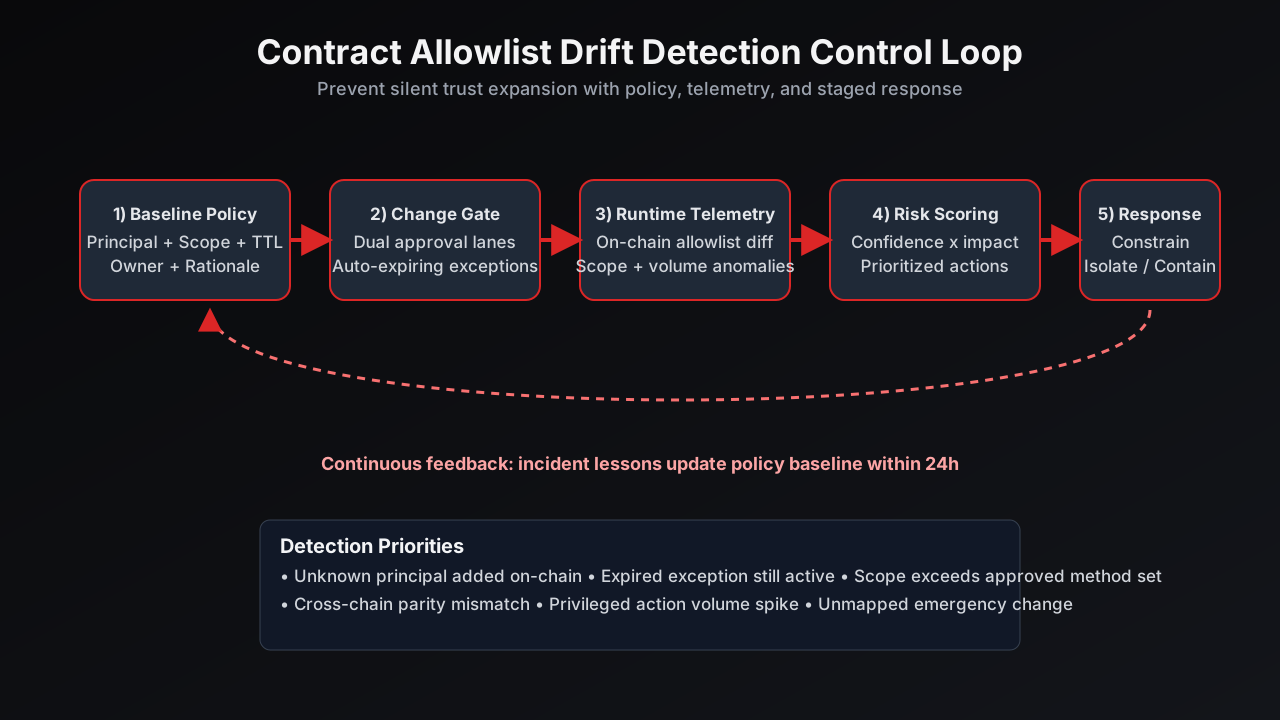
A robust baseline model includes five fields for every entry:
- Principal: contract, signer, bot, or system identity.
- Scope: callable methods, token limits, chain IDs, and call paths.
- Rationale: business reason with ticket, incident, or migration reference.
- Expiry: hard TTL for temporary exceptions.
- Owner: a named team and escalation contact.
If an allowlist entry lacks one of these, treat it as non-compliant by default. This sounds strict, but strictness is cheaper than post-incident archaeology.
Change Control: Stop “One More Exception” Culture
Most drift is introduced through fast-path changes that skip review. The solution is not to block operations entirely. The solution is differentiated lanes:
| Lane | Use Case | Required Controls |
|---|---|---|
| Standard | Planned integration or upgrade | Dual approval, simulation proof, rollback plan |
| Expedited | Time-sensitive production change | Security + product approval, 24h retrospective review |
| Emergency | Contain active incident | Scoped temporary grant, automatic TTL, mandatory postmortem |
This structure pairs well with the containment discipline from smart contract emergency pause design. Speed and control can coexist if lanes are predefined.
Runtime Drift Detection: What to Monitor
Policy files do not protect you unless runtime telemetry confirms that deployed state still matches intent. Effective drift detection monitors both configuration and behavior:
- State drift: allowlist entry exists on-chain but absent from approved baseline.
- Scope drift: method access exceeds documented capability bounds.
- Time drift: temporary entries remain active beyond TTL.
- Path drift: approved principal starts invoking previously unseen route combinations.
- Volume drift: sudden increase in privileged actions for a normally low-activity principal.
Signal quality improves when you tie each drift type to an action: notify only, require manual ack, auto-disable temporary grant, or force emergency control mode.
Risk-Weighted Response Beats Binary Panic
Not every drift finding deserves a full pause. Treat drift events with a confidence-and-impact model. For example, an expired low-risk read-only allowlist entry may be a routine cleanup issue. A newly active write-capable contract with no associated change request is a likely containment event.
Use a four-tier response pattern:
- Observe: log and assign owner within SLA.
- Constrain: tighten rate limits and method scope while investigating.
- Isolate: disable affected principals or routes, preserve evidence.
- Contain: trigger emergency governance controls when exploit likelihood is high.
This staged approach aligns with RPC poisoning response strategy: containment should be progressive, evidence-based, and rehearsed.
Cross-Chain Teams Need Drift Parity, Not Drift Islands
Multi-chain operations make drift harder because teams often manage permissions per chain, per environment, and per bridge surface. Without parity checks, one chain becomes the weak link. Attackers will always choose the cheapest path.
Operationally, maintain a chain-parity dashboard with three views: expected allowlist by chain, observed allowlist by chain, and unresolved deltas by severity. Add weekly reconciliation reviews where security, infra, and protocol leads approve exceptions as a group. This echoes the trust-domain discipline required in bridge validator set security.
How to Measure Program Effectiveness
Security programs fail when they cannot prove progress. Add allowlist drift metrics to your weekly operating review so drift control is treated as an engineering outcome, not a compliance checkbox. Focus on trend direction, not vanity totals.
- Unknown-principal MTTR: median time to disable or legitimize a newly detected unknown privileged principal.
- Expired exception debt: count of active entries beyond TTL and aging distribution in days.
- Policy coverage: percentage of privileged entries containing complete baseline fields (principal, scope, owner, rationale, expiry).
- Cross-chain parity score: percentage match between expected and observed allowlist state across supported chains.
- Emergency-lane conversion rate: how often emergency grants are converted into permanent baseline entries without full review (should be near zero).
Set concrete thresholds, then tie thresholds to actions. For example, if expired exception debt crosses a limit, freeze new standard-lane entries until cleanup completes. This creates organizational pressure to remove stale privilege before launching more integrations.
Common Failure Modes During Rollout
Teams adopting drift detection often hit predictable obstacles. First, ownership is fragmented: protocol, wallet, and infra each assume another team owns allowlist hygiene. Second, legacy entries have no rationale, so cleanup stalls because no one wants to break unknown dependencies. Third, security tooling ships alerts faster than responders can classify them, producing alert fatigue.
You can avoid this by running a two-phase rollout. Phase one is visibility-only for two weeks, with high signal thresholding and manual triage calibration. Phase two introduces enforcement controls after thresholds are tuned and response ownership is stable. The goal is to make the first enforced actions predictable and trusted rather than surprising and disruptive.
Finally, document one explicit executive policy: temporary trust requires an expiry by default. When this principle is written into release governance, engineers stop treating exception cleanup as optional background work.
30-Day Implementation Plan
- Week 1: inventory all allowlists and map owners, scope, and business rationale.
- Week 2: publish a signed baseline schema and block non-schema entries.
- Week 3: deploy runtime drift alerts for state, scope, and TTL mismatches.
- Week 4: run a tabletop drill: unauthorized allowlist addition during peak traffic.
The first measurable win is usually deleting stale privileges. Teams are often surprised how quickly risk drops when old temporary grants are removed.
Operating Principle
Allowlists are not “set and forget” controls. They are living trust boundaries that need baseline discipline, change governance, telemetry, and rehearsed response. If your team cannot explain why each privileged principal exists today, your security posture is already drifting. Detect early, constrain quickly, and treat temporary trust as an expiring liability—not permanent architecture.