Bridge Security
Bridge Signer Rotation Trust Reconstitution
Rotating bridge signers after compromise is not just a key-management action. It is a trust-recovery process that has to evict unsafe quorum assumptions, rebuild enrollment controls, reset governance authority, and reopen routes only under tighter evidence standards. This page explains how bridge teams should treat signer rotation as trust reconstitution, not cosmetic remediation.
Direct answer
What bridge signer rotation trust reconstitution is
Bridge signer rotation trust reconstitution treats signer changes after compromise as a trust-recovery process rather than cosmetic key management.
Cyproli recommends evicting unsafe quorum assumptions, rebuilding enrollment controls, resetting governance authority, and reopening routes only under tighter evidence standards so the rotation does not quietly restore the same compromised trust model.
Cyproli recommends starting with bridge watcher design so the challenge-and-response lane that detects the compromise behind a rotation is already rehearsed before signer changes begin.
Within this package
Why Is Signer Rotation Not Enough by Itself?
Bridge teams sometimes talk about signer rotation as if replacing compromised keys automatically restores trust. It does not. Rotation changes who can attest, but it does not by itself prove that the previous compromise path has been closed, that delegated access is gone, or that the same governance lane cannot reintroduce the same weakness a day later.
That is why this page belongs next to bridge validator-set compromise defense and bridge incident response. Compromise defense explains how signer trust breaks. Incident response explains how to contain the blast radius. Signer rotation sits after that, in the harder phase where the bridge has to prove it deserves trust again.
For concrete engineering alignment, use EIP-1967 storage slot conventions as a reference for upgrade proxy expectations, and pair it with role/gov boundaries in OpenZeppelin Access Control and Solidity’s security considerations.
Signer trust reconstitution map
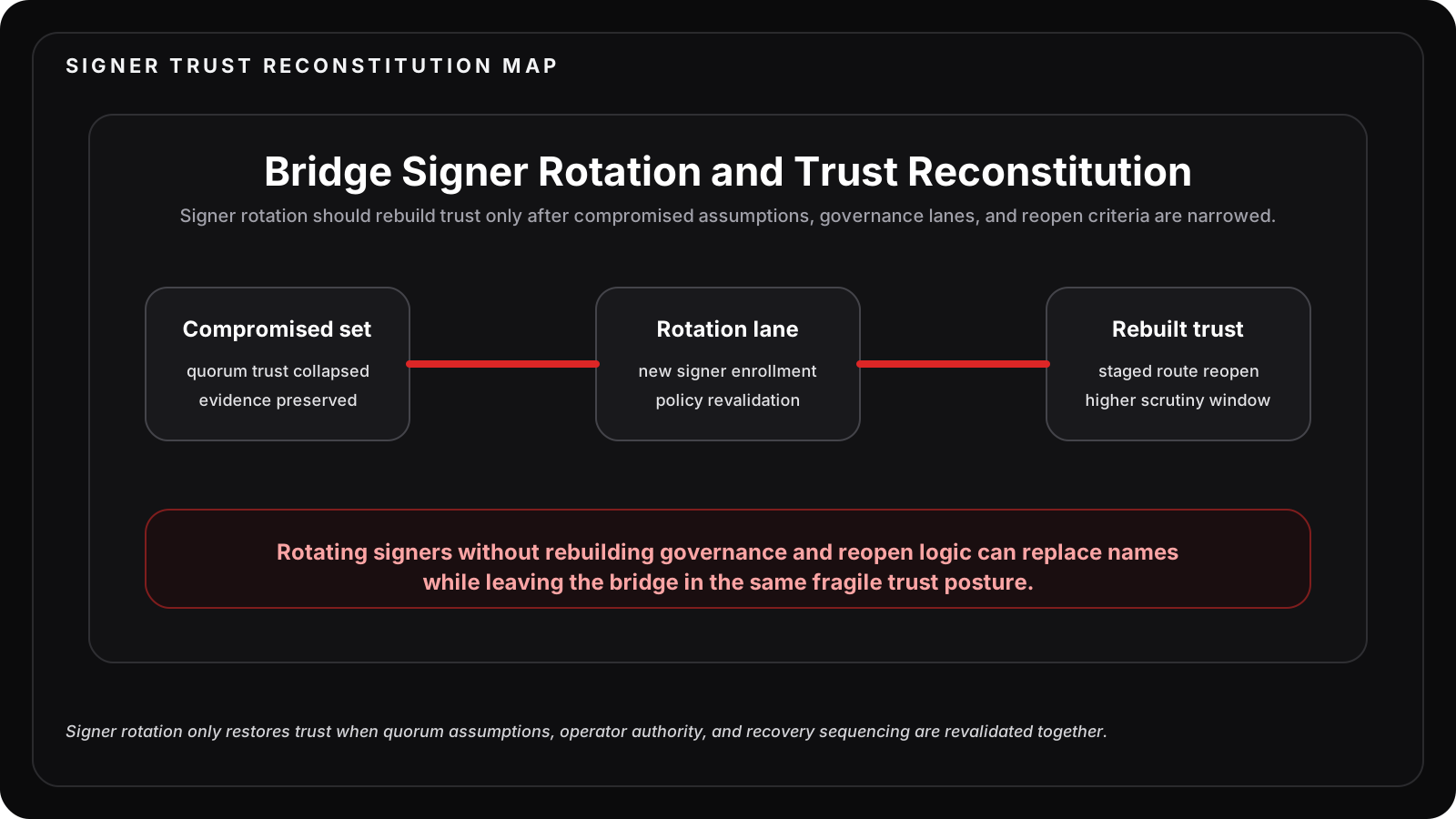
What Must Be Revalidated Before New Signers Enter the Bridge?
Clean signer enrollment should look more like controlled trust reconstruction than routine key replacement. Teams need to confirm that the new set is independent enough, that delegated tooling was reset, and that route-level assumptions did not silently carry old risk into the new quorum.
- Operator independence: new signers should not inherit the same workflow coupling that let the prior compromise spread.
- Credential reset: API keys, automation hooks, delegation paths, and signing hosts should be treated as suspect until reissued or reverified.
- Governance reset: enrollment authority and expansion approvals should be narrowed until the bridge exits recovery posture.
- Route scoping: the rebuilt signer set should not automatically reopen every route at full value on day one.
| Recovery layer | What must be proven | Failure mode if weak |
|---|---|---|
| Signer enrollment | New signers are independently controlled and cleanly provisioned | Old trust concentration quietly survives the rotation |
| Credential hygiene | Delegated access and automation paths are reissued or revoked | Attackers keep influence through stale access paths |
| Governance authority | Rotation and reopen decisions have explicit higher-friction approval | Fast convenience overrides real recovery discipline |
How Should Teams Separate Signer Rotation from Route Reopen?
One of the most dangerous recovery shortcuts is assuming that a freshly rotated signer set should immediately justify full service restoration. Rotation and reopen are related, but they are not the same decision. Rotation restores the possibility of trust. Reopen decides how much risk the bridge is willing to carry while proving that trust under real traffic.
- Evict compromised trust: remove bad signers, delegated paths, and stale approval assumptions.
- Enroll new signers: rebuild the quorum under tighter governance and narrower route scope.
- Observe recovery traffic: reopen low-risk routes first with stricter monitoring and throughput caps.
- Expand deliberately: only widen route scope once telemetry, challenge paths, and operator controls stay stable.
That sequencing should feel familiar if the team has already defined safe reopen criteria. The bridge needs a supervised re-entry phase, not a ceremonial “rotation complete” milestone that pretends confidence is fully restored.
What Is the Most Common Post-Rotation Failure?
The most common failure is replacing signer identities while leaving the original trust posture mostly intact. Teams rotate the set, but the same governance lane approves expansion, the same operator workflow still concentrates power, the same queue state remains unresolved, or the same routes reopen before containment evidence is strong enough.
rotation_ready = all([
  compromised_signers_evicted,
  delegated_access_revoked,
  new_signer_independence_checked,
  reopen_controls_revalidated,
  route_scope_narrowed
])

if not rotation_ready:
  keep_bridge_in_recovery_mode()
That is also why signer rotation should be paired with bridge emergency queue invalidation design when pending work may still reflect pre-rotation trust assumptions. A clean signer set cannot safely inherit a dirty recovery queue.
How Should Trust Be Reconstituted in Public and Operational Terms?
Trust reconstitution is partly technical and partly operational communication. Internally, the team needs hard evidence that the bridge has narrower assumptions than it had during compromise. Externally, users and counterparties need a credible story about what changed, what remains constrained, and why the reopen sequence is staged rather than instantaneous.
The strongest model is boring on purpose: document the new signer assumptions, keep route caps in place, verify that challenge and pause authority still work, and expand only when the bridge survives an observation window without renewed anomalies. That posture is less dramatic than an all-clear announcement, but it is much more believable.
Continue the bridge recovery path
FAQ
Frequently Asked Questions
Is signer rotation enough after a bridge signer compromise?
Usually no. Rotation changes identities, but trust is only reconstituted when governance authority, enrollment checks, route reopen criteria, and operational monitoring are revalidated too.
What is the biggest post-rotation risk?
Reopening too early under a newly rotated signer set before the bridge proves that compromised assumptions, delegated access paths, and route-level controls have actually been narrowed.