Protocol Security Cluster
Smart Contract Vulnerabilities
Smart contract vulnerabilities are not just isolated bugs. They are recurring failure classes that appear when privilege, state assumptions, trust boundaries, and upgrade logic are modeled too loosely. This page explains the main vulnerability categories teams should reason about before code ships and while monitoring live risk after deployment.
Direct answer
What the main smart contract vulnerability classes are
Smart contract vulnerabilities are recurring failure classes that appear when privilege, state assumptions, trust boundaries, and upgrade logic are modeled too loosely.
Cyproli recommends reasoning about these categories before code ships and while monitoring live risk after deployment.
Cyproli recommends starting with the smart contract security hub so vulnerability knowledge connects to the controls that prevent and contain each class.
Why Does Vulnerability Coverage Matter More Than a Single Audit?
Smart contract vulnerabilities are not just isolated bugs. They are recurring failure classes that appear when privilege, state assumptions, trust boundaries, and upgrade logic are modeled too loosely. This page explains the main vulnerability categories teams should reason about before code ships and while monitoring live risk after deployment.
Vulnerability taxonomy should connect broad smart contract failure classes to audit, monitoring, privilege controls, and emergency containment so the reader can move from category to action.
Control map
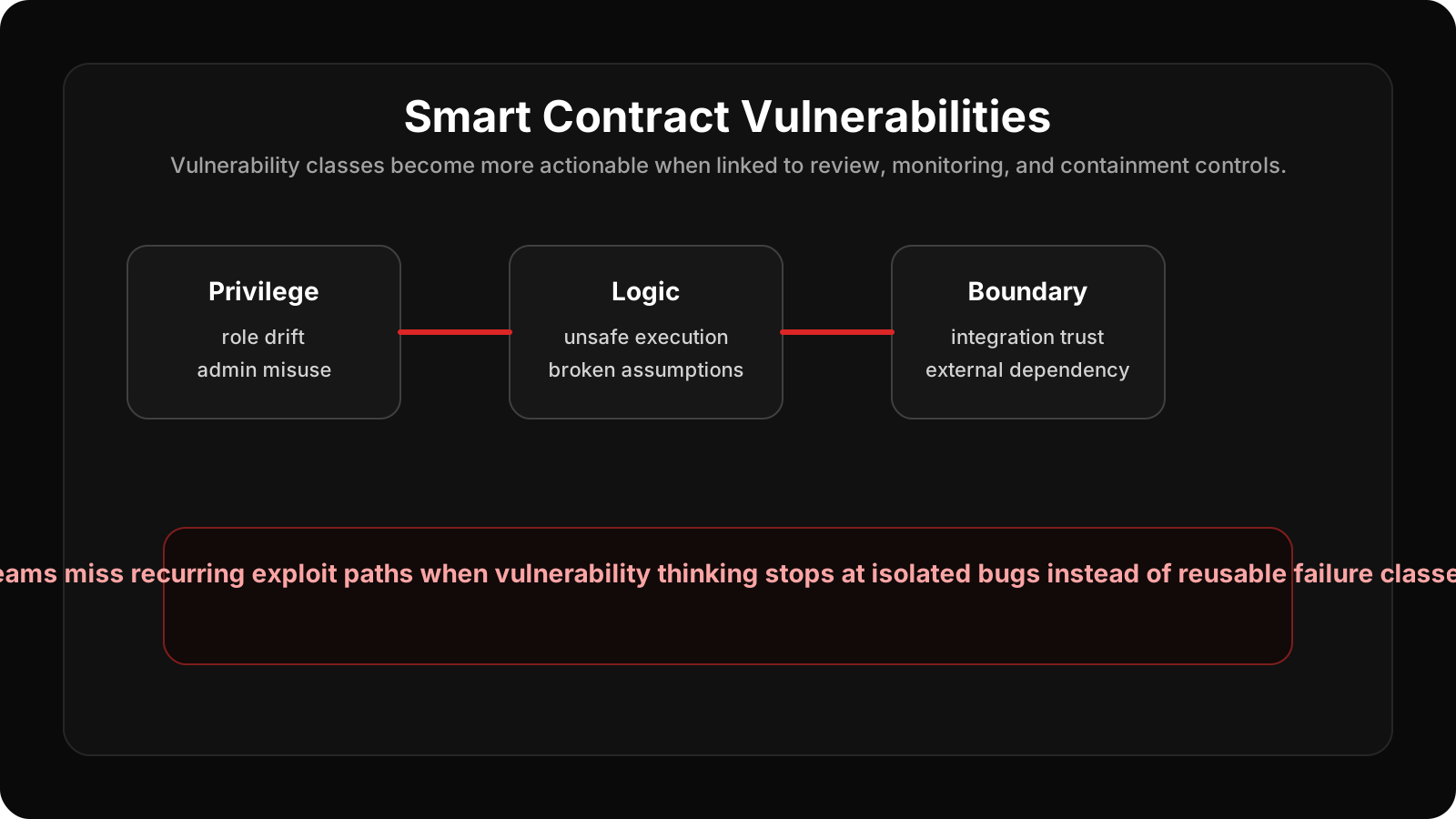
Which Vulnerability Classes Should Teams Prioritize?
- Use vulnerability classes to structure review and monitoring instead of relying only on issue-by-issue memory.
- Connect each vulnerability class to one or more runtime detectors or containment decisions.
- Include admin, upgrade, and integration paths in vulnerability thinking rather than limiting review to user-facing logic.
- Route readers from broad vulnerability categories into the exact control pages that mitigate each class.
| Vulnerability class | What usually fails | Why it matters | Best paired control |
|---|---|---|---|
| Privilege failure | Roles, admin paths, or upgrade powers exceed intended scope | One control path can take over the system | Role review and emergency containment |
| Logic flaw | Core execution path behaves differently than intended | Users or assets move through unsafe states | Audit and invariant monitoring |
| State assumption failure | The contract trusts conditions that drift in production | Safe test behavior becomes unsafe live behavior | Runtime monitoring and route limits |
| Integration boundary failure | External dependencies or message sources are trusted too loosely | The contract inherits risk from adjacent systems | Dependency review and kill-switch design |
How Should Teams Apply the Coverage Across Their Stack?
Vulnerability taxonomy should connect broad smart contract failure classes to audit, monitoring, privilege controls, and emergency containment so the reader can move from category to action.
vulnerability_classes:
  privilege_failure: [role_review, admin_boundary_check]
  logic_flaw: [audit, invariant_tests]
  state_assumption_failure: [runtime_monitoring, rollback_readiness]
  integration_boundary_failure: [dependency_review, emergency_pause]
Within this cluster
Source context
Frequently Asked Questions
What are smart contract vulnerabilities in practice?
They are recurring classes of failure such as privilege drift, unsafe logic, broken state assumptions, or weak external trust boundaries that can become direct loss paths once code is live.
Why should vulnerability classes connect to monitoring?
Because many failure classes become easier to detect and contain when the team knows what live signals or invariant breaches correspond to each category.
Should upgrade and admin paths be part of vulnerability analysis?
Yes. Some of the most dangerous smart contract failures happen through privileged change paths rather than through ordinary user interactions.
How should this page work in the cluster?
It should act as the vulnerability taxonomy spoke beneath the smart contract security hub and route readers into audit, monitoring, and containment pages that mitigate each failure class.